Forces and Friction: past paper questions & worked solutions
Every Forces and Friction question from the WME01 papers in our bank, 2019–2026, sorted from easiest to hardest. Try each one first, then open the worked solution.
Level is estimated from marks: 1–6 easy, 7–8 medium, 9+ hard.
1. WME01/01 May/June 2024 · Q2
Easy4 marksShow worked solution
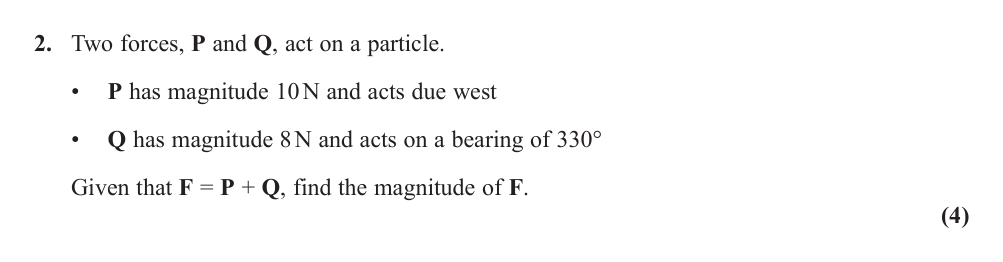
Resolve the two forces
Take east as $\mathbf{i}$ and north as $\mathbf{j}$. The force due west is $-10\mathbf{i}$. A bearing of $330^\circ$ is $30^\circ$ west of north, so the 8 N force has components $-8\sin30^\circ\mathbf{i}+8\cos30^\circ\mathbf{j}$.
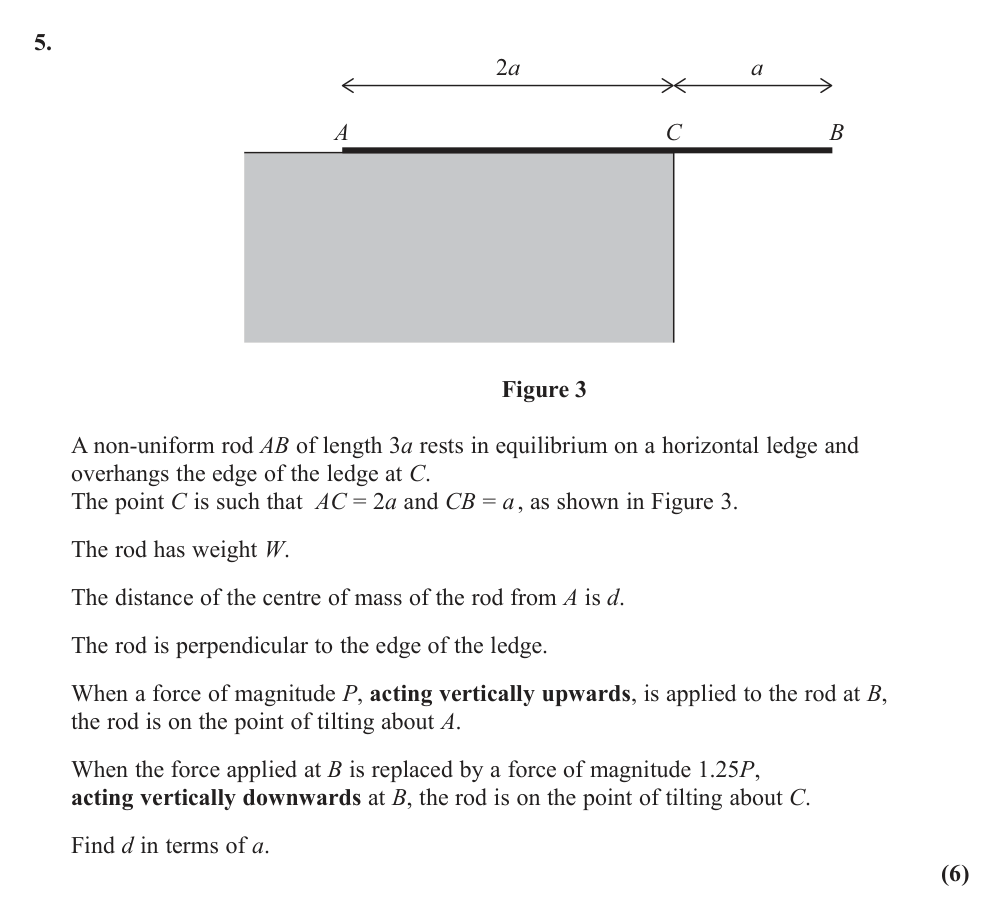
Taking moments about C: $\sum M_C = 0$ Distance from C to COM = $(2a - d)$ Distance from C to B = $a$ $1.25P \times a = W \times (2a - d)$ $1.25Pa = W(2a - d)$ $1.25Pa = 2aW - Wd \quad \text{...(2)}$
Setup Diagrams - Substitute equation (1) into equation (2)
Easy6 marks · main topic: MomentsShow worked solution
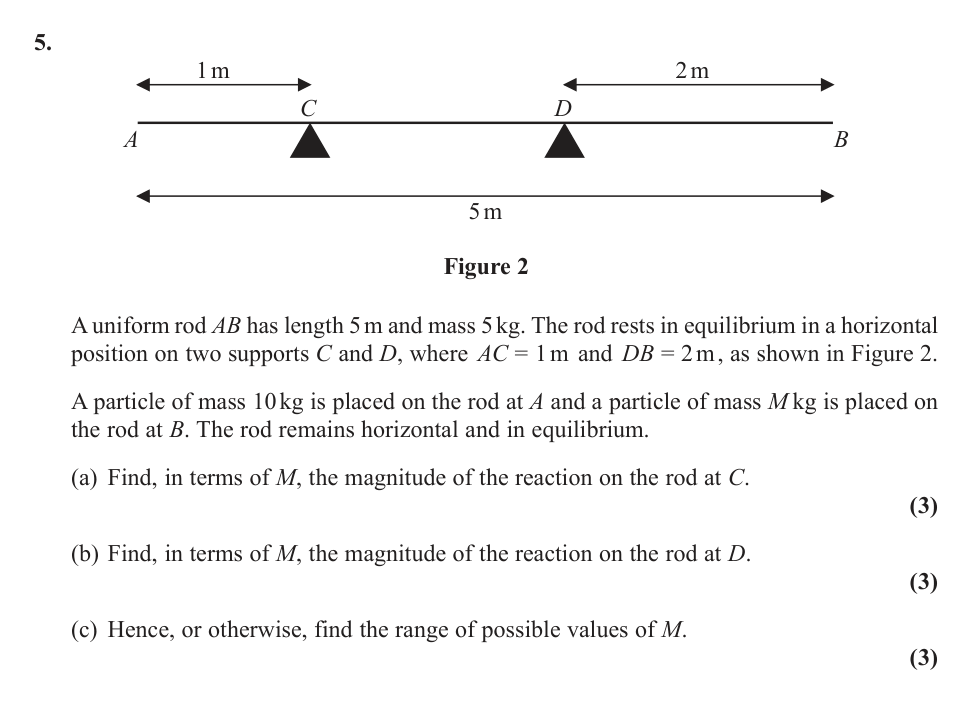
Set the positions relative to C
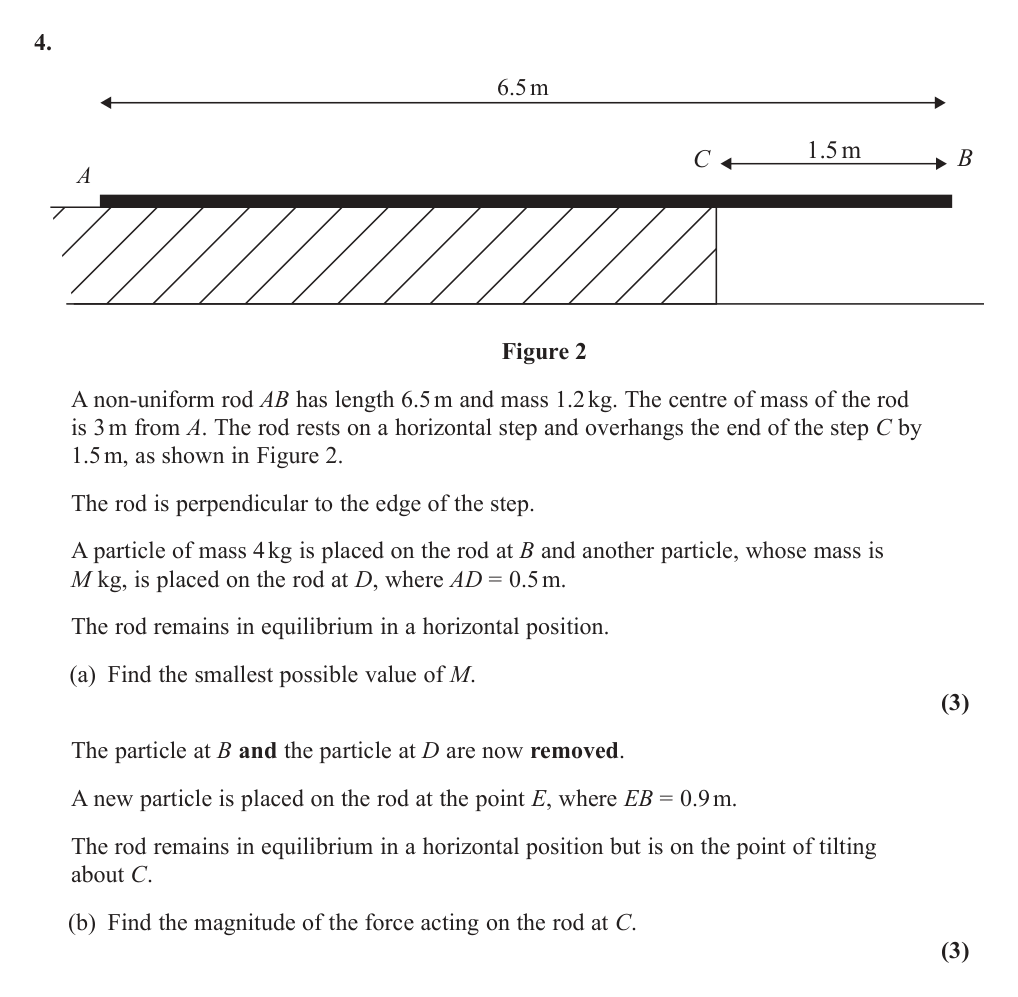
The rod is 6.5 m long and overhangs C by 1.5 m, so C is 5.0 m from A. The rod centre of mass is 3.0 m from A, so it is 2.0 m to the left of C. Point D is 0.5 m from A, so it is 4.5 m to the left of C.
Use the limiting balance for smallest M
For the smallest $M$, the rod is just prevented from tilting clockwise about C. Taking moments about C: $Mg(4.5)+1.2g(2)=4g(1.5)$.
Find M
$4.5M+2.4=6$, so $4.5M=3.6$ and $M=0.8$.
Place the new particle E
Now the old particles are removed. Since $EB=0.9$ m and $AB=6.5$ m, E is $5.6$ m from A, so E is $0.6$ m to the right of C.
Find the new particle mass from moments
At tilting about C, moments about C give $Xg(0.6)=1.2g(2)$, so $X=4$.
Find the force at C
The upward force at C balances the rod and the new particle: $R_C=1.2g+4g=5.2g\ \mathrm{N}$, which is about $51\ \mathrm{N}$.
Given $\tan\theta=\dfrac34$, use $\sin\theta=\dfrac35$ and $\cos\theta=\dfrac45$.
Resolve horizontally
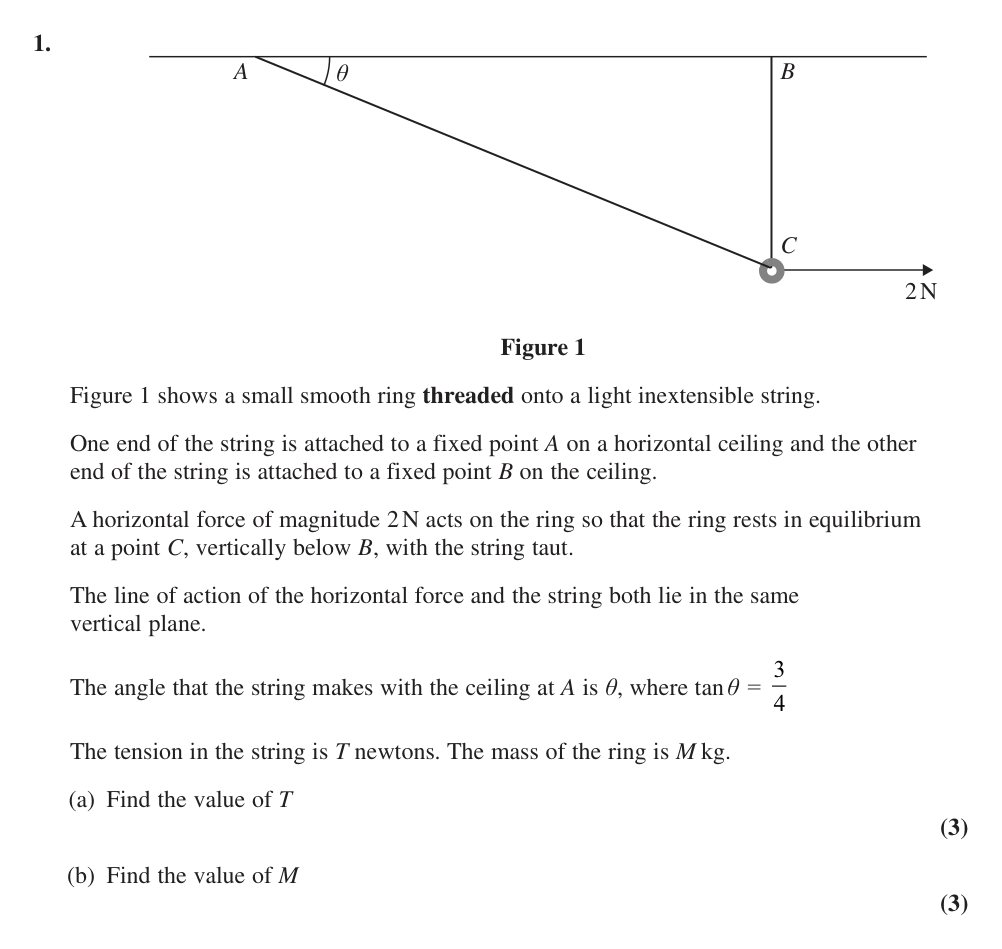
The horizontal force of $2$ N is balanced by the horizontal component of the tension in the sloping part of the string: $T\cos\theta=2$.
Find the tension
$T\cdot\dfrac45=2$, so $T=2.5\ \mathrm{N}$.
Resolve vertically
The ring is smooth, so the tension is the same in both parts of the string. Upward components are $T$ from the vertical part and $T\sin\theta$ from the sloping part. Therefore $T+T\sin\theta=Mg$.
Find the mass
$Mg=2.5+2.5\cdot\dfrac35=4.0$, so $M=\dfrac{4.0}{9.8}=0.408\ \mathrm{kg}$.
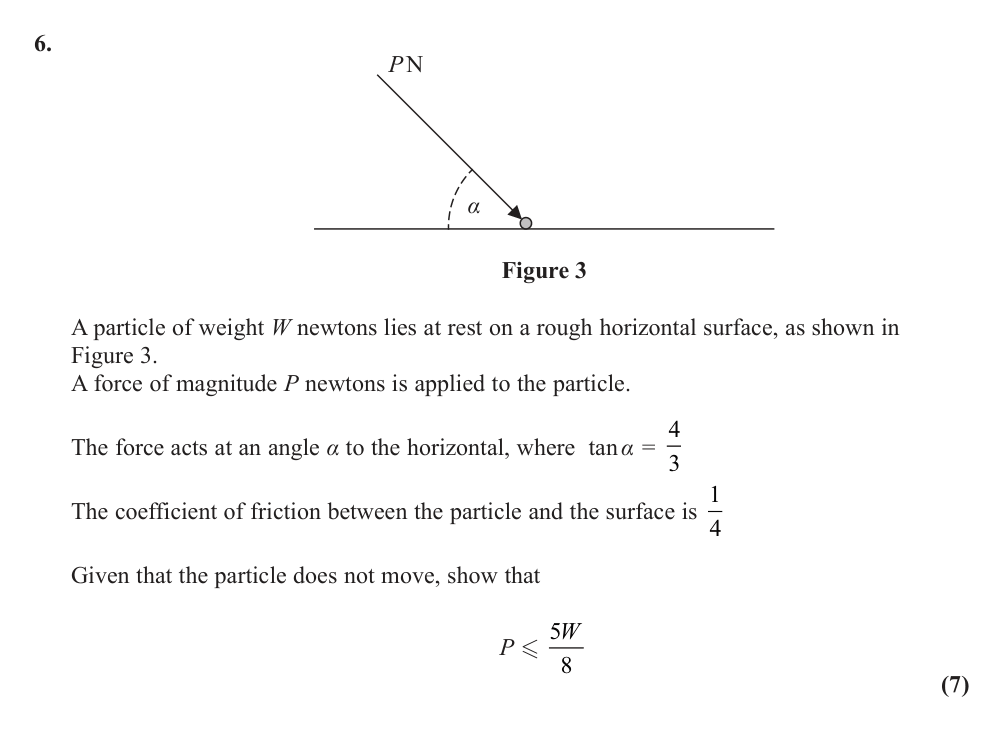
Multiplying by $20$ gives $12P\le5W+4P$. Hence $8P\le5W$, so $P\le\dfrac58W$.
Final answer
$P\le\dfrac{5}{8}W$.
9. WME01/01 January 2021 · Q5
Medium7 marks · main topic: Working with VectorsShow worked solution
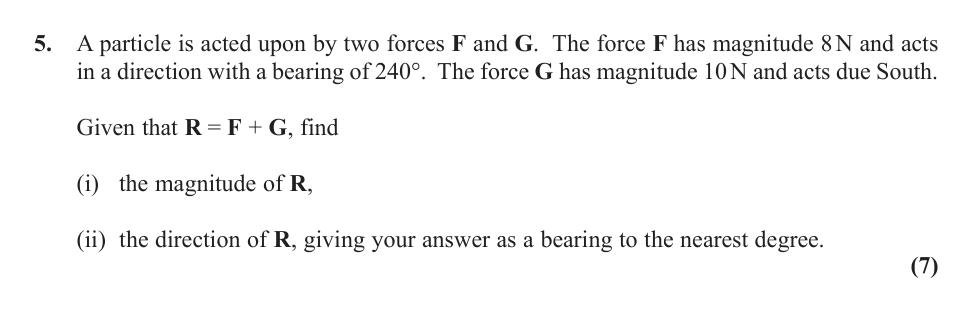
Resolve F into components
A bearing of $240^\circ$ is $60^\circ$ west of south. Hence $\mathbf{F}=(-8\sin60^\circ)\mathbf{i}+(-8\cos60^\circ)\mathbf{j}=-4\sqrt3\mathbf{i}-4\mathbf{j}$.
Add G
The force $\mathbf{G}$ is due south with magnitude $10$, so $\mathbf{G}=-10\mathbf{j}$. Therefore $\mathbf{R}=\mathbf{F}+\mathbf{G}=-4\sqrt3\mathbf{i}-14\mathbf{j}$.
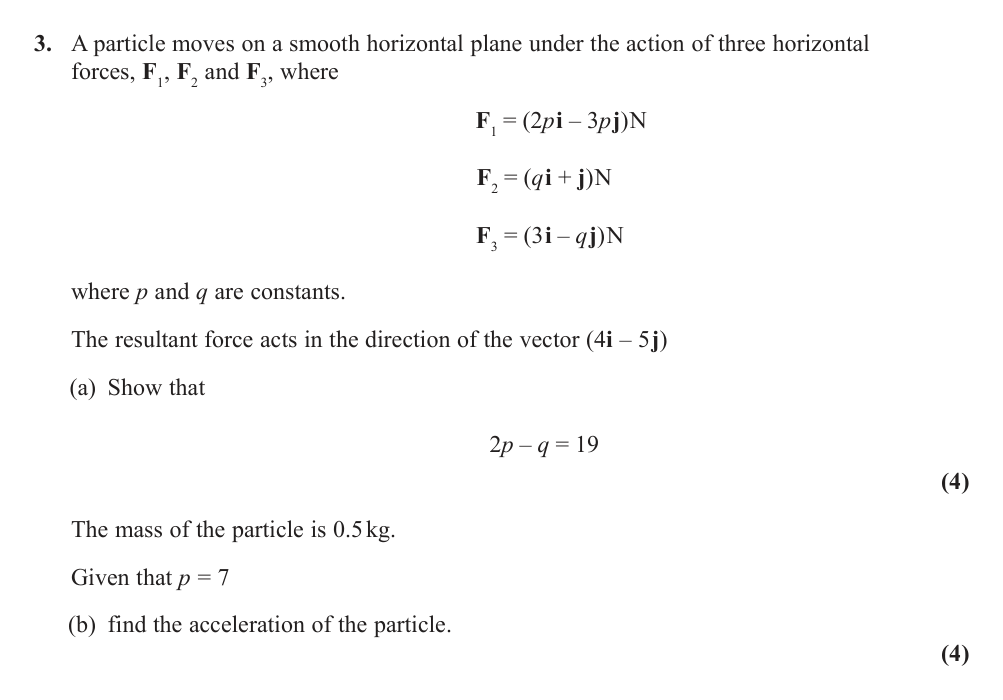
The resultant force is $(2p\mathbf{i}-3p\mathbf{j})+(q\mathbf{i}+\mathbf{j})+(3\mathbf{i}-q\mathbf{j})=(2p+q+3)\mathbf{i}+(-3p+1-q)\mathbf{j}$.
Use the direction vector
The resultant acts in the direction $4\mathbf{i}-5\mathbf{j}$, so the ratio of the components is the same: $\dfrac{-3p+1-q}{2p+q+3}=\dfrac{-5}{4}$.
Show the required relation
Cross-multiplying gives $4(-3p+1-q)=-5(2p+q+3)$. Therefore $-12p+4-4q=-10p-5q-15$, so $2p-q=19$.
Find q when p is 7
With $p=7$, the relation gives $14-q=19$, hence $q=-5$.
Apply Newtons second law
Substitute $p=7$ and $q=-5$ into the resultant: $\mathbf{F}=12\mathbf{i}-15\mathbf{j}$. Since the mass is $0.5$ kg, $\mathbf{F}=m\mathbf{a}$ gives $12\mathbf{i}-15\mathbf{j}=0.5\mathbf{a}$.
Find the acceleration
Dividing by $0.5$ gives $\mathbf{a}=24\mathbf{i}-30\mathbf{j}\ \mathrm{m\,s^{-2}}$.
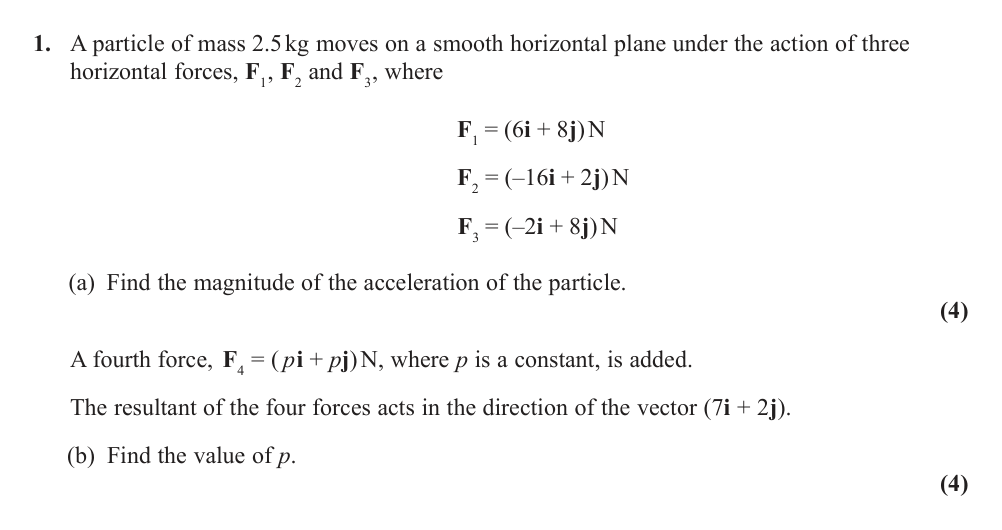
The mass is $2.5$ kg, so $-12\mathbf{i}+18\mathbf{j}=2.5\mathbf{a}$. Hence $\mathbf{a}=-4.8\mathbf{i}+7.2\mathbf{j}\ \mathrm{m\,s^{-2}}$.
Find the magnitude of the acceleration
$|\mathbf{a}|=\sqrt{(-4.8)^2+7.2^2}=8.653\ldots$, so the magnitude is $8.7\ \mathrm{m\,s^{-2}}$ to 2 significant figures. Exactly, $|\mathbf{a}|=\dfrac{12\sqrt{13}}{5}$.
Add the fourth force
With $\mathbf{F}_4=p\mathbf{i}+p\mathbf{j}$, the new resultant is $(p-12)\mathbf{i}+(p+18)\mathbf{j}$.
Use the given direction
The resultant acts in the direction $7\mathbf{i}+2\mathbf{j}$, so $\dfrac{p-12}{p+18}=\dfrac{7}{2}$.
Solve for p
$2(p-12)=7(p+18)$, so $2p-24=7p+126$. Therefore $-150=5p$ and $p=-30$.
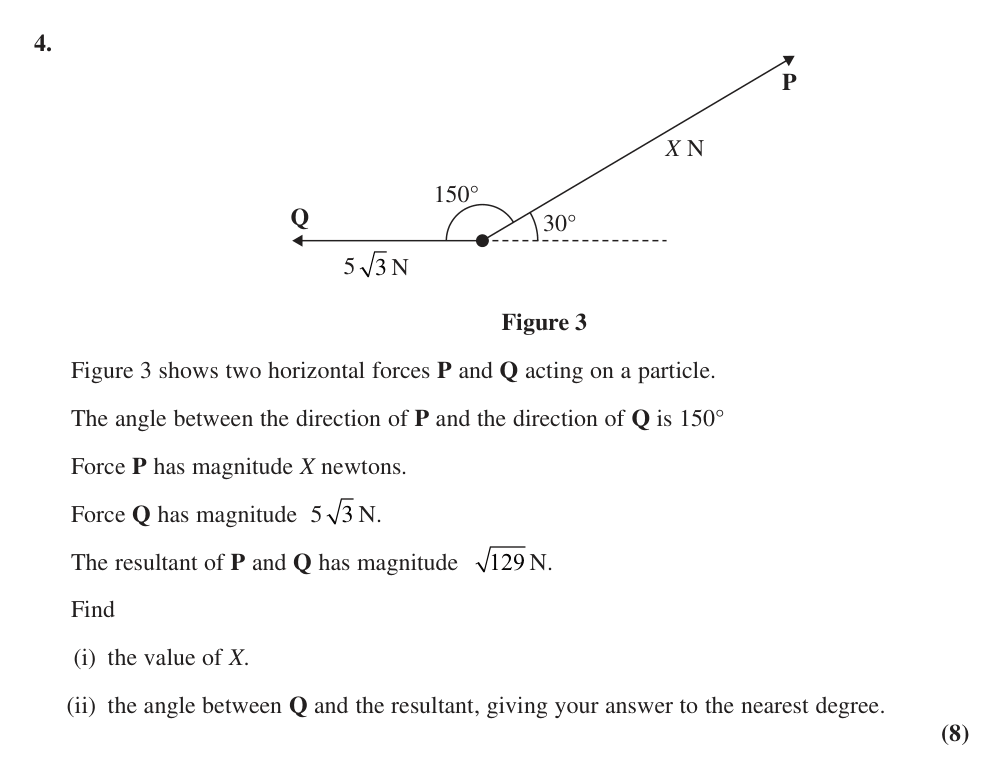
The two given forces have angle $150^\circ$ between them, so the triangle used for adding them has the supplementary angle $30^\circ$ between the side of length $X$ and the side of length $5\sqrt3$.
Use the cosine rule to find X
The resultant has magnitude $\sqrt{129}$. Therefore $129=X^2+(5\sqrt3)^2-2X(5\sqrt3)\cos30^\circ$.
Solve for X
Since $(5\sqrt3)^2=75$ and $2(5\sqrt3)\cos30^\circ=15$, the equation becomes $129=X^2+75-15X$. Thus $X^2-15X-54=0$, giving $X=18$.
Find the angle with Q
Let $\beta$ be the angle between Q and the resultant. Using the cosine rule in the same triangle, $\dfrac{18}{\sin\beta}=\dfrac{\sqrt{129}}{\sin30^\circ}$.
Choose the correct angle
This gives an obtuse angle for $\beta$. Equivalently, $\cos\beta=\dfrac{(5\sqrt3)^2+129-18^2}{2(5\sqrt3)\sqrt{129}}$, so $\beta=127.6\ldots^\circ$.
Round the angle
To the nearest degree, the angle between Q and the resultant is $128^\circ$.
Final answer
$(i)\ X=18\ \mathrm{N}.\quad (ii)\ \text{angle}=128^\circ\ \text{to the nearest degree}$.
14. WME01/01 January 2023 · Q6
Medium8 marksShow worked solution
Resolve perpendicular to the motion
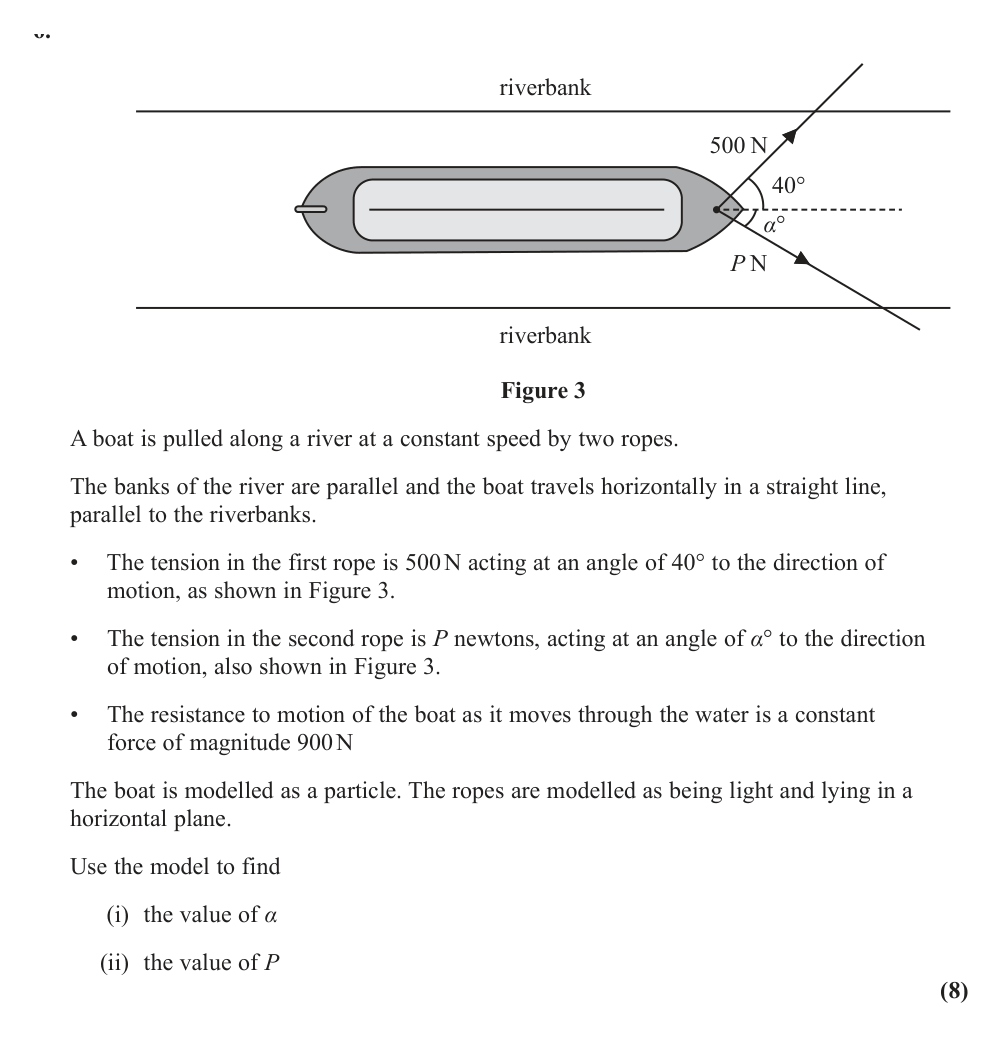
The boat travels straight, so the sideways components balance: $500\sin40^\circ=P\sin\alpha$.
Resolve along the motion
The speed is constant, so the forward components balance the resistance: $500\cos40^\circ+P\cos\alpha=900$.
Eliminate P
From the two equations, $P\sin\alpha=500\sin40^\circ$ and $P\cos\alpha=900-500\cos40^\circ$.
Find alpha
Divide the sine equation by the cosine equation: $\tan\alpha=\dfrac{500\sin40^\circ}{900-500\cos40^\circ}$. This gives $\alpha=31.9^\circ$, so $\alpha=32^\circ$ approximately.
Find P
Use $P\sin\alpha=500\sin40^\circ$: $P=\dfrac{500\sin40^\circ}{\sin31.9^\circ}=608.7\ldots\ \mathrm{N}$. Hence $P\approx610\ \mathrm{N}$.
Hard9 marks · main topic: Working with VectorsShow worked solution
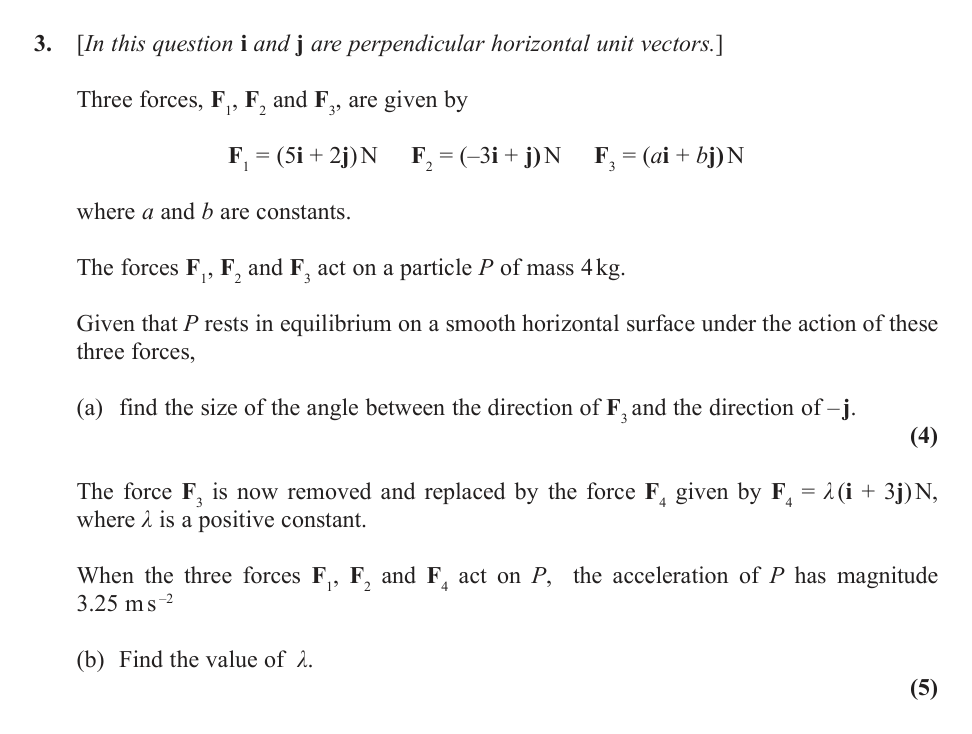
Find F3 from equilibrium
Equilibrium gives $\mathbf{F}_1+\mathbf{F}_2+\mathbf{F}_3=\mathbf{0}$. Now $\mathbf{F}_1+\mathbf{F}_2=(5\mathbf{i}+2\mathbf{j})+(-3\mathbf{i}+\mathbf{j})=2\mathbf{i}+3\mathbf{j}$.
Write F3
So $\mathbf{F}_3=-2\mathbf{i}-3\mathbf{j}$.
Find the angle with -j
The vector $-\mathbf{j}$ points vertically downward. For $\mathbf{F}_3=-2\mathbf{i}-3\mathbf{j}$, the angle from $-\mathbf{j}$ satisfies $\tan\theta=\dfrac{2}{3}$.
State the angle
$\theta=33.7^\circ$, so the angle is about $34^\circ$.
Find the new resultant force
With $\mathbf{F}_4=\lambda(\mathbf{i}+3\mathbf{j})$, the resultant is $(2+\lambda)\mathbf{i}+(3+3\lambda)\mathbf{j}$.
Use the acceleration magnitude
The mass is $4$ kg and acceleration magnitude is $3.25$, so the resultant force magnitude is $4(3.25)=13$ N.
Form the equation
$(2+\lambda)^2+(3+3\lambda)^2=13^2$.
Solve for lambda
Expanding gives $10\lambda^2+22\lambda-156=0$. The roots are $3$ and $-5.2$, and since $\lambda$ is positive, $\lambda=3$.
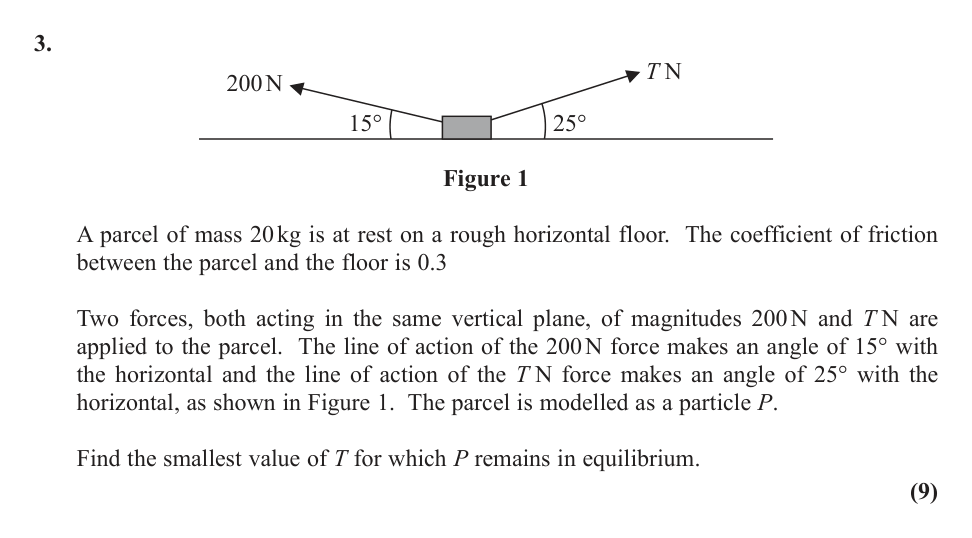
For vertical equilibrium, $R+200\sin15^\circ+T\sin25^\circ=20g$.
Resolve horizontally
For the smallest $T$, friction is limiting and balances the remaining horizontal tendency. Horizontally, $200\cos15^\circ-T\cos25^\circ-F=0$.
Use limiting friction
$F=0.3R$.
Eliminate R and F
From the vertical equation, $R=20g-200\sin15^\circ-T\sin25^\circ$. Substitute into $F=0.3R$ and then into the horizontal equation.
Solve for T
$200\cos15^\circ-T\cos25^\circ-0.3(20g-200\sin15^\circ-T\sin25^\circ)=0$. Solving gives $T=192.3\ldots\ \mathrm{N}$, so the smallest value is about $192\ \mathrm{N}$.
Final answer
$T=192\ \mathrm{N}\ \text{approximately}$.
19. WME01/01 January 2024 · Q5
Hard10 marks · main topic: MomentsShow worked solution
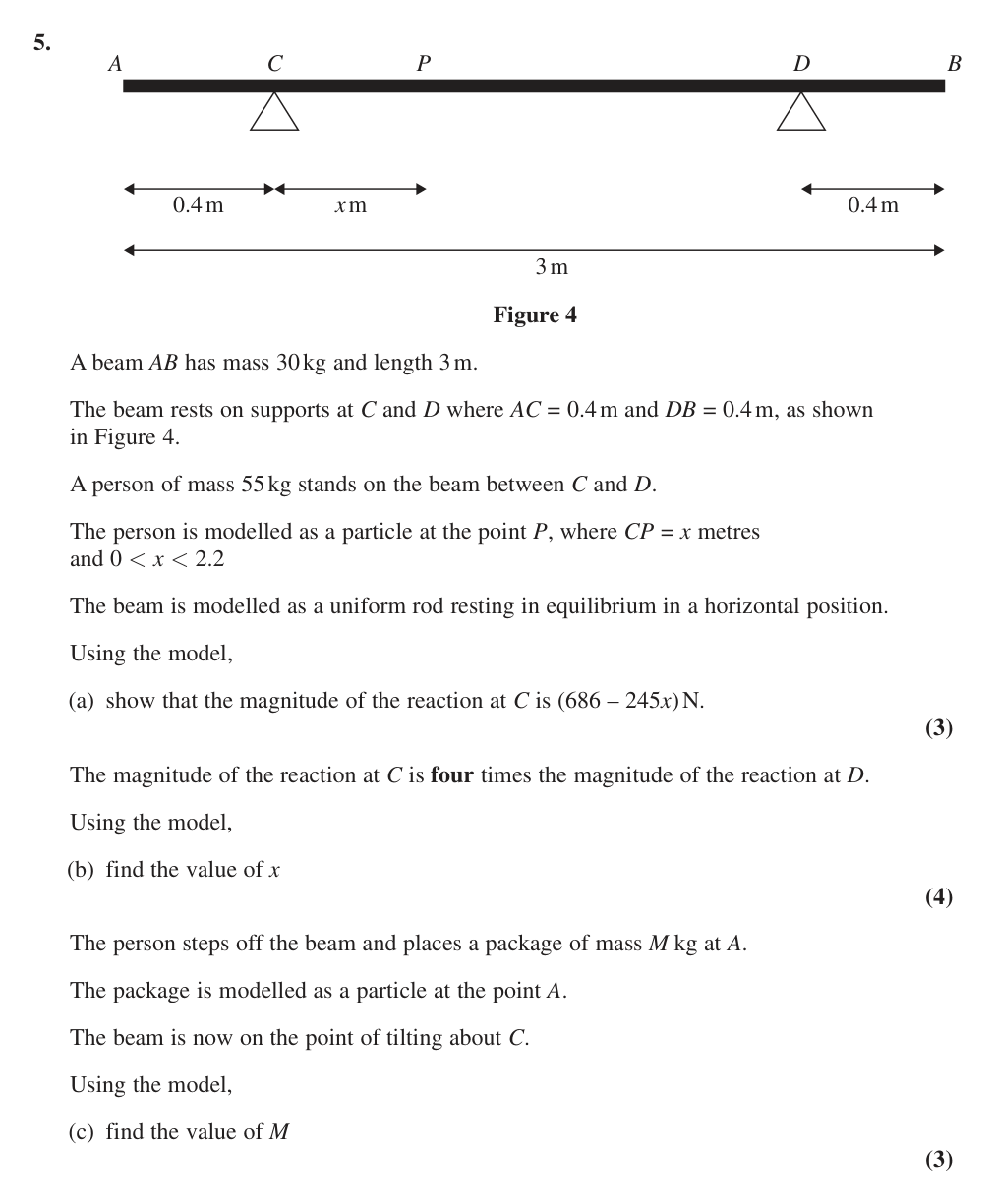
Set the positions on the beam
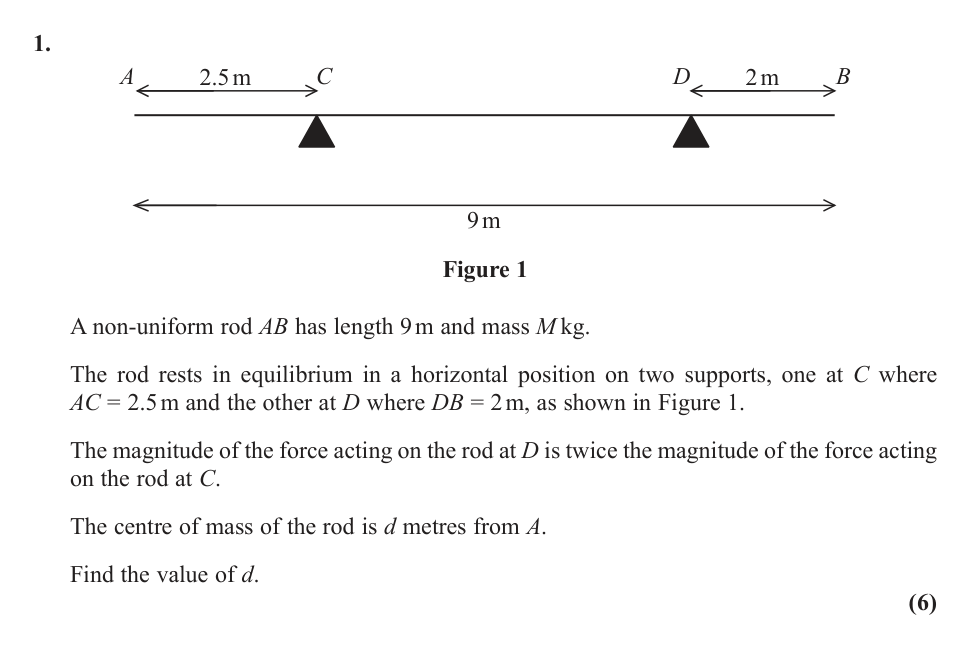
$AC=0.4$ m and $DB=0.4$ m, so $CD=2.2$ m. The beam is uniform, so its weight $30g$ acts at the midpoint, which is $1.1$ m from D. The person is $2.2-x$ m from D.
Take moments about D
Taking moments about D removes $R_D$: $R_C(2.2)=55g(2.2-x)+30g(1.1)$.
Show the expression for RC
Using $g=9.8$, $R_C=\dfrac{539(2.2-x)+294(1.1)}{2.2}=686-245x$.
Use the reaction ratio
Given $R_C=4R_D$ and vertical equilibrium gives $R_C+R_D=(55+30)g=833$. Hence $5R_D=833$ and $R_C=666.4$.
Find x
$686-245x=666.4$, so $245x=19.6$ and $x=0.08$.
Use the tilting condition with the package
When the package is at A and the beam is on the point of tilting about C, the reaction at D is zero.
Find M
Take moments about C: $Mg(0.4)=30g(1.1)$. Thus $M=\dfrac{33}{0.4}=82.5$.
Hard10 marks · main topic: Working with VectorsShow worked solution
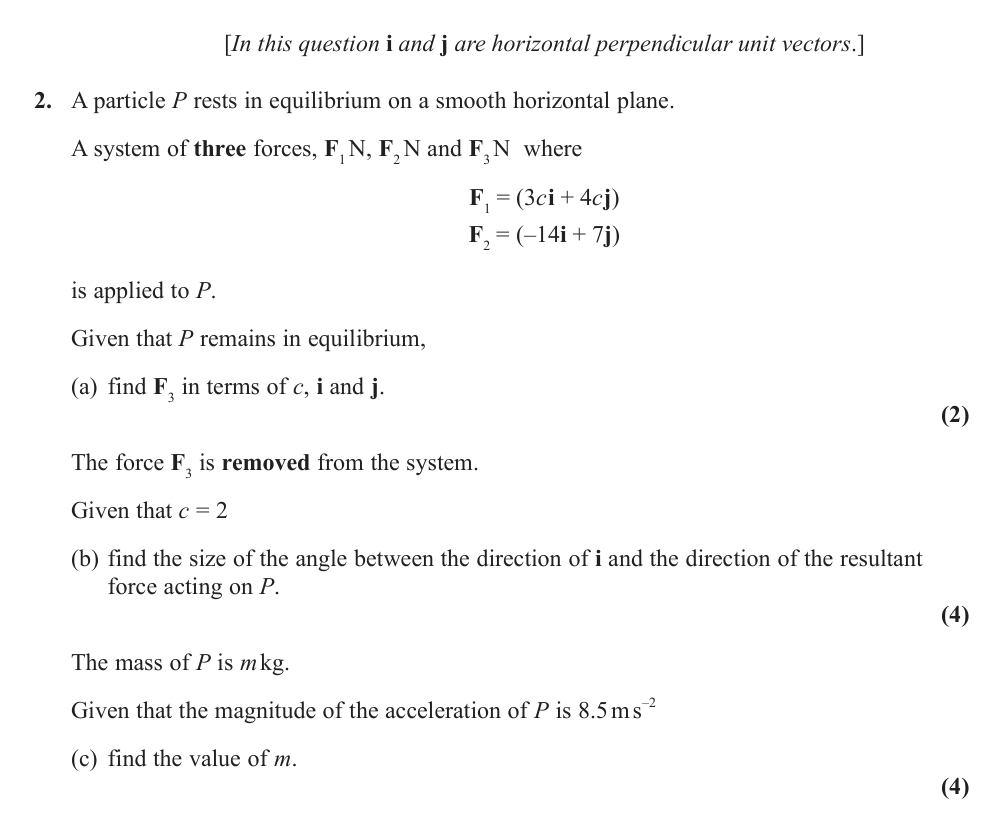
Use equilibrium
For equilibrium, $\mathbf{F}_1+\mathbf{F}_2+\mathbf{F}_3=\mathbf{0}$. Hence $\mathbf{F}_3=-(\mathbf{F}_1+\mathbf{F}_2)$.
Find F3
$\mathbf{F}_1+\mathbf{F}_2=(3c-14)\mathbf{i}+(4c+7)\mathbf{j}$, so $\mathbf{F}_3=(14-3c)\mathbf{i}+(-7-4c)\mathbf{j}$.
Find the resultant when c = 2
When $c=2$, $\mathbf{F}_1=6\mathbf{i}+8\mathbf{j}$ and $\mathbf{F}_2=-14\mathbf{i}+7\mathbf{j}$. Therefore the resultant is $-8\mathbf{i}+15\mathbf{j}$.
Find the angle
The resultant is in the second quadrant. Its angle from the positive $\mathbf{i}$ direction is $180^\circ-\tan^{-1}\left(\dfrac{15}{8}\right)=118.1^\circ$, so the angle is about $118^\circ$.
Find the magnitude of the resultant
$|\mathbf{R}|=\sqrt{(-8)^2+15^2}=17\ \mathrm{N}$.
Use F = ma
The acceleration magnitude is $8.5\ \mathrm{m\,s^{-2}}$, so $17=8.5m$. Hence $m=2$.
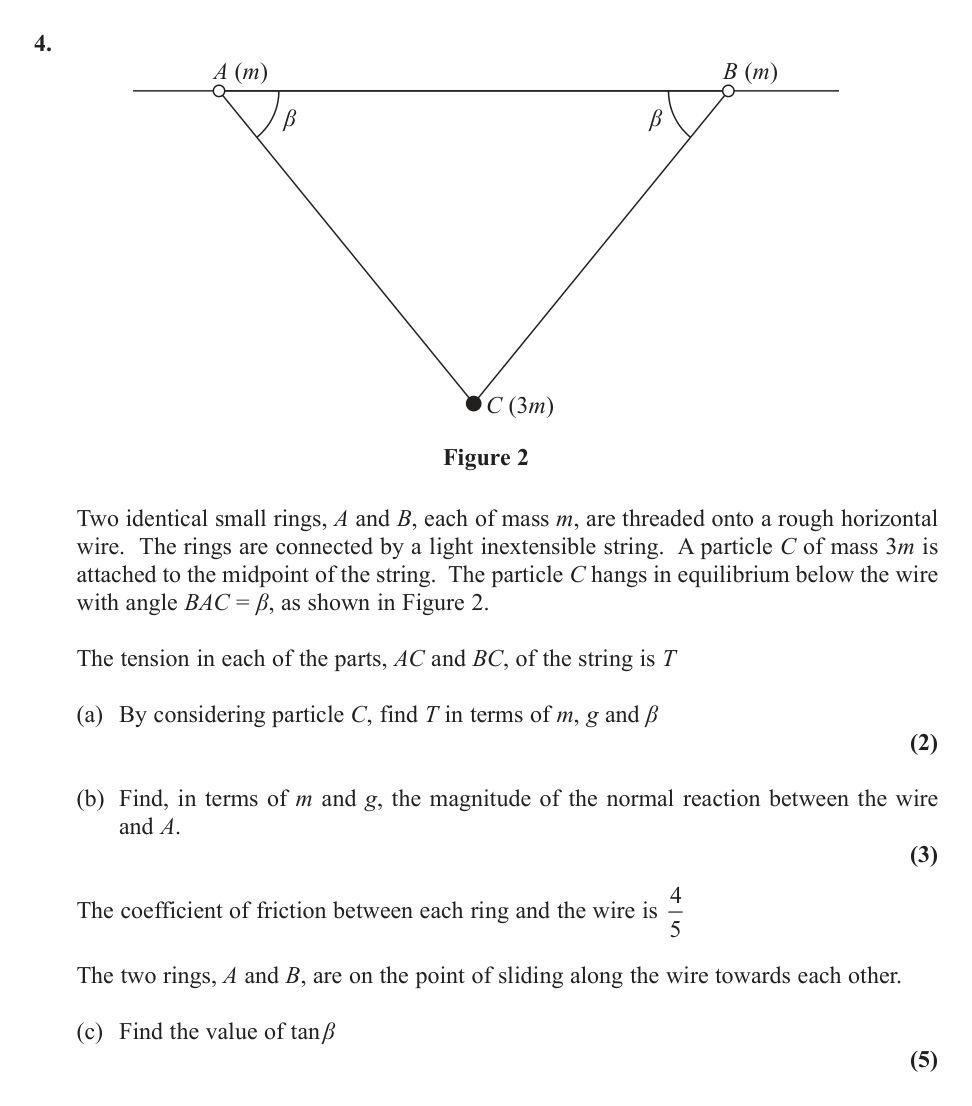
The two tensions are equal and symmetric. Their vertical components support the weight of C, so $2T\sin\beta=3mg$. Hence $T=\dfrac{3mg}{2\sin\beta}$.
Resolve vertically for ring A
For ring A, the normal reaction balances its own weight and the downward vertical component of the string tension: $R=mg+T\sin\beta$.
Find the normal reaction
From $2T\sin\beta=3mg$, we have $T\sin\beta=\dfrac32mg$. Therefore $R=mg+\dfrac32mg=\dfrac52mg$.
Use limiting friction
The rings are just about to slide towards each other, so friction is limiting. With $\mu=\dfrac45$, $F=\mu R=\dfrac45\cdot\dfrac52mg=2mg$.
Resolve horizontally for a ring
The horizontal component of the tension is balanced by friction: $T\cos\beta=F=2mg$.
Find tan beta
Substitute $T=\dfrac{3mg}{2\sin\beta}$: $\dfrac{3mg}{2\sin\beta}\cos\beta=2mg$. Hence $\dfrac32\cot\beta=2$, so $\cot\beta=\dfrac43$ and $\tan\beta=\dfrac34$.
Hard11 marks · main topic: Resolving Forces, Inclined PlanesShow worked solution
Use the trig ratios
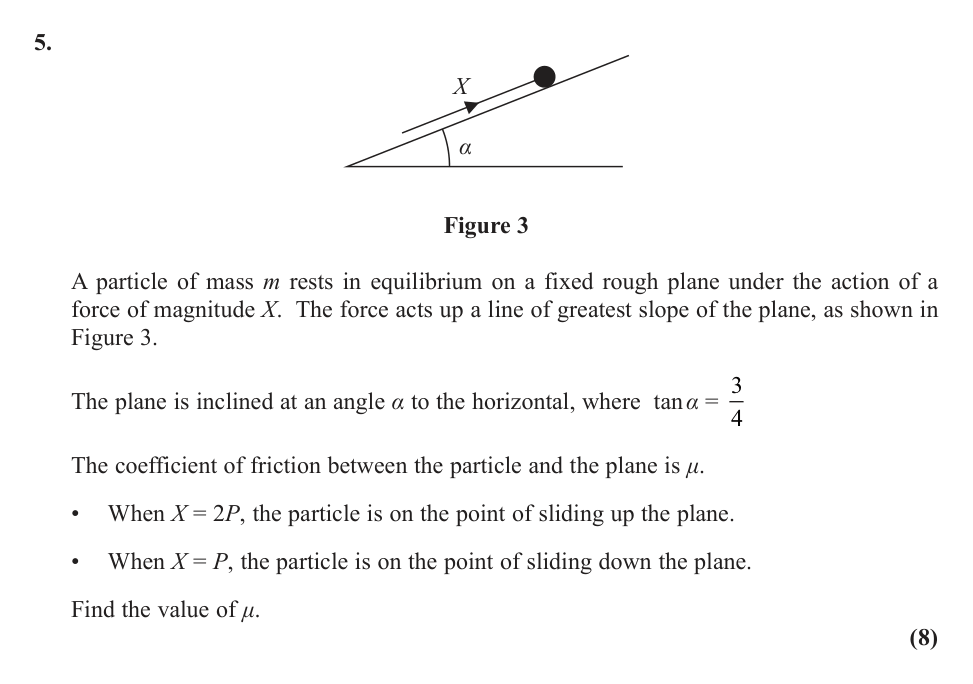
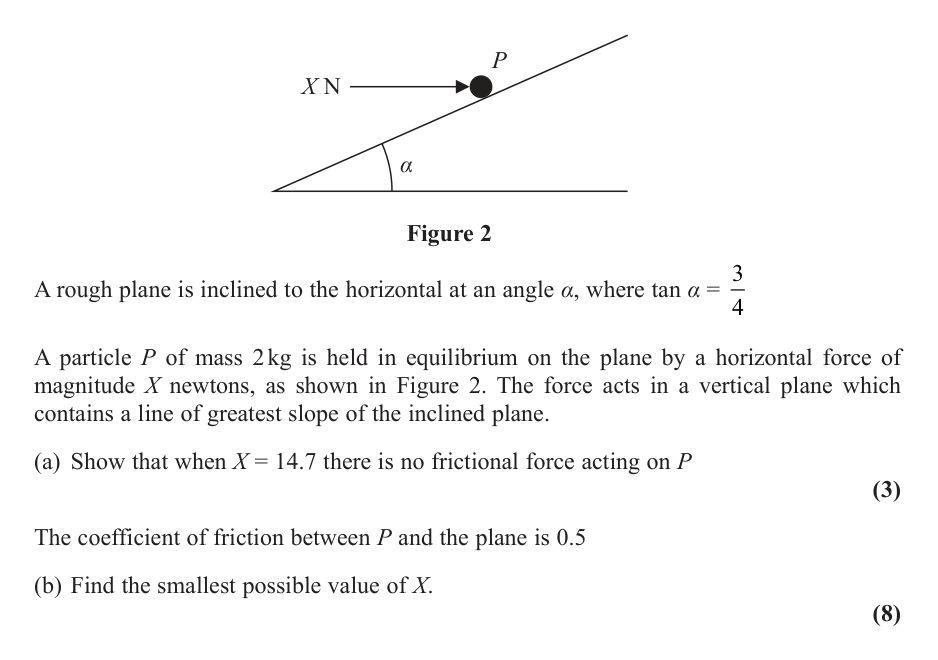
Since $\tan\alpha=\dfrac34$, $\sin\alpha=\dfrac35$ and $\cos\alpha=\dfrac45$.
Check the no-friction case
If there is no friction, the component of the horizontal force up the plane balances the component of weight down the plane: $X\cos\alpha=2g\sin\alpha$.
Substitute X = 14.7
$14.7\cdot\dfrac45=11.76$, and $2(9.8)\cdot\dfrac35=11.76$. The components balance exactly, so the frictional force is zero.
Set the direction for smallest X
For the smallest possible $X$, the particle is about to slide down the plane, so friction acts up the plane.
Resolve perpendicular to the plane
The horizontal force increases the normal reaction, so $R=2g\cos\alpha+X\sin\alpha$.
Use limiting friction
With $\mu=0.5$, the limiting friction is $F=0.5R=0.5(2g\cos\alpha+X\sin\alpha)$.
Resolve along the plane
At the limiting case, $X\cos\alpha+F=2g\sin\alpha$.
Solve for X
Substitute the exact trig values: $\dfrac45X+0.5\left(2g\cdot\dfrac45+X\cdot\dfrac35\right)=2g\cdot\dfrac35$. This gives $\dfrac{11}{10}X+\dfrac{4g}{5}=\dfrac{6g}{5}$, so $X=\dfrac{4g}{11}=3.56\ldots\ \mathrm{N}$.
Final answer
$(a)$ When $X=14.7$, $F=0$. $(b)\ X_{\min}=\dfrac{4g}{11}=3.56\ldots\ \mathrm{N}$.
24. WME01/01 January 2025 · Q6
Hard12 marks · main topic: Resolving Forces, Inclined PlanesShow worked solution
Resolve parallel to the plane
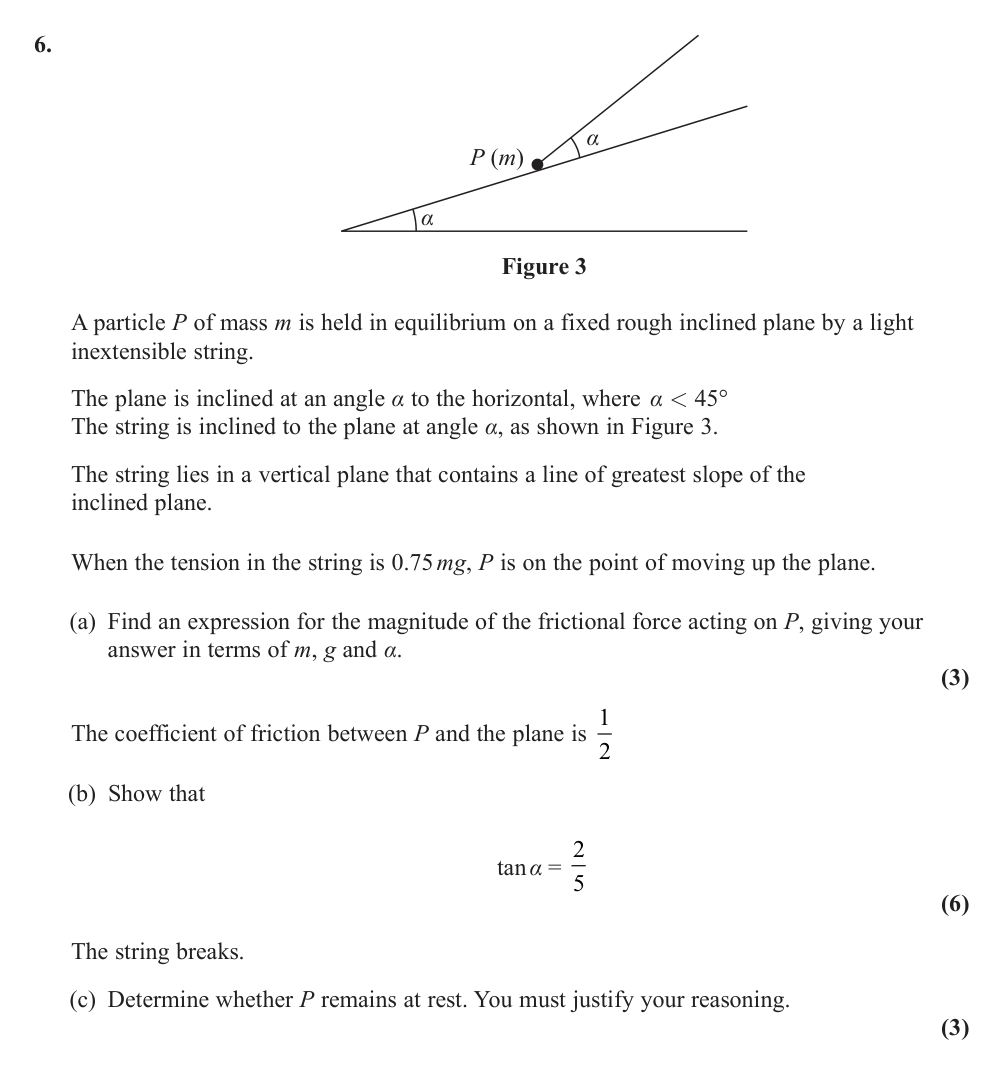
P is on the point of moving up the plane, so friction acts down the plane. The tension has component $0.75mg\cos\alpha$ up the plane, and the weight component is $mg\sin\alpha$ down the plane.
Find the frictional force
For equilibrium parallel to the plane, $0.75mg\cos\alpha=mg\sin\alpha+F$. Hence $F=0.75mg\cos\alpha-mg\sin\alpha$.
Resolve perpendicular to the plane
The string has a component away from the plane, so $R=mg\cos\alpha-0.75mg\sin\alpha$.
Use the coefficient of friction
Given $\mu=\dfrac12$, limiting friction gives $F=\dfrac12R$. Therefore $0.75mg\cos\alpha-mg\sin\alpha=\dfrac12(mg\cos\alpha-0.75mg\sin\alpha)$.
Show the tangent result
Divide by $mg$ and collect terms: $0.75\cos\alpha-\sin\alpha=0.5\cos\alpha-0.375\sin\alpha$. Thus $0.25\cos\alpha=0.625\sin\alpha$, so $\tan\alpha=\dfrac{0.25}{0.625}=\dfrac25$.
Check what happens when the string breaks
Without the string, $R=mg\cos\alpha$ and the maximum friction is $\dfrac12mg\cos\alpha$. The component of weight down the plane is $mg\sin\alpha$.
Compare friction with the downslope component
Since $\tan\alpha=\dfrac25<\dfrac12$, we have $mg\sin\alpha<\dfrac12mg\cos\alpha$. The available friction is large enough to hold P, so P remains at rest.
Final answer
$(a)\ F=0.75mg\cos\alpha-mg\sin\alpha.\quad (b)\ \tan\alpha=\dfrac25.\quad (c)\ P\ \text{remains at rest}$.
25. WME01/01 October 2023 · Q5
Hard12 marksShow worked solution
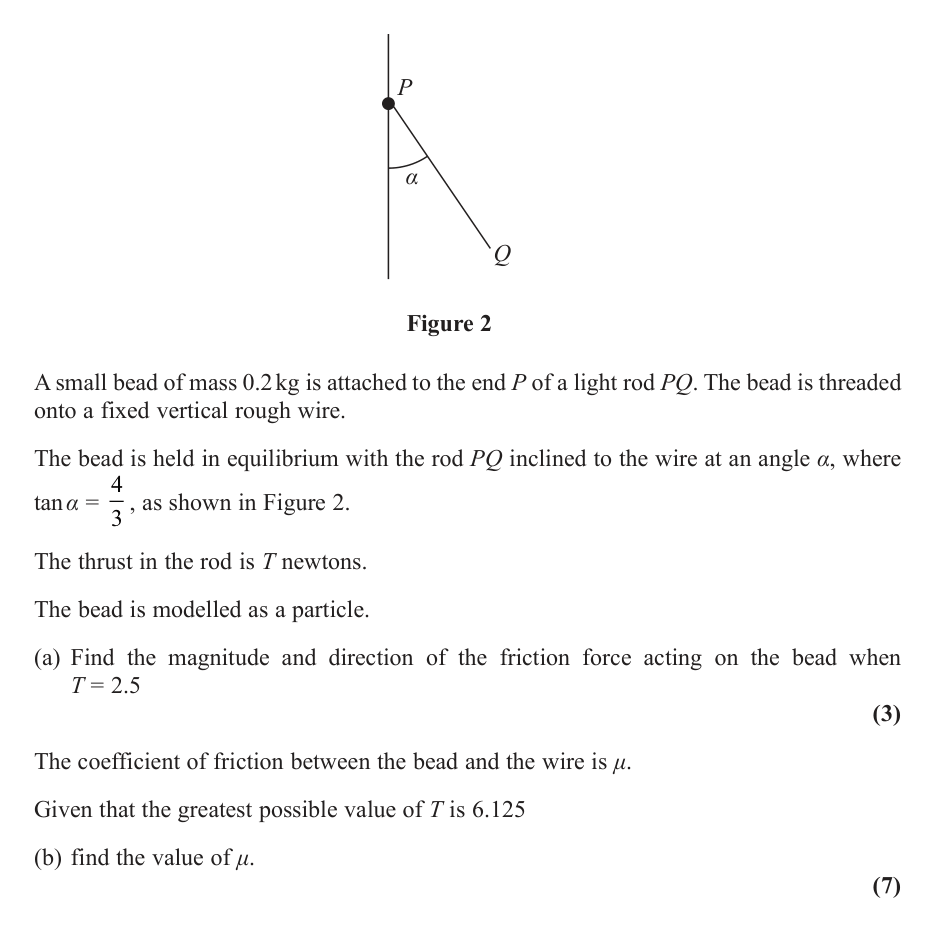
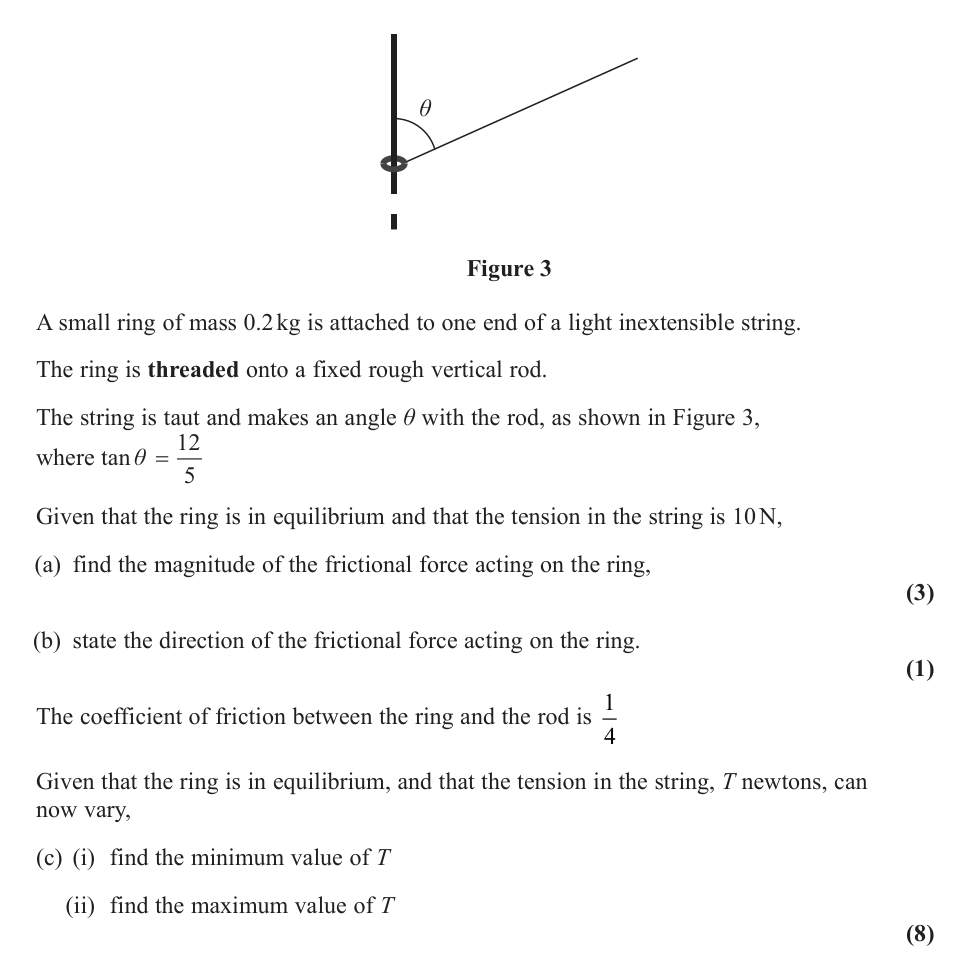
Use the trig ratios
The string makes angle $\theta$ with the vertical rod and $\tan\theta=\dfrac{12}{5}$. Hence $\sin\theta=\dfrac{12}{13}$ and $\cos\theta=\dfrac{5}{13}$.
Find the friction for T = 10
The upward component of the tension is $10\cos\theta=10\cdot\dfrac{5}{13}=\dfrac{50}{13}$ N. The weight is $0.2g=1.96$ N.
Balance vertical forces
Since the upward component of tension is larger than the weight, friction must act downwards. Its magnitude is $\dfrac{50}{13}-1.96=1.89\ldots\ \mathrm{N}$, so $F=1.9\ \mathrm{N}$.
Write the normal reaction
For variable tension $T$, the normal reaction from the rod is produced by the horizontal component of tension: $R=T\sin\theta=\dfrac{12T}{13}$.
Use limiting friction
Since $\mu=\dfrac14$, limiting friction is $F=\mu R=\dfrac14\cdot\dfrac{12T}{13}=\dfrac{3T}{13}$.
Find the minimum tension
For the minimum tension, the ring would tend to slide down, so friction acts upwards. Vertical equilibrium gives $T\cos\theta+F=0.2g$, hence $\dfrac{5T}{13}+\dfrac{3T}{13}=1.96$. Thus $T=3.185\ldots\ \mathrm{N}$, so $T_{\min}=3.2\ \mathrm{N}$.
Find the maximum tension
For the maximum tension, the ring would tend to move up, so friction acts downwards. Vertical equilibrium gives $T\cos\theta=0.2g+F$, hence $\dfrac{5T}{13}=1.96+\dfrac{3T}{13}$. Thus $T=12.74\ldots\ \mathrm{N}$, so $T_{\max}=13\ \mathrm{N}$.
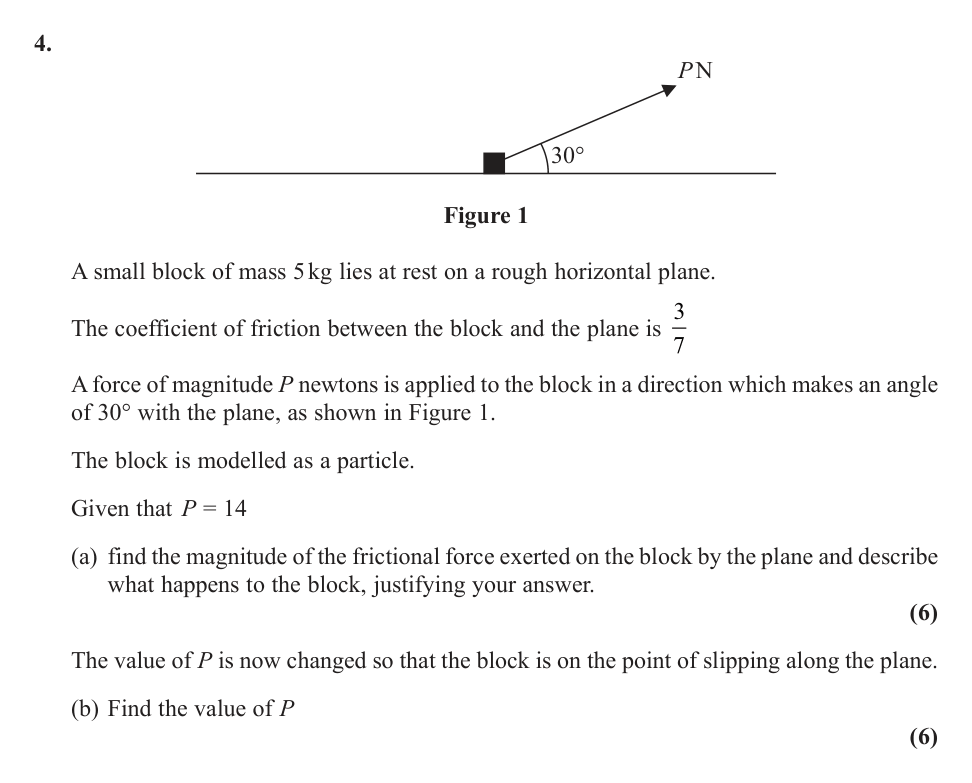
Resolve vertically. The upward component of the applied force is $14\sin30^\circ$, so $R+14\sin30^\circ=5g$.
Calculate R
$R+7=49$, so $R=42\ \mathrm{N}$.
Find the maximum friction
$F_{\max}=\mu R=\dfrac37(42)=18\ \mathrm{N}$.
Compare with the horizontal pull
The horizontal component of the applied force is $14\cos30^\circ=12.1\ldots\ \mathrm{N}$. Since this is less than the maximum possible friction, the block does not move.
State the actual friction
For equilibrium, the actual friction equals the horizontal pull, so $F=12.1\ \mathrm{N}$ approximately.
Set up the limiting case
When the block is on the point of slipping, friction is limiting. Resolve vertically: $R+P\sin30^\circ=5g$, so $R=5g-P\sin30^\circ$.
Resolve horizontally
At the limiting case, $P\cos30^\circ=\dfrac37R=\dfrac37(5g-P\sin30^\circ)$.
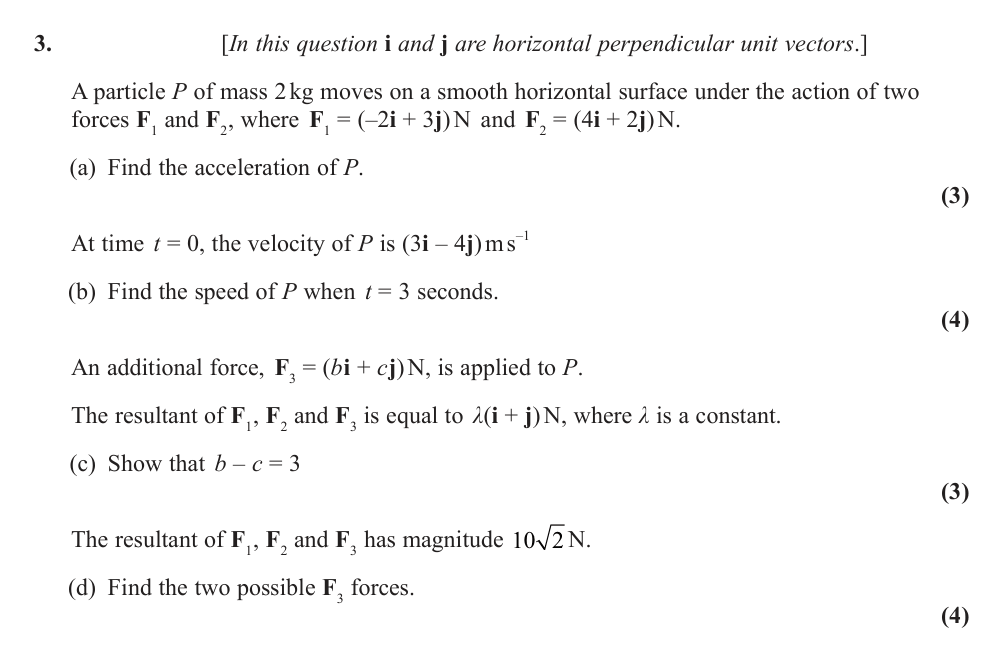
Part (c): Show that b - c = 3 - Apply the condition
Given that resultant = $\lambda(\mathbf{i} + \mathbf{j})$, we can write: $(2 + b)\mathbf{i} + (5 + c)\mathbf{j} = \lambda\mathbf{i} + \lambda\mathbf{j}$
Part (c): Show that b - c = 3 - Compare coefficients
For this to be in the form $\lambda(\mathbf{i} + \mathbf{j})$, the coefficients must be equal: $2 + b = \lambda$ $5 + c = \lambda$ Therefore: $2 + b = 5 + c$ $b = 5 + c - 2$ $b = 3 + c$ $b - c = 3$
Part (d): Find the two possible $\mathbf{F}_3$ forces - Use the magnitude condition
Resultant = $(2 + b)\mathbf{i} + (5 + c)\mathbf{j}$ Since resultant = $\lambda(\mathbf{i} + \mathbf{j})$, we have $2 + b = 5 + c = \lambda$ $|\mathbf{F}_{\text{resultant}}| = \lambda\sqrt{1^2 + 1^2} = \lambda\sqrt{2}$ Given: $|\mathbf{F}_{\text{resultant}}| = 10\sqrt{2}$ $\lambda\sqrt{2} = 10\sqrt{2}$ $\lambda = 10 \quad \text{or} \quad \lambda = -10$ (The negative value comes from considering the opposite direction)
Part (d): Find the two possible $\mathbf{F}_3$ forces - Find b and c for each value of $\lambda$
Case 1: $\lambda = 10$ $2 + b = 10 \quad \Rightarrow \quad b = 8$ $5 + c = 10 \quad \Rightarrow \quad c = 5$ Check: $b - c = 8 - 5 = 3$ ✓ Therefore: $\mathbf{F}_3 = 8\mathbf{i} + 5\mathbf{j}$ N Case 2: $\lambda = -10$ $2 + b = -10 \quad \Rightarrow \quad b = -12$ $5 + c = -10 \quad \Rightarrow \quad c = -15$ Check: $b - c = -12 - (-15) = 3$ ✓ Therefore: $\mathbf{F}_3 = -12\mathbf{i} - 15\mathbf{j}$ N
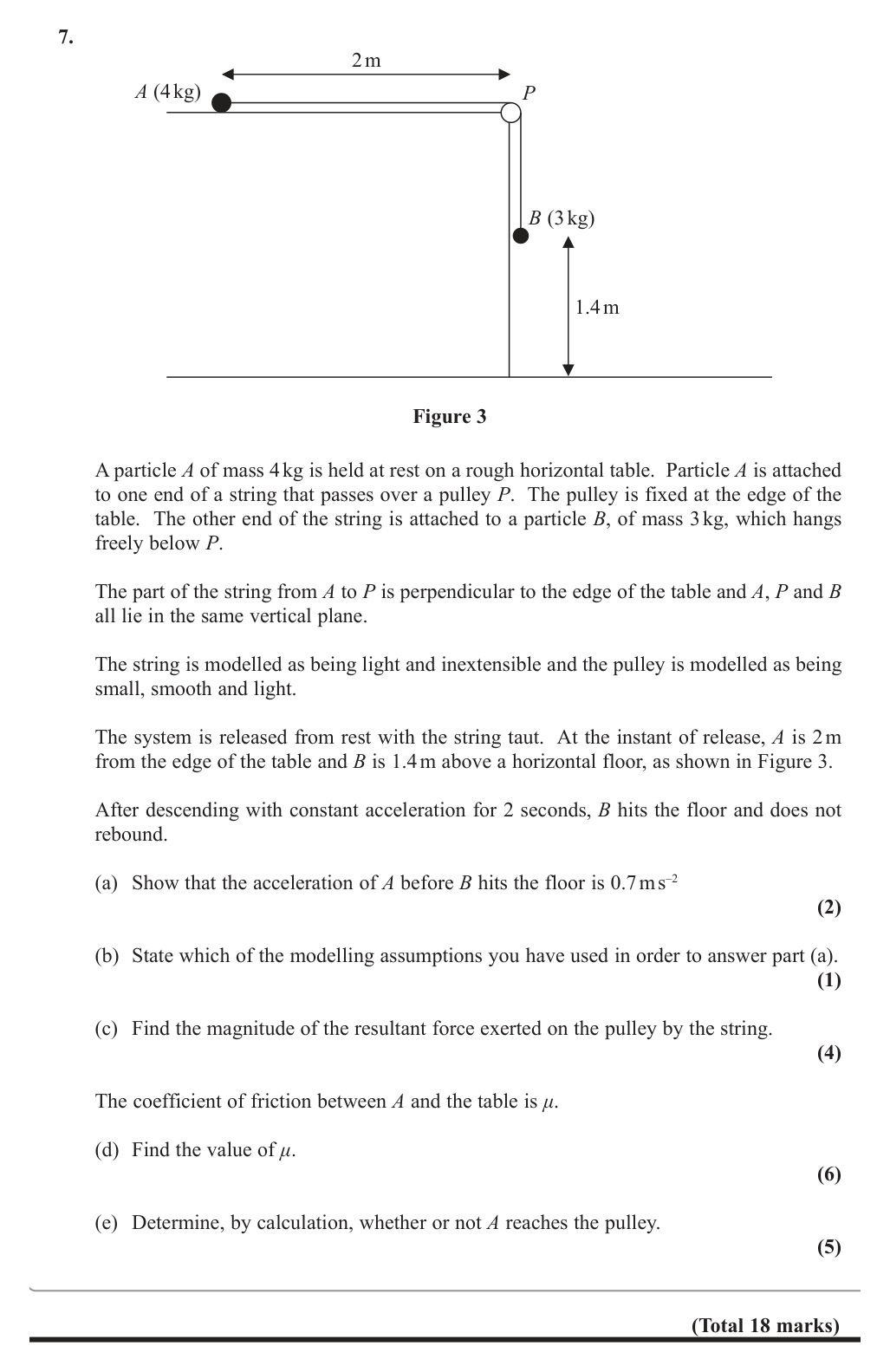
Hard18 marks · main topic: Newton's Second LawShow worked solution
Use B's descent
Before B hits the floor, it descends $1.4$ m from rest in $2$ s. Use $s=ut+\dfrac12at^2$: $1.4=\dfrac12a(2)^2$. Hence $a=0.7\ \mathrm{m\,s^{-2}}$.
Name the modelling assumption
The string is inextensible, so A and B have the same magnitude of acceleration while the string is taut.
Find the tension
For B, taking downward as positive: $3g-T=3(0.7)$. Thus $T=3g-2.1=27.3$ N.
Find the resultant force on the pulley
The pulley is pulled by two perpendicular tensions of magnitude $T$. Therefore the resultant is $\sqrt{T^2+T^2}=T\sqrt2=27.3\sqrt2=38.6$ N approximately.
Find the friction on A
For A before B hits the floor, $T-F=4(0.7)$. Hence $F=27.3-2.8=24.5$ N.
Find mu
On the horizontal table, $R=4g=39.2$ N and $F=\mu R$. So $\mu=\dfrac{24.5}{39.2}=0.625$.
Find A's speed when B hits the floor
At this instant, $v=at=0.7(2)=1.4\ \mathrm{m\,s^{-1}}$. A has also moved $1.4$ m towards the pulley.
Find the extra stopping distance
After B hits the floor, A is slowed only by friction. Its deceleration is $\mu g=0.625(9.8)=6.125\ \mathrm{m\,s^{-2}}$. Use $0=(1.4)^2-2(6.125)s$, giving $s=0.16$ m.
Compare with the distance to the pulley
A's total distance is $1.4+0.16=1.56$ m, which is less than $2$ m. Therefore A does not reach the pulley.
Final answer
$(a)\ a=0.7\ \mathrm{m\,s^{-2}}.\quad (b)$ Inextensibility of the string. $(c)\ 38.6\ \mathrm{N}.\quad (d)\ \mu=0.625.\quad (e)$ A does not reach the pulley.
 Elite Mathematics