Resolving Forces and Inclined Planes: past paper questions & worked solutions
Every Resolving Forces and Inclined Planes question from the WME01 papers in our bank, 2019–2026, sorted from easiest to hardest. Try each one first, then open the worked solution.
Level is estimated from marks: 1–6 easy, 7–8 medium, 9+ hard.
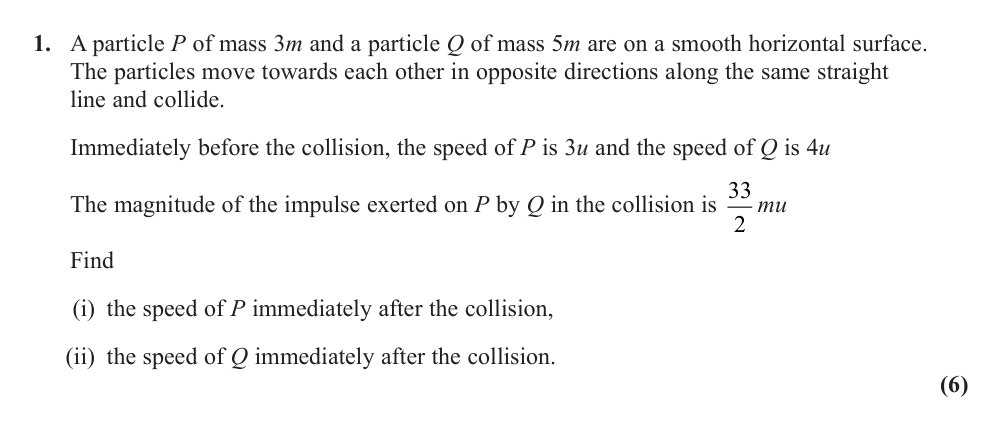
1. WME01/01 January 2026 · Q1
Easy6 marks · main topic: Momentum, Impulse & CollisionsShow worked solution
Choose a sign convention
Take the initial direction of P as positive. Then before impact, $v_P=3u$ and $v_Q=-4u$. The impulse on P acts opposite to P\'s initial motion, so its signed impulse is $-\dfrac{33}{2}mu$.
Use impulse on P
For P, impulse equals change in momentum: $-\dfrac{33}{2}mu=3m(v_P-3u)$. Dividing by $3m$ gives $v_P-3u=-\dfrac{11u}{2}$, so $v_P=-\dfrac{5u}{2}$.
Interpret the speed of P
The negative sign means P has reversed direction. Its speed is therefore $\left|-\dfrac{5u}{2}\right|=\dfrac{5u}{2}$.
Use the equal and opposite impulse on Q
Q receives impulse $+\dfrac{33}{2}mu$ in the positive direction. Hence $\dfrac{33}{2}mu=5m(v_Q-(-4u))=5m(v_Q+4u)$.
Interpret the speed of Q
Dividing by $5m$ gives $v_Q+4u=\dfrac{33u}{10}$, so $v_Q=-\dfrac{7u}{10}$. Q is still moving in its original direction, and its speed is $\dfrac{7u}{10}$.
Final answer
$(i)\ \text{speed of P}=\dfrac{5u}{2}.\quad (ii)\ \text{speed of Q}=\dfrac{7u}{10}$.
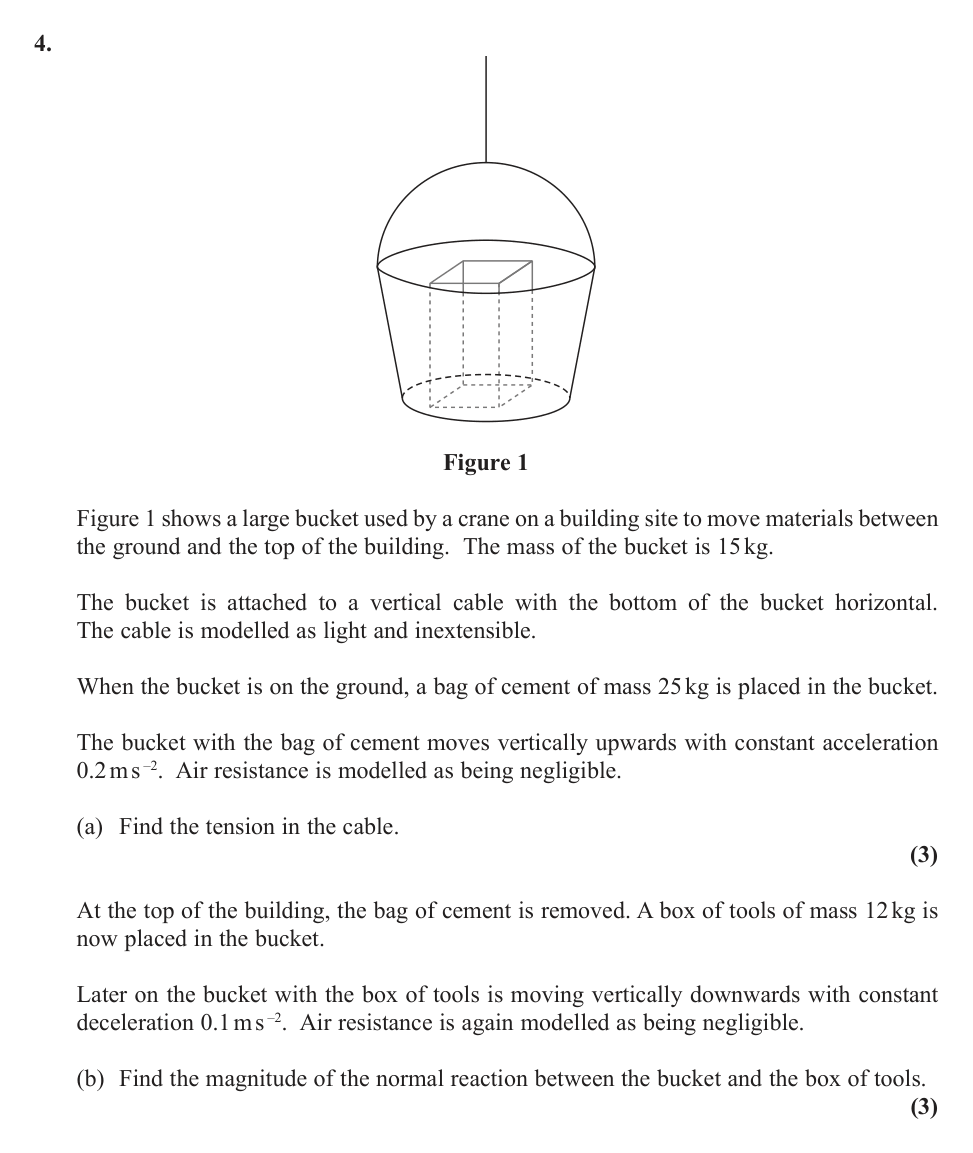
2. WME01/01 May/June 2021 · Q4
Easy6 marks · main topic: Newton's Second LawShow worked solution
Find total mass going up
The bucket and cement have total mass $15+25=40$ kg and acceleration $0.2\ \mathrm{m\,s^{-2}}$ upward.
Apply Newtons second law
Taking upward as positive: $T-40g=40(0.2)$.
Find the tension
$T-392=8$, so $T=400\ \mathrm{N}$.
Interpret the downward deceleration
The bucket and tools are moving downward but decelerating, so their acceleration is upward with magnitude $0.1\ \mathrm{m\,s^{-2}}$.
Consider the box of tools
For the $12$ kg box, upward force is the normal reaction $R$, and downward force is weight $12g$.
Find R
$R-12g=12(0.1)$. Thus $R=117.6+1.2=118.8\ \mathrm{N}$, about $119\ \mathrm{N}$.
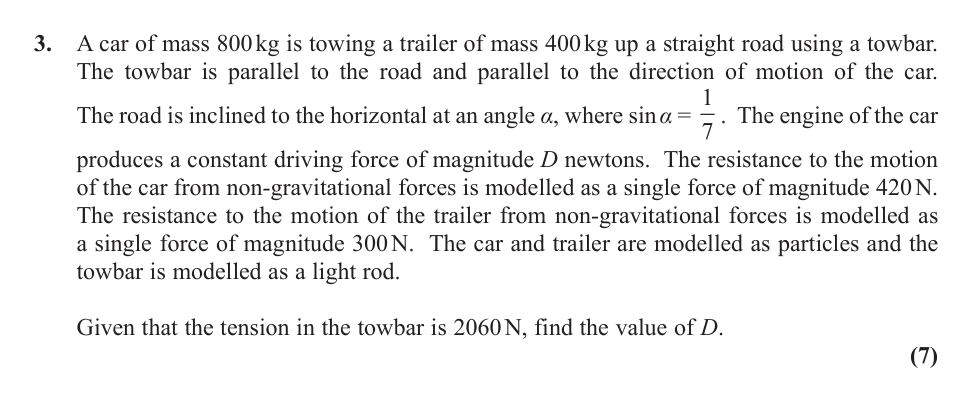
Medium7 marks · main topic: Newton's Second LawShow worked solution
Use the trailer to find acceleration
For the trailer, take up the road as positive. The forces along the road are tension $2060$ N up the road, resistance $300$ N down the road, and weight component $400g\sin\alpha$ down the road.
Form the trailer equation
$2060-300-400g\sin\alpha=400a$. Since $\sin\alpha=\dfrac17$, this becomes $2060-300-400g\cdot\dfrac17=400a$.
Find the acceleration
Using $g=9.8$, $400g\cdot\dfrac17=560$. Hence $1200=400a$ and $a=3\ \mathrm{m\,s^{-2}}$.
Apply Newton's second law to the car
For the car: $D-420-800g\sin\alpha-2060=800a$.
Find the driving force
$D-420-800g\cdot\dfrac17-2060=800(3)$. Since $800g\cdot\dfrac17=1120$, $D=420+1120+2060+2400=6000$ N.
Final answer
$D=6000\ \mathrm{N}$.
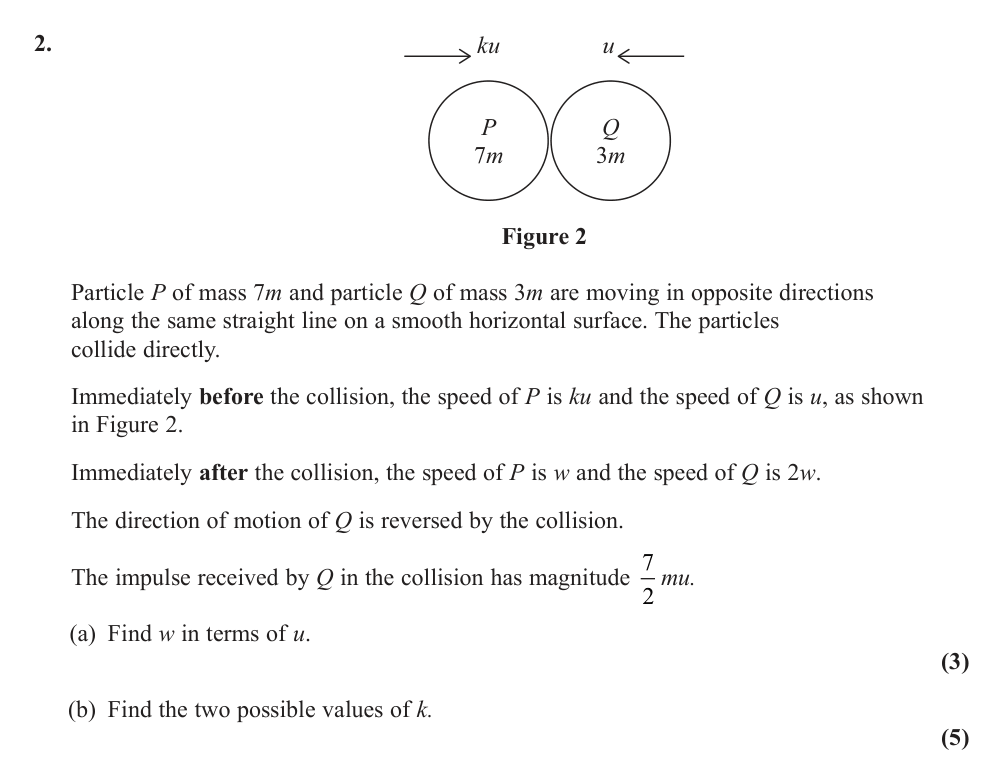
4. WME01/01 October 2025 · Q2
Medium8 marks · main topic: Momentum, Impulse & CollisionsShow worked solution
Part (a): Find w in terms of u - Apply impulse-momentum theorem to Q
Part (b): Find the two possible values of k - Consider both directions for P after collision
P could move either right (velocity = $+w$) or left (velocity = $-w$) Case 1: P moves right with velocity $+w$ Already solved: $k = \frac{7}{12}$ Case 2: P moves left with velocity $-w$ Total momentum after = $-7mw + 6mw = -mw$ $7mku - 3mu = -mw$ $7ku - 3u = -w$ $7ku - 3u = -\frac{u}{12}$ $7ku = 3u - \frac{u}{12}$ $7ku = \frac{36u - u}{12}$ $7ku = \frac{35u}{12}$ $k = \frac{35}{84} = \frac{5}{12}$
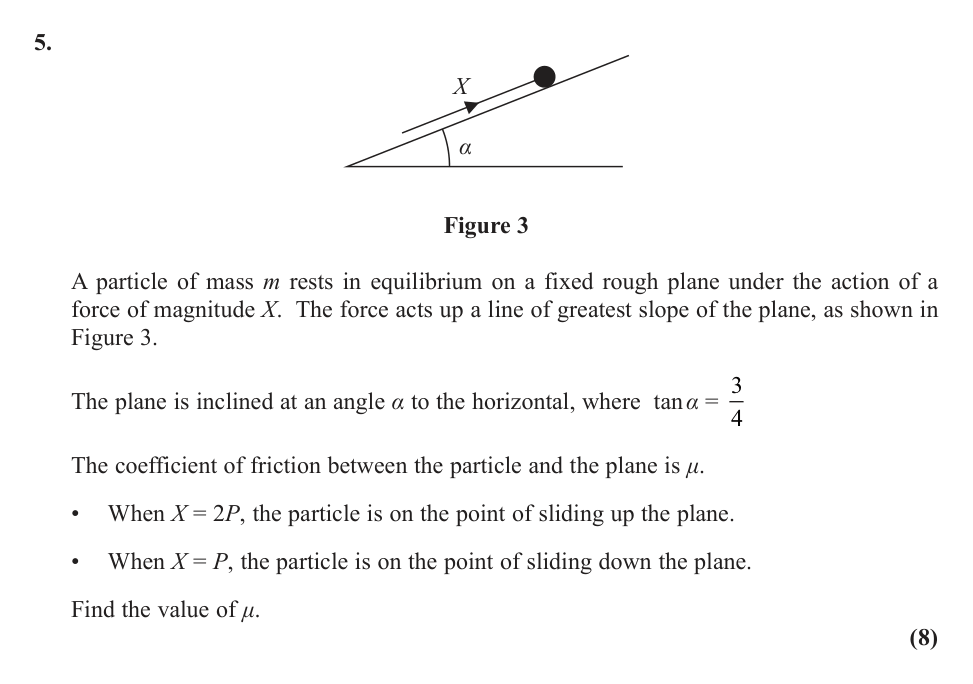
Since $\tan\alpha=\dfrac34$, $\sin\alpha=\dfrac35$ and $\cos\alpha=\dfrac45$.
Resolve perpendicular to the plane
The force $X$ acts along the plane, so the normal reaction is $R=mg\cos\alpha=\dfrac45mg$.
Use friction
The limiting friction is $F=\mu R=\dfrac45\mu mg$.
Use the sliding-up condition
When $X=2P$, the particle is about to slide up, so friction acts down the plane. Hence $2P=mg\sin\alpha+F=\dfrac35mg+\dfrac45\mu mg$.
Use the sliding-down condition
When $X=P$, the particle is about to slide down, so friction acts up the plane. Hence $P+F=mg\sin\alpha$, so $P=\dfrac35mg-\dfrac45\mu mg$.
Eliminate P
Double the second equation: $2P=\dfrac65mg-\dfrac85\mu mg$. This equals the first expression for $2P$.
Solve for mu
$\dfrac65mg-\dfrac85\mu mg=\dfrac35mg+\dfrac45\mu mg$. Cancel $mg$ and multiply by $5$: $6-8\mu=3+4\mu$. Hence $3=12\mu$ and $\mu=\dfrac14$.
Final answer
$\mu=\dfrac14$.
6. WME01/01 October 2024 · Q2
Hard9 marks · main topic: MomentsShow worked solution
Find the reactions from vertical equilibrium
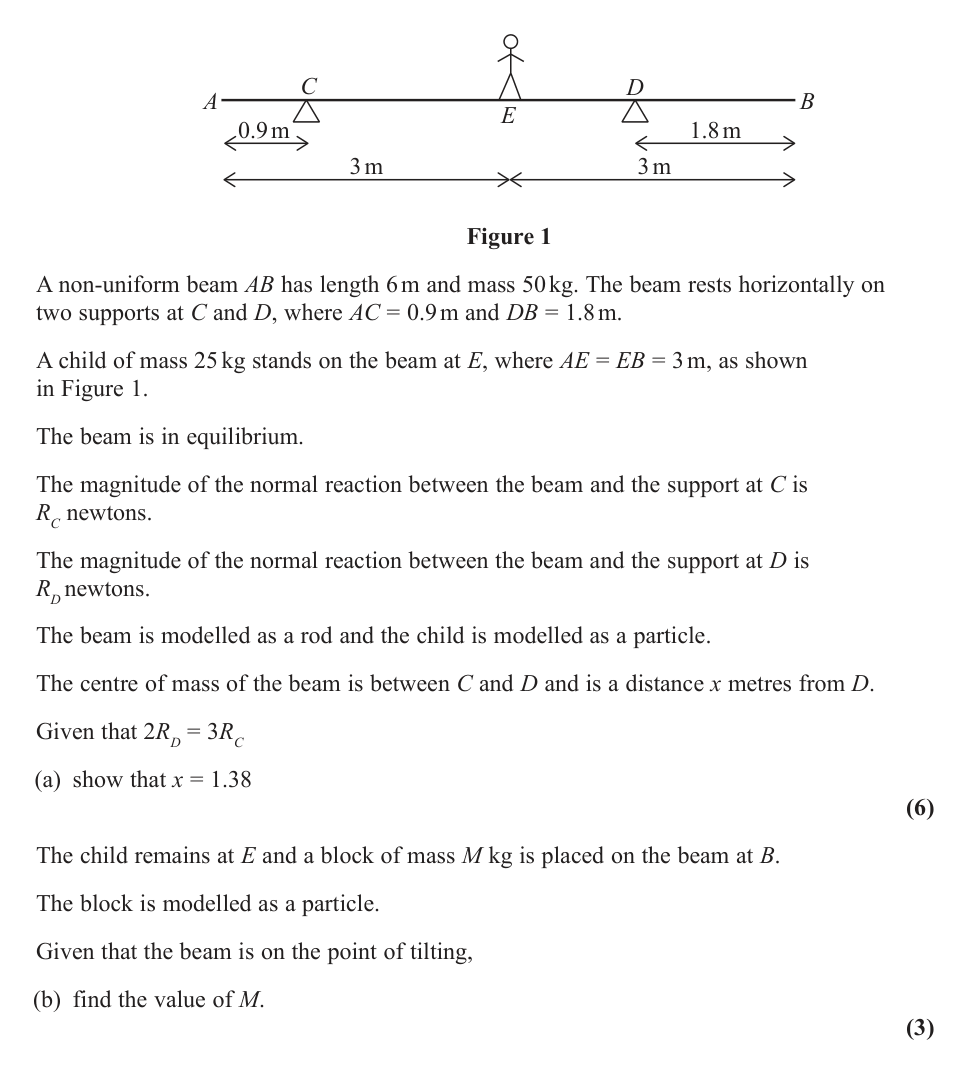
Vertically, $R_C+R_D=50g+25g=75g$. Given $2R_D=3R_C$, we have $R_D=1.5R_C$. Therefore $2.5R_C=75g$, so $R_C=30g$ and $R_D=45g$.
Set the distances from D
$D$ is $6-1.8=4.2$ m from A. The support C is $4.2-0.9=3.3$ m to the left of D, the child at E is $4.2-3=1.2$ m to the left of D, and the centre of mass is $x$ m to the left of D.
Take moments about D
Balancing moments about D gives $50gx+25g(1.2)=R_C(3.3)$.
Show x is 1.38
Substitute $R_C=30g$: $50x+30=99$, so $50x=69$ and $x=\dfrac{69}{50}=1.38$.
Use the tilting condition with the block
When the block at B is on the point of making the beam tilt, the beam is about to pivot about D and the reaction at C is zero.
Take moments about D for the block
The child and the beam act to the left of D, and the block at B acts $1.8$ m to the right of D. Hence $25g(1.2)+50g(1.38)=Mg(1.8)$.
Find M
$30+69=1.8M$, so $M=\dfrac{99}{1.8}=55$.
Final answer
$(a)\ x=1.38.\quad (b)\ M=55$.
7. WME01/01 May/June 2021 · Q7
Hard10 marks · main topic: MomentsShow worked solution
Set the support positions
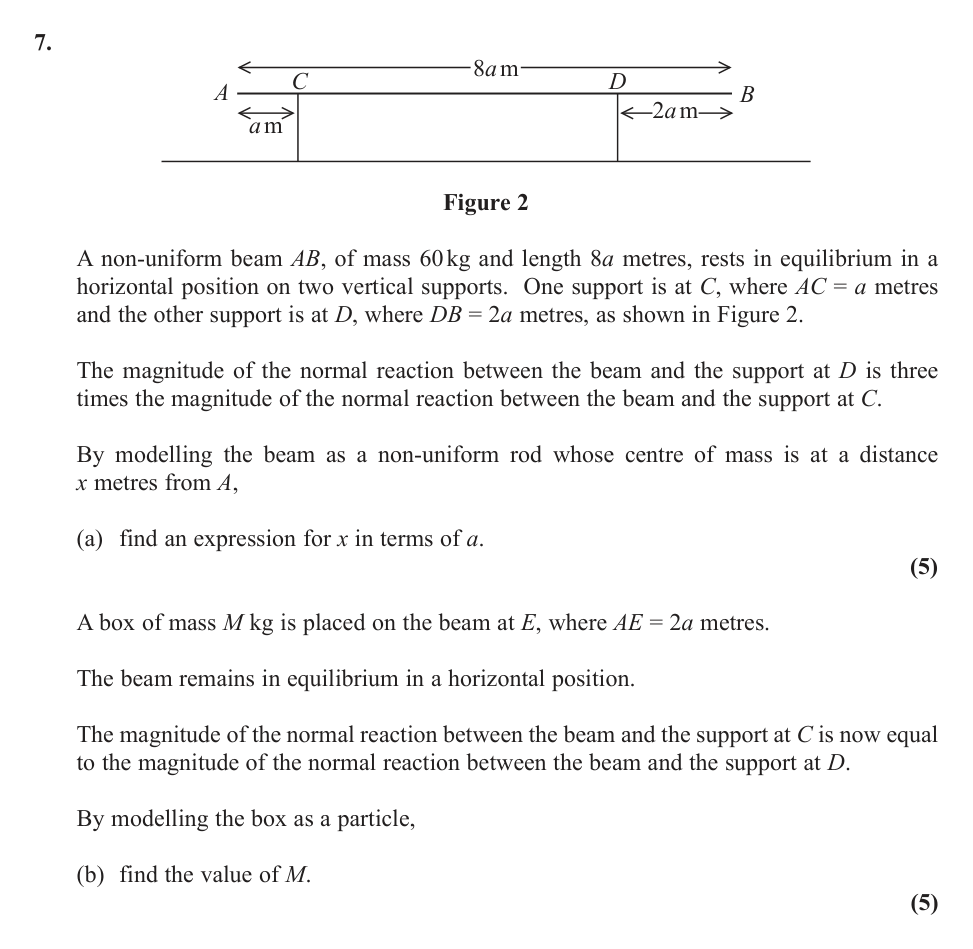
The beam length is $8a$. C is at distance $a$ from A, and D is at distance $6a$ from A because $DB=2a$.
Name the reactions
Let the reaction at C be $R$. The reaction at D is $3R$.
Use vertical equilibrium
$R+3R=60g$, so $4R=60g$ and $R=15g$.
Take moments about A
The beam's weight acts at distance $x$ from A. Hence $60g x=R(a)+3R(6a)$.
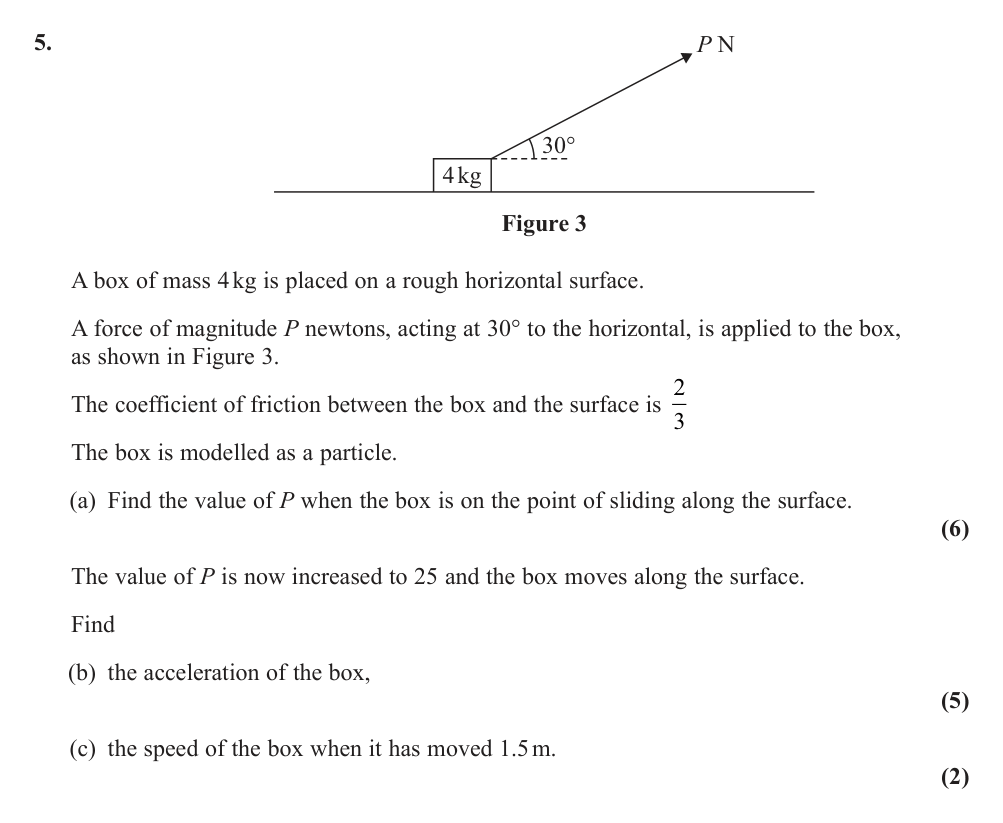
Part (a): Show deceleration = $\frac{4g}{5}$ - Calculate friction force
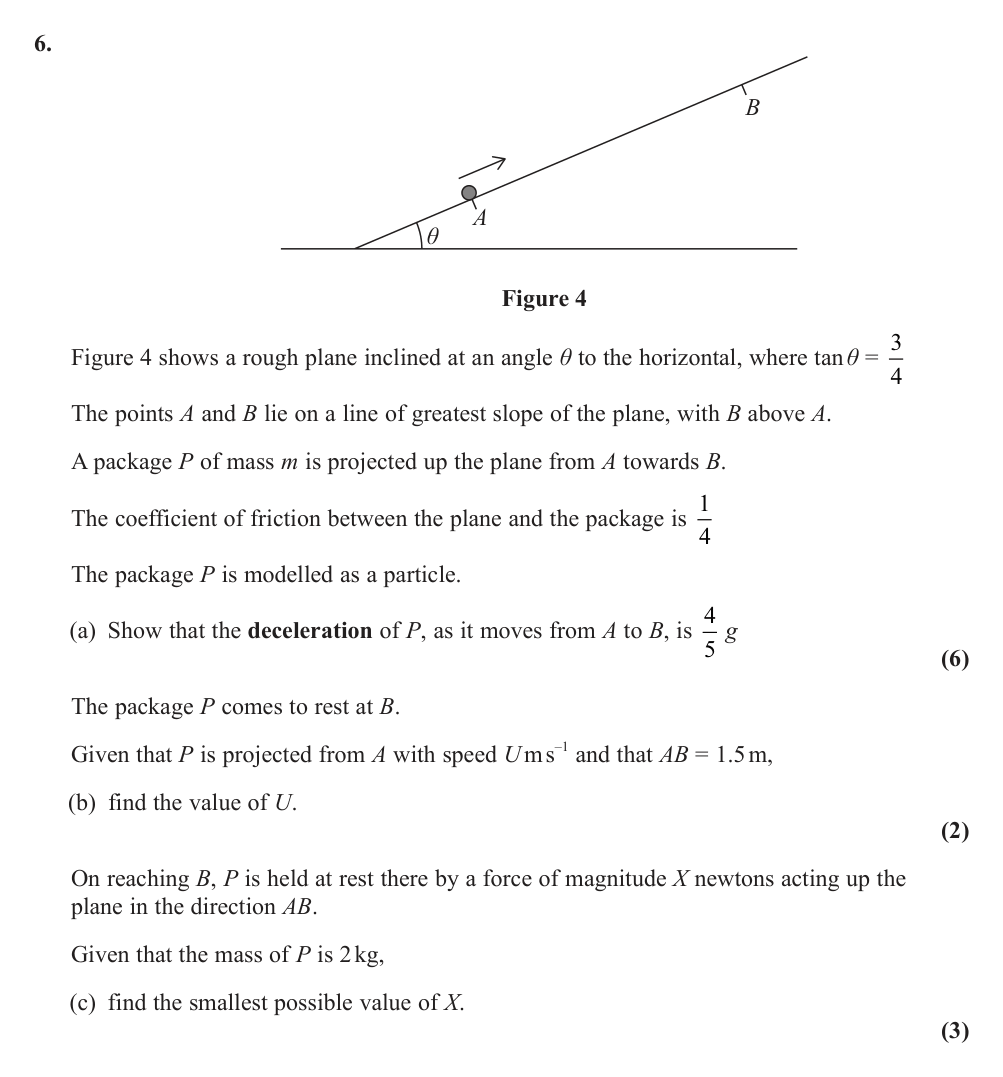
Package moving UP, so friction acts DOWN the plane: $F = \mu R$ $= \frac{1}{4} \times \frac{4mg}{5}$ $= \frac{mg}{5}$
Part (a): Show deceleration = $\frac{4g}{5}$ - Resolve parallel to plane
Taking up the plane as positive: $\parallel: \sum F = ma$ $-mg\sin\theta - F = ma$ $-mg \times \frac{3}{5} - \frac{mg}{5} = ma$ $-\frac{3mg}{5} - \frac{mg}{5} = ma$ $-\frac{4mg}{5} = ma$ $a = -\frac{4g}{5}$ Deceleration = $\left|-\frac{4g}{5}\right| = \frac{4g}{5}$
Part (b): Find initial speed U - Identify SUVAT variables
Package projected up plane, comes to rest at B: ; $u = U$ m s$^{-1}$ (unknown) ; $v = 0$ m s$^{-1}$ (comes to rest) ; $a = -\frac{4g}{5}$ m s$^{-2}$ (from part a) ; $s = 1.5$ m
Part (b): Find initial speed U - Apply $v^2 = u^2 + 2as$
Part (c): Find smallest value of X - Analyze forces when package at rest at B
Package held at rest on slope by force X up the plane. Without X, package would slide down (component down > friction up). For MINIMUM X, friction acts UP the plane (at limiting friction).
Part (c): Find smallest value of X - Resolve perpendicular to plane
Mass = 2 kg, so weight = $2g$ N $R = 2g\cos\theta$ $= 2g \times \frac{4}{5}$ $= \frac{8g}{5} \text{ N}$
Part (c): Find smallest value of X - Calculate friction
Friction acts UP the plane (limiting): $F = \mu R$ $= \frac{1}{4} \times \frac{8g}{5}$ $= \frac{2g}{5} \text{ N}$
Part (c): Find smallest value of X - Resolve parallel to plane
For equilibrium (package at rest): $\parallel: \sum F = 0$ Taking up plane as positive: $X + F - 2g\sin\theta = 0$ $X + \frac{2g}{5} - 2g \times \frac{3}{5} = 0$ $X + \frac{2g}{5} - \frac{6g}{5} = 0$ $X = \frac{6g}{5} - \frac{2g}{5}$ $X = \frac{4g}{5}$ $X = \frac{4 \times 9.8}{5}$ $X = 7.84 \text{ N}$
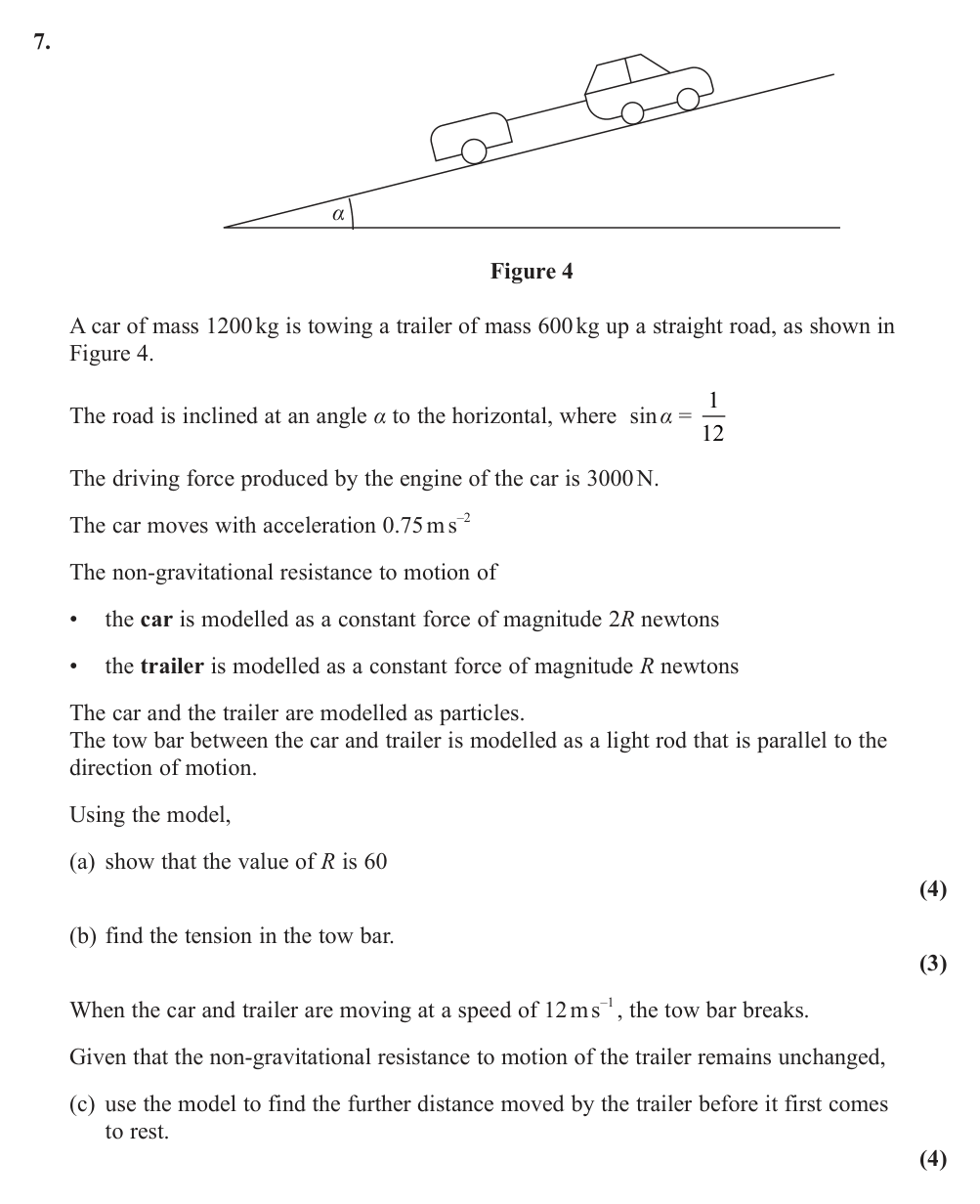
Hard11 marks · main topic: Newton's Second LawShow worked solution
Use the whole system
For car plus trailer, the total mass is $1800$ kg and the total resistance is $2R+R=3R$. Taking up the slope as positive: $3000-1800g\sin\alpha-3R=1800(0.75)$.
Show R is 60
Since $\sin\alpha=\dfrac1{12}$, $1800g\sin\alpha=1800\cdot9.8\cdot\dfrac1{12}=1470$. So $3000-1470-3R=1350$, giving $180=3R$ and $R=60\ \mathrm{N}$.
Apply Newtons second law to the trailer
For the trailer while it is being towed, $T-600g\sin\alpha-R=600(0.75)$.
Find the tow-bar tension
$T-600\cdot9.8\cdot\dfrac1{12}-60=450$, so $T-490-60=450$ and $T=1000\ \mathrm{N}$.
Find the trailer acceleration after the break
After the tow bar breaks, the trailer is still moving up the slope, but the component of weight and resistance act down the slope. Taking up the slope as positive: $-600g\sin\alpha-60=600a$.
Simplify the acceleration
$-490-60=600a$, so $a=-\dfrac{550}{600}=-\dfrac{11}{12}\ \mathrm{m\,s^{-2}}$.
Find the stopping distance
With initial speed $12\ \mathrm{m\,s^{-1}}$ and final speed $0$, use $v^2=u^2+2as$: $0=12^2+2\left(-\dfrac{11}{12}\right)d$. Hence $d=\dfrac{864}{11}=78.5\ldots\ \mathrm{m}$.
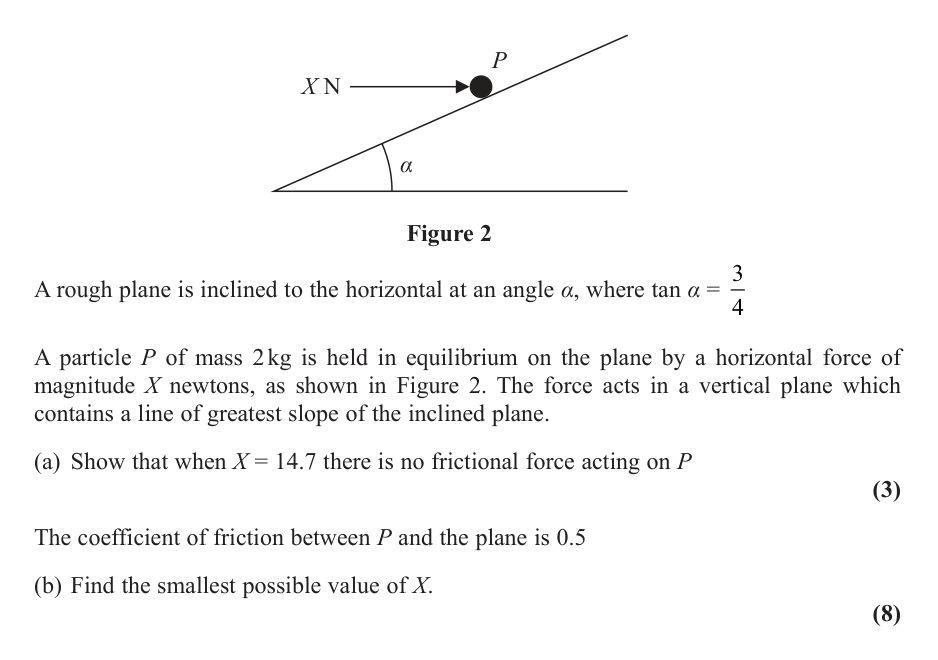
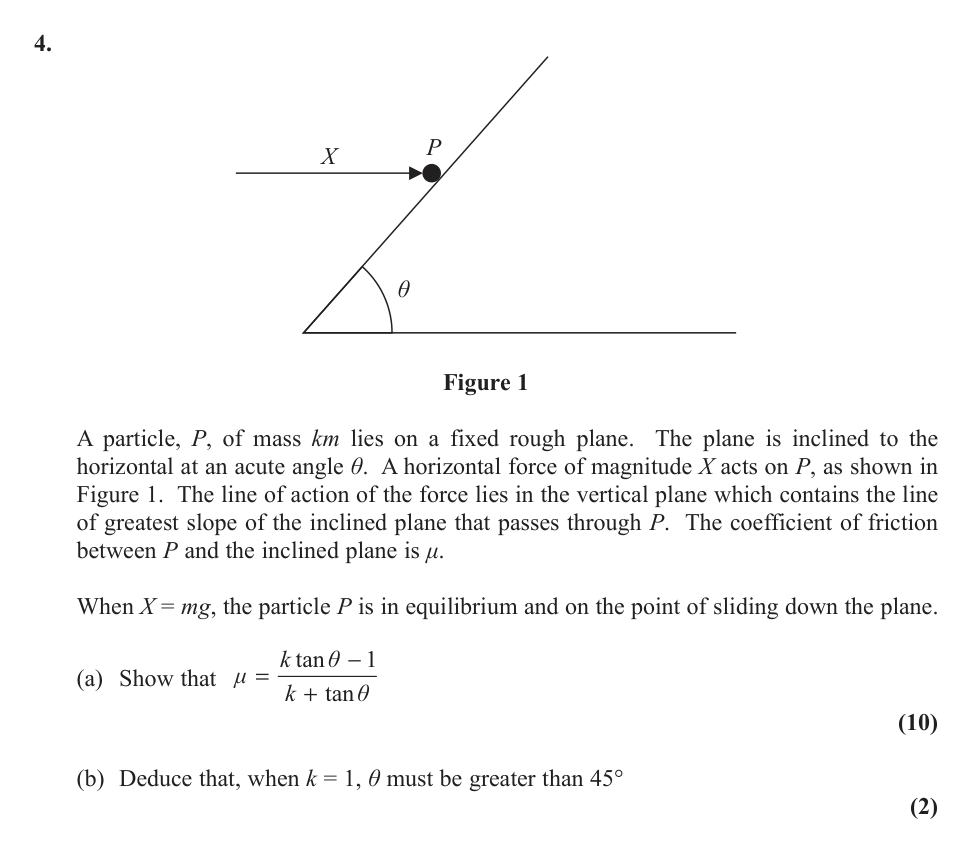
Since $\tan\alpha=\dfrac34$, $\sin\alpha=\dfrac35$ and $\cos\alpha=\dfrac45$.
Check the no-friction case
If there is no friction, the component of the horizontal force up the plane balances the component of weight down the plane: $X\cos\alpha=2g\sin\alpha$.
Substitute X = 14.7
$14.7\cdot\dfrac45=11.76$, and $2(9.8)\cdot\dfrac35=11.76$. The components balance exactly, so the frictional force is zero.
Set the direction for smallest X
For the smallest possible $X$, the particle is about to slide down the plane, so friction acts up the plane.
Resolve perpendicular to the plane
The horizontal force increases the normal reaction, so $R=2g\cos\alpha+X\sin\alpha$.
Use limiting friction
With $\mu=0.5$, the limiting friction is $F=0.5R=0.5(2g\cos\alpha+X\sin\alpha)$.
Resolve along the plane
At the limiting case, $X\cos\alpha+F=2g\sin\alpha$.
Solve for X
Substitute the exact trig values: $\dfrac45X+0.5\left(2g\cdot\dfrac45+X\cdot\dfrac35\right)=2g\cdot\dfrac35$. This gives $\dfrac{11}{10}X+\dfrac{4g}{5}=\dfrac{6g}{5}$, so $X=\dfrac{4g}{11}=3.56\ldots\ \mathrm{N}$.
Final answer
$(a)$ When $X=14.7$, $F=0$. $(b)\ X_{\min}=\dfrac{4g}{11}=3.56\ldots\ \mathrm{N}$.
11. WME01/01 January 2026 · Q5
Hard12 marksShow worked solution
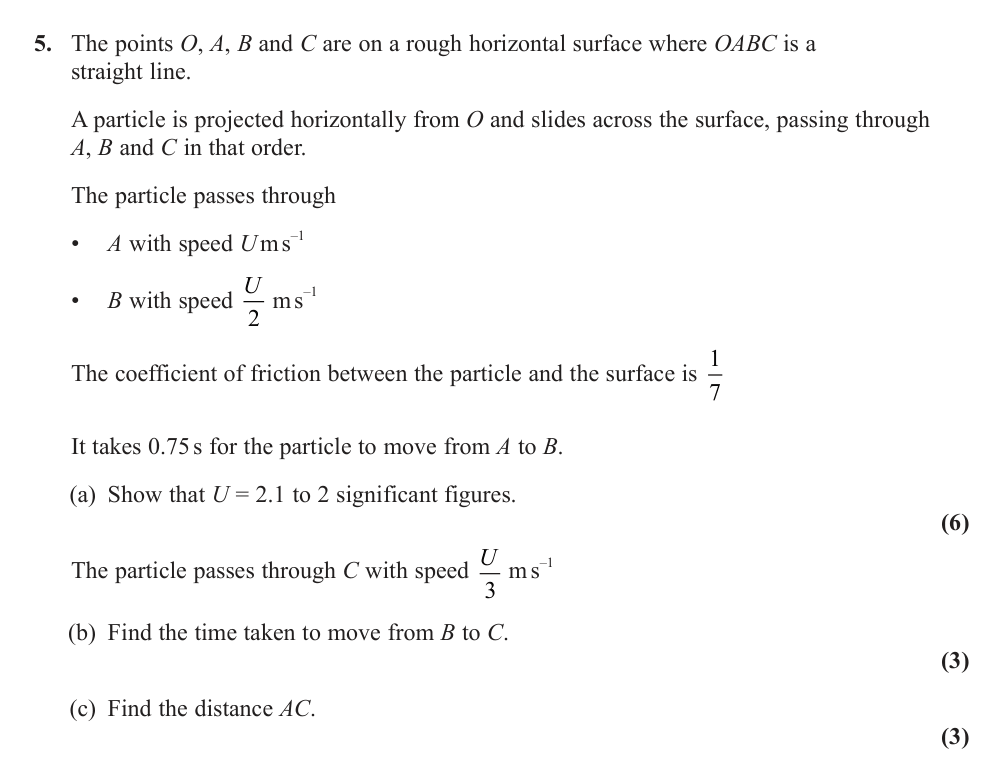
Find the acceleration from friction
On a horizontal surface, $R=mg$ and the friction is $F=\mu R=\dfrac17mg$. The friction is the only horizontal force, so the acceleration is opposite the motion with magnitude $\dfrac{F}{m}=\dfrac{g}{7}=1.4\ \mathrm{m\,s^{-2}}$.
Use A to B to find U
From A to B, $u=U$, $v=\dfrac{U}{2}$, $a=-\dfrac{g}{7}$ and $t=0.75$. Using $v=u+at$: $\dfrac{U}{2}=U-\dfrac{g}{7}(0.75)$.
Show the value of U
With $g=9.8$, $\dfrac{g}{7}(0.75)=1.05$, so $\dfrac{U}{2}=U-1.05$. Hence $U=2.10\ \mathrm{m\,s^{-1}}$, which is $2.1\ \mathrm{m\,s^{-1}}$ to 2 significant figures.
Find the time from B to C
From B to C, the speed falls from $\dfrac{U}{2}$ to $\dfrac{U}{3}$ with the same acceleration $-1.4$. Thus $\dfrac{U}{3}=\dfrac{U}{2}-1.4t$. With $U=2.1$, this gives $0.7=1.05-1.4t$, so $t=0.25\ \mathrm{s}$.
Find the distance AC
Use average speed on each section. $AB=\dfrac{U+U/2}{2}(0.75)=1.18125\ \mathrm{m}$ and $BC=\dfrac{U/2+U/3}{2}(0.25)=0.21875\ \mathrm{m}$. Therefore $AC=1.18125+0.21875=1.4\ \mathrm{m}$.
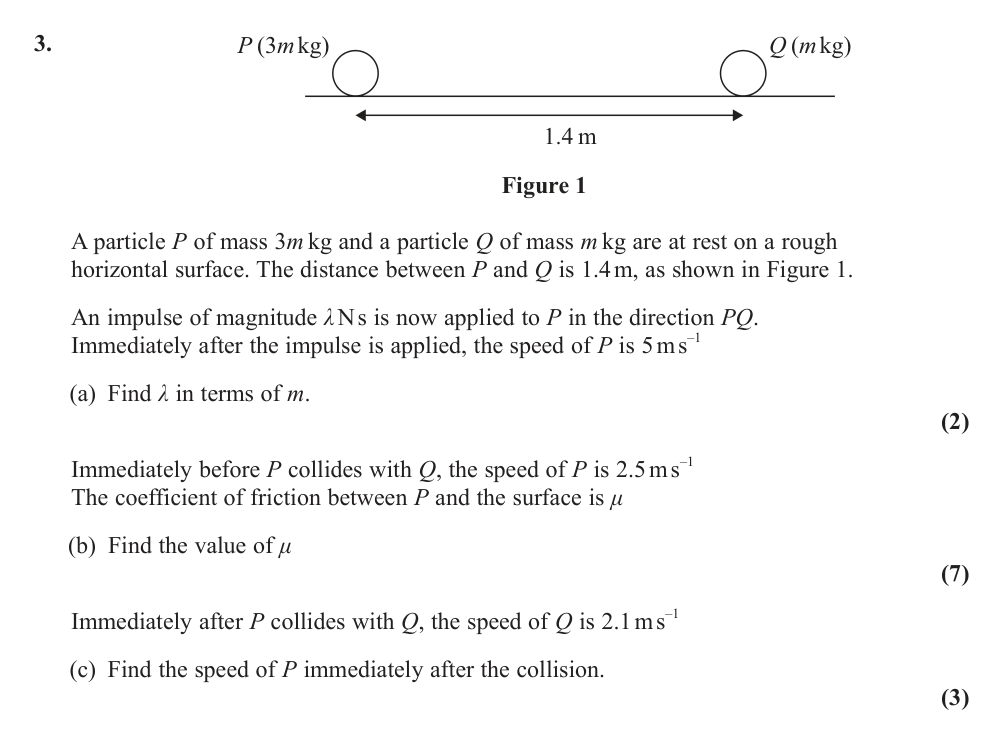
Hard12 marks · main topic: Momentum, Impulse & CollisionsShow worked solution
Use impulse to find lambda
P starts from rest and immediately after the impulse has speed $5\ \mathrm{m\,s^{-1}}$. Since the mass of P is $3m$, $\lambda=3m(5-0)=15m$.
Find the acceleration before collision
Between the impulse and the collision, P slows from $5$ to $2.5\ \mathrm{m\,s^{-1}}$ over $1.4$ m. Using $v^2=u^2+2as$: $(2.5)^2=5^2+2a(1.4)$.
Calculate the acceleration
$6.25=25+2.8a$, so $a=\dfrac{-18.75}{2.8}=-6.696\ldots\ \mathrm{m\,s^{-2}}$.
Connect friction to acceleration
On the horizontal surface, $R=3mg$ and friction is $F=\mu R=3\mu mg$. This friction is opposite the motion, so $-3\mu mg=3ma$ and therefore $a=-\mu g$.
Find mu
$\mu=\dfrac{-a}{g}=\dfrac{6.696\ldots}{9.8}=0.683\ldots$, so $\mu=0.68$ to 2 significant figures.
Use momentum in the collision
Immediately before collision, P has speed $2.5$ and Q is at rest. Immediately after, Q has speed $2.1$ and P has speed $v$. Conservation of momentum gives $3m(2.5)+m(0)=3mv+m(2.1)$.
Find the speed after collision
$7.5=3v+2.1$, so $3v=5.4$ and $v=1.8\ \mathrm{m\,s^{-1}}$.
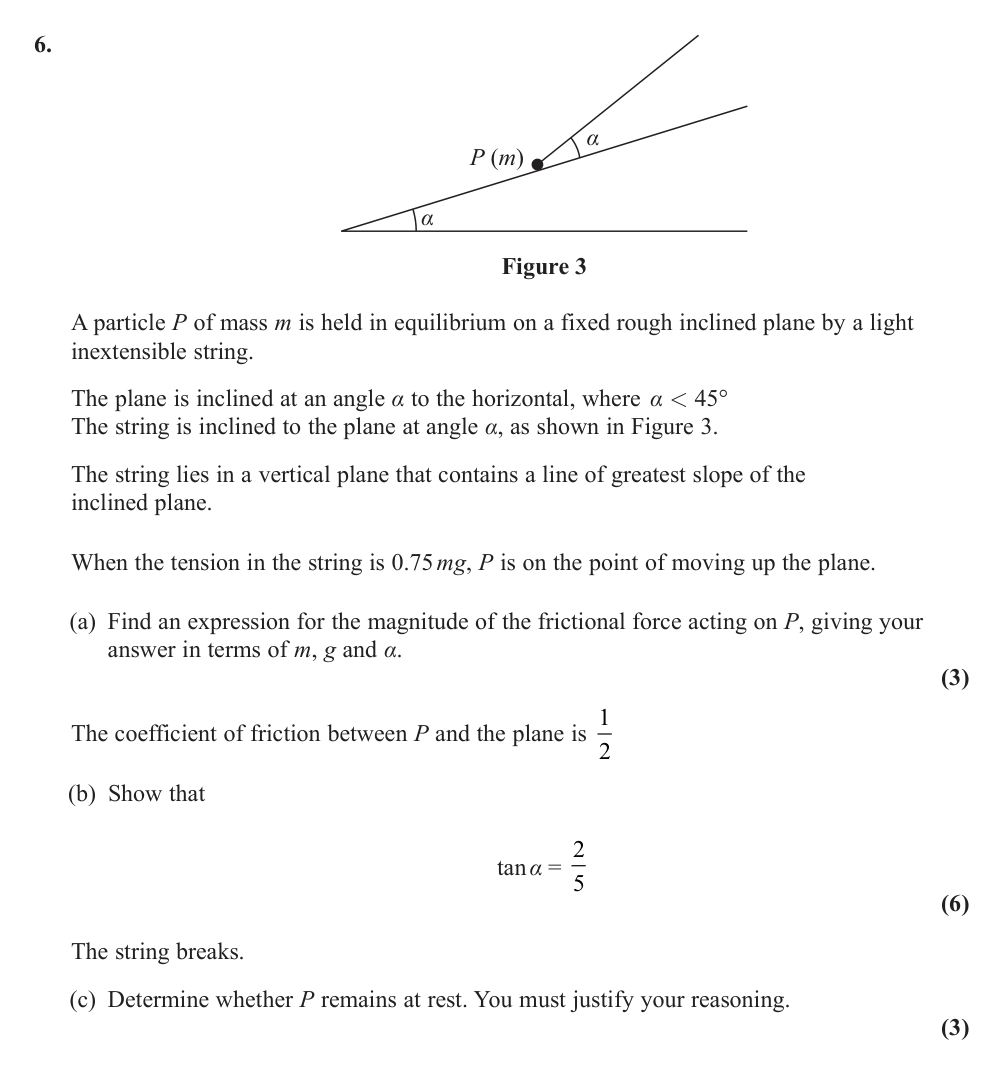
P is on the point of moving up the plane, so friction acts down the plane. The tension has component $0.75mg\cos\alpha$ up the plane, and the weight component is $mg\sin\alpha$ down the plane.
Find the frictional force
For equilibrium parallel to the plane, $0.75mg\cos\alpha=mg\sin\alpha+F$. Hence $F=0.75mg\cos\alpha-mg\sin\alpha$.
Resolve perpendicular to the plane
The string has a component away from the plane, so $R=mg\cos\alpha-0.75mg\sin\alpha$.
Use the coefficient of friction
Given $\mu=\dfrac12$, limiting friction gives $F=\dfrac12R$. Therefore $0.75mg\cos\alpha-mg\sin\alpha=\dfrac12(mg\cos\alpha-0.75mg\sin\alpha)$.
Show the tangent result
Divide by $mg$ and collect terms: $0.75\cos\alpha-\sin\alpha=0.5\cos\alpha-0.375\sin\alpha$. Thus $0.25\cos\alpha=0.625\sin\alpha$, so $\tan\alpha=\dfrac{0.25}{0.625}=\dfrac25$.
Check what happens when the string breaks
Without the string, $R=mg\cos\alpha$ and the maximum friction is $\dfrac12mg\cos\alpha$. The component of weight down the plane is $mg\sin\alpha$.
Compare friction with the downslope component
Since $\tan\alpha=\dfrac25<\dfrac12$, we have $mg\sin\alpha<\dfrac12mg\cos\alpha$. The available friction is large enough to hold P, so P remains at rest.
Final answer
$(a)\ F=0.75mg\cos\alpha-mg\sin\alpha.\quad (b)\ \tan\alpha=\dfrac25.\quad (c)\ P\ \text{remains at rest}$.
14. WME01/01 October 2024 · Q6
Hard12 marksShow worked solution
Use the triangle for alpha
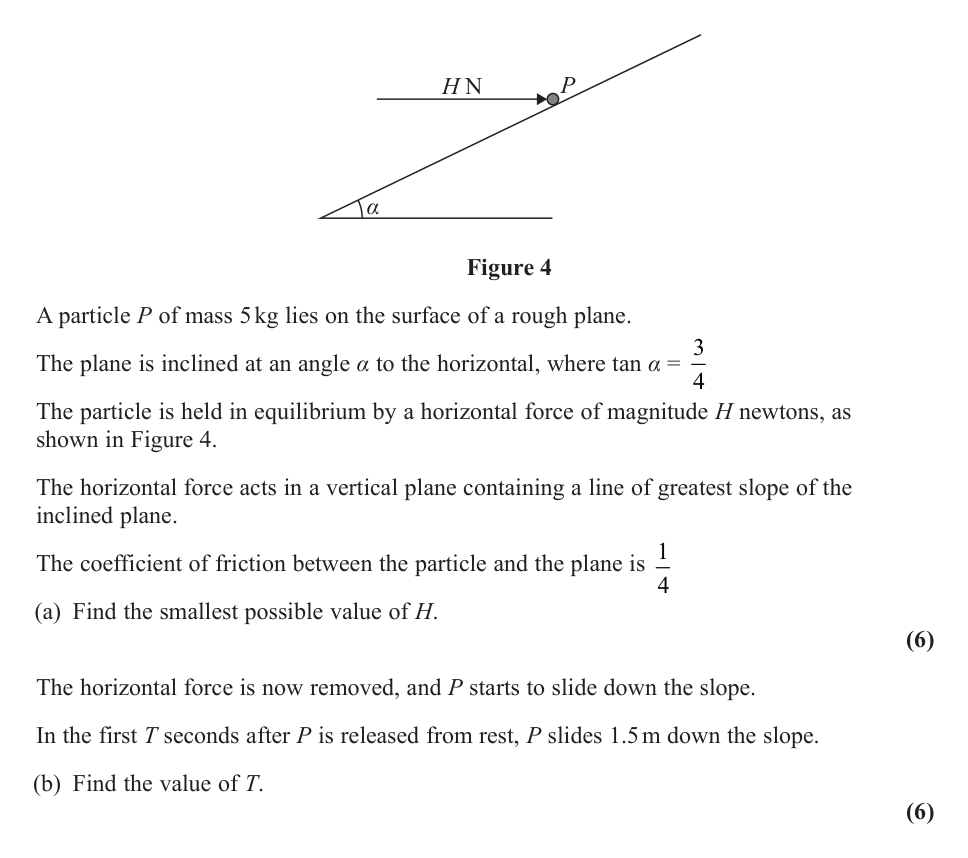
From $\tan\alpha=\dfrac34$, use $\sin\alpha=\dfrac35$ and $\cos\alpha=\dfrac45$.
Resolve perpendicular to the plane
The horizontal force has a component into the plane, so $R=5g\cos\alpha+H\sin\alpha=4g+\dfrac35H$.
Resolve parallel for the smallest H
For the smallest $H$, the particle is on the point of sliding down, so friction acts up the plane. Parallel to the plane, $H\cos\alpha+F=5g\sin\alpha$.
Use friction to find H
With $F=\dfrac14R$, the parallel equation becomes $\dfrac45H+\dfrac14\left(4g+\dfrac35H\right)=3g$. Hence $0.95H+g=3g$, so $H=\dfrac{40g}{19}=20.6\ \mathrm{N}$.
Find the acceleration after H is removed
When $H$ is removed, $R=5g\cos\alpha=4g$ and friction is $\dfrac14R=g$. The component of weight down the plane is $5g\sin\alpha=3g$, so the resultant down the plane is $2g$.
Apply Newtons second law
$2g=5a$, so $a=\dfrac{2g}{5}=3.92\ \mathrm{m\,s^{-2}}$ down the plane.
Find T from the displacement
From rest, the particle moves $1.5$ m with acceleration $2g/5$. Using $s=\dfrac12at^2$: $1.5=\dfrac12\left(\dfrac{2g}{5}\right)T^2=\dfrac{g}{5}T^2$. Thus $T=\sqrt{\dfrac{7.5}{9.8}}=0.875\ \mathrm{s}$.
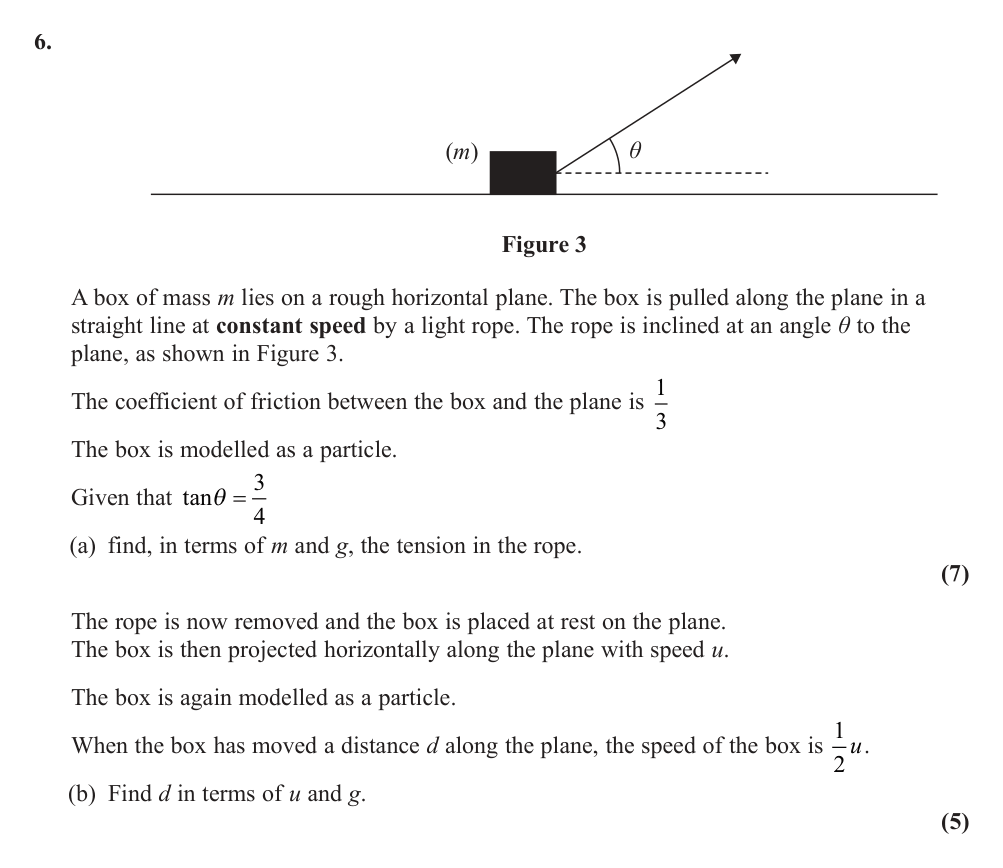
Given $\tan\theta=\dfrac34$, use $\sin\theta=\dfrac35$ and $\cos\theta=\dfrac45$.
Resolve vertically
The box moves at constant speed, so it is in equilibrium. Vertically, $R+T\sin\theta=mg$, hence $R=mg-T\sin\theta$.
Resolve horizontally
Horizontally, the tension component balances friction: $T\cos\theta=F$.
Use friction
With $\mu=\dfrac13$, $F=\dfrac13R$. Therefore $T\cos\theta=\dfrac13(mg-T\sin\theta)$.
Find T
Substitute $\sin\theta=\dfrac35$ and $\cos\theta=\dfrac45$: $\dfrac45T=\dfrac13\left(mg-\dfrac35T\right)$. This gives $\dfrac45T=\dfrac{mg}{3}-\dfrac15T$, so $T=\dfrac{mg}{3}$.
Find the deceleration when the rope is removed
On the horizontal plane without the rope, $R=mg$ and friction is $\dfrac13mg$. Hence the acceleration is $-\dfrac{g}{3}$.
Use SUVAT to find d
When the speed has fallen from $u$ to $\dfrac12u$, use $v^2=u^2+2as$: $\left(\dfrac{u}{2}\right)^2=u^2+2\left(-\dfrac{g}{3}\right)d$.
Solve for d
$\dfrac{u^2}{4}=u^2-\dfrac{2gd}{3}$, so $\dfrac{2gd}{3}=\dfrac{3u^2}{4}$ and $d=\dfrac{9u^2}{8g}$.
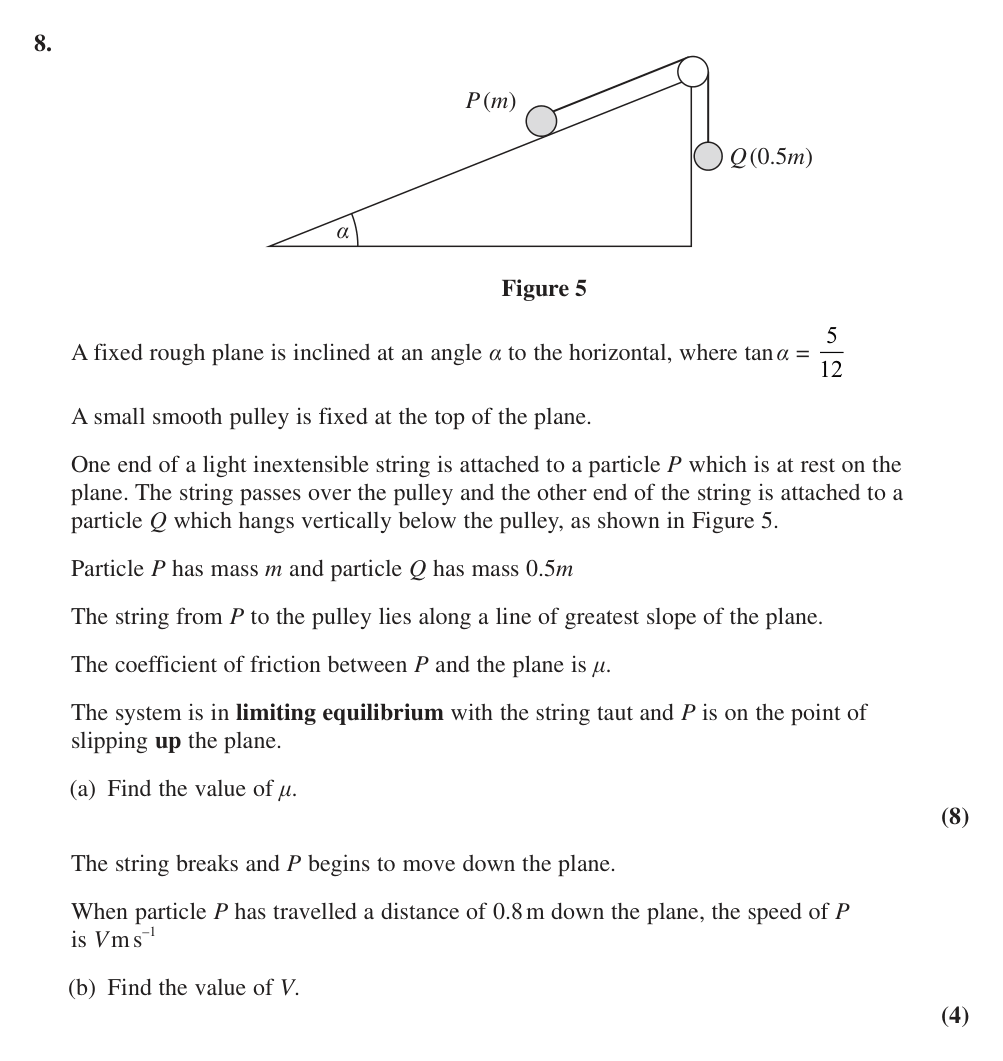
$R=mg\cos\alpha=\dfrac{12}{13}mg$. Since $F=\mu R$, $\mu=\dfrac{3mg/26}{12mg/13}=\dfrac18$.
Find acceleration after the string breaks
P moves down the plane, so friction acts up the plane. The resultant down the plane is $mg\sin\alpha-F=\dfrac{5}{13}mg-\dfrac18\cdot\dfrac{12}{13}mg=\dfrac{7}{26}mg$.
Apply Newtons second law
As P has mass $m$, $a=\dfrac{7g}{26}$ down the plane.
Find V
From rest over $0.8$ m, $V^2=2\left(\dfrac{7g}{26}\right)(0.8)$. With $g=9.8$, $V=2.05\ \mathrm{m\,s^{-1}}$ to 3 significant figures.
Hard12 marks · main topic: ForcesShow worked solution
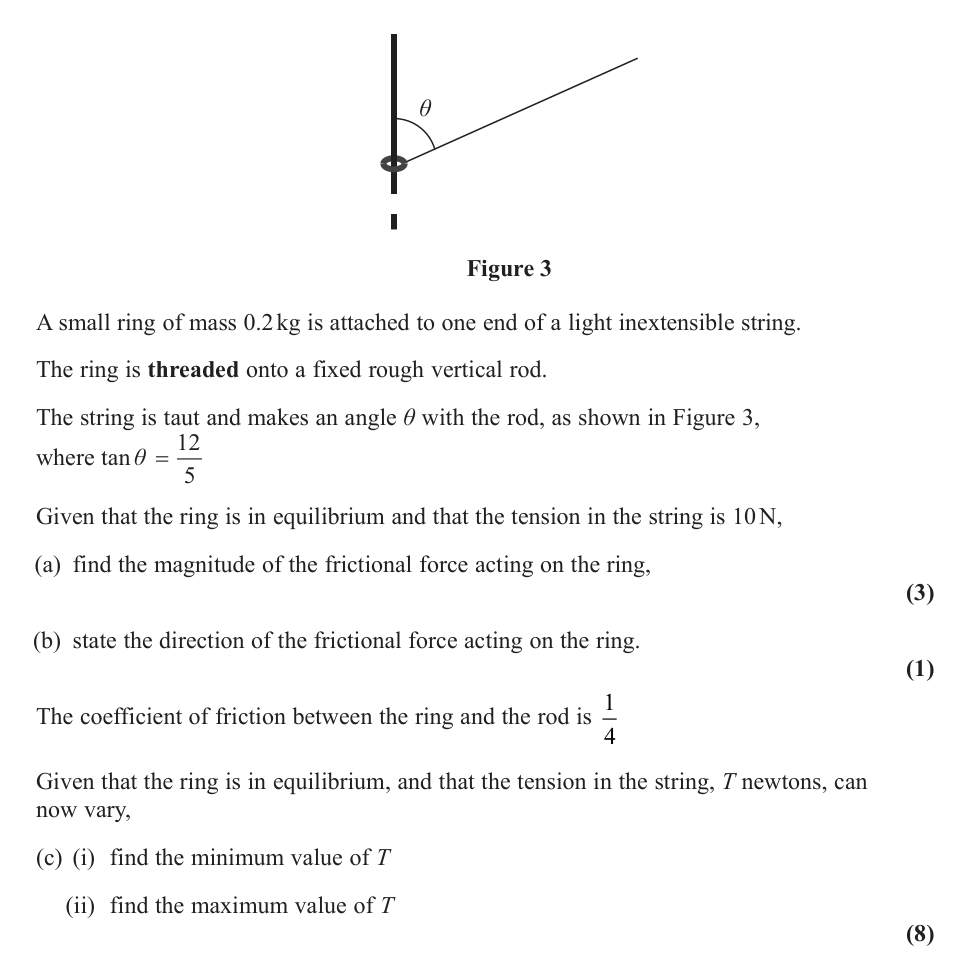
Use the trig ratios
The string makes angle $\theta$ with the vertical rod and $\tan\theta=\dfrac{12}{5}$. Hence $\sin\theta=\dfrac{12}{13}$ and $\cos\theta=\dfrac{5}{13}$.
Find the friction for T = 10
The upward component of the tension is $10\cos\theta=10\cdot\dfrac{5}{13}=\dfrac{50}{13}$ N. The weight is $0.2g=1.96$ N.
Balance vertical forces
Since the upward component of tension is larger than the weight, friction must act downwards. Its magnitude is $\dfrac{50}{13}-1.96=1.89\ldots\ \mathrm{N}$, so $F=1.9\ \mathrm{N}$.
Write the normal reaction
For variable tension $T$, the normal reaction from the rod is produced by the horizontal component of tension: $R=T\sin\theta=\dfrac{12T}{13}$.
Use limiting friction
Since $\mu=\dfrac14$, limiting friction is $F=\mu R=\dfrac14\cdot\dfrac{12T}{13}=\dfrac{3T}{13}$.
Find the minimum tension
For the minimum tension, the ring would tend to slide down, so friction acts upwards. Vertical equilibrium gives $T\cos\theta+F=0.2g$, hence $\dfrac{5T}{13}+\dfrac{3T}{13}=1.96$. Thus $T=3.185\ldots\ \mathrm{N}$, so $T_{\min}=3.2\ \mathrm{N}$.
Find the maximum tension
For the maximum tension, the ring would tend to move up, so friction acts downwards. Vertical equilibrium gives $T\cos\theta=0.2g+F$, hence $\dfrac{5T}{13}=1.96+\dfrac{3T}{13}$. Thus $T=12.74\ldots\ \mathrm{N}$, so $T_{\max}=13\ \mathrm{N}$.
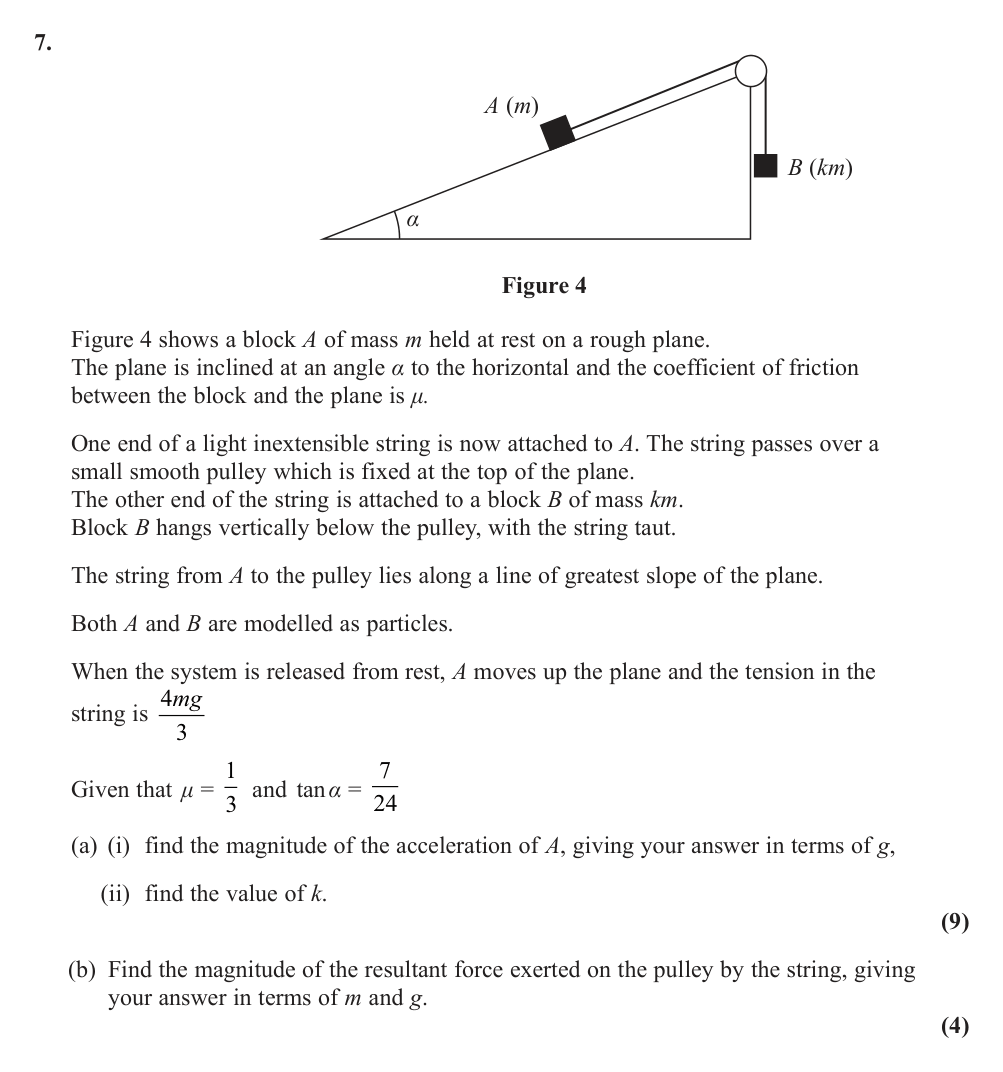
Given $\tan\alpha=\dfrac{7}{24}$, use $\sin\alpha=\dfrac{7}{25}$ and $\cos\alpha=\dfrac{24}{25}$.
Find friction on A
For block A, $R=mg\cos\alpha=\dfrac{24mg}{25}$. Since $\mu=\dfrac13$, friction is $F=\dfrac13R=\dfrac{8mg}{25}$.
Apply Newtons second law to A
A moves up the plane, so friction and the component of weight act down the plane. Taking up the plane as positive: $T-mg\sin\alpha-F=ma$.
Find the acceleration
Substitute $T=\dfrac43mg$, $mg\sin\alpha=\dfrac{7mg}{25}$ and $F=\dfrac{8mg}{25}$: $ma=\dfrac43mg-\dfrac{15mg}{25}=\left(\dfrac43-\dfrac35\right)mg=\dfrac{11mg}{15}$. Hence $a=\dfrac{11g}{15}$.
Apply Newtons second law to B
Block B moves downwards with the same acceleration. Taking downward as positive: $kmg-T=kma$.
Find k
Substitute $T=\dfrac43mg$ and $a=\dfrac{11g}{15}$: $kmg-\dfrac43mg=k m\dfrac{11g}{15}$. Divide by $mg$ to get $k-\dfrac43=\dfrac{11k}{15}$, so $15k-20=11k$ and $k=5$.
Resolve the force on the pulley
The pulley is pulled by two tensions of magnitude $T$. One is vertical and the other is along the plane. The horizontal component of the resultant is $T\cos\alpha$ and the vertical component is $T+T\sin\alpha$.
Find the resultant
The magnitude is $T\sqrt{\cos^2\alpha+(1+\sin\alpha)^2}$. With $\sin\alpha=\dfrac{7}{25}$ and $\cos\alpha=\dfrac{24}{25}$, this is $T\sqrt{\dfrac{576}{625}+\dfrac{1024}{625}}=\dfrac{8T}{5}$. Since $T=\dfrac43mg$, the resultant is $\dfrac{32}{15}mg$.
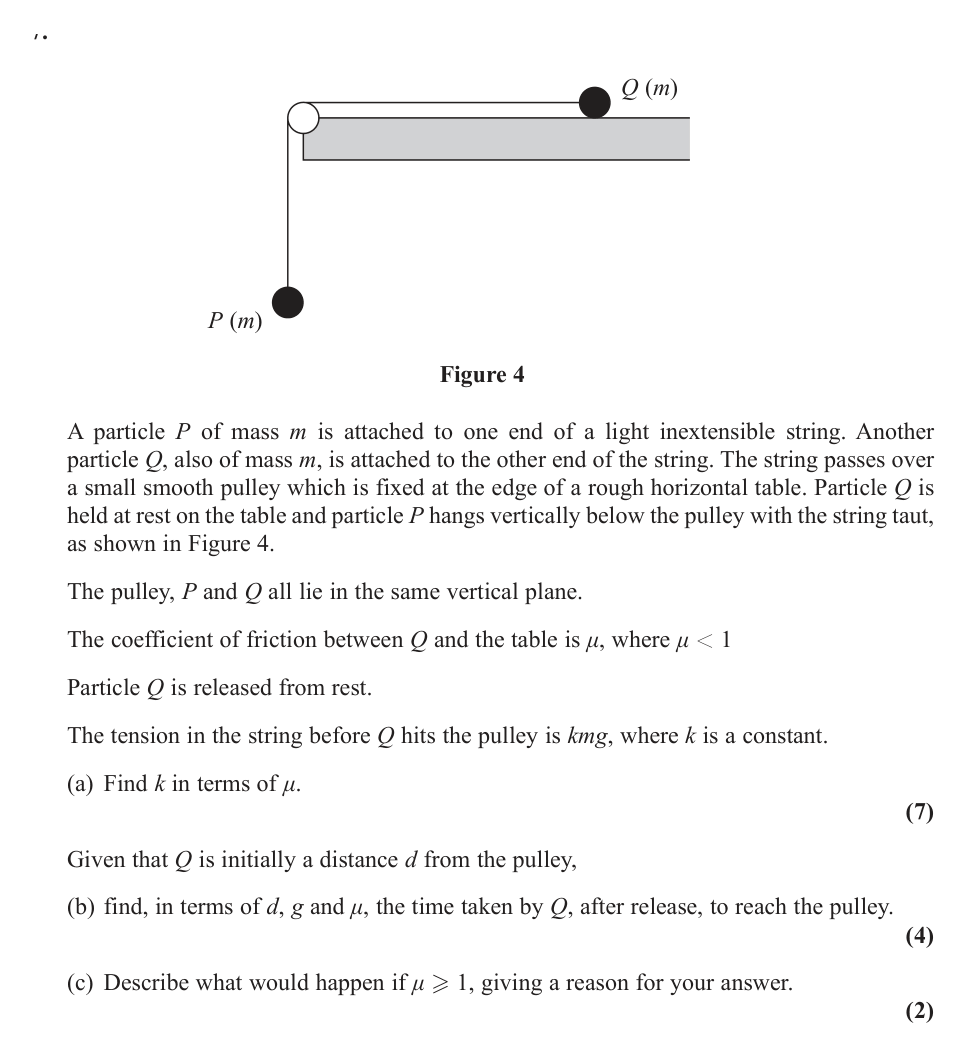
Q starts from rest and travels distance $d$, so $d=\dfrac12at^2=\dfrac12\cdot\dfrac{g(1-\mu)}{2}t^2$.
Find the time
$d=\dfrac{g(1-\mu)t^2}{4}$, so $t=\sqrt{\dfrac{4d}{g(1-\mu)}}$.
Consider mu at least 1
If $\mu\ge1$, the maximum available friction on Q is at least $mg$, so it can balance the pull caused by the hanging particle. The system would not start moving.
Final answer
$(a)\ k=\dfrac{1+\mu}{2}.\quad (b)\ t=\sqrt{\dfrac{4d}{g(1-\mu)}}.\quad (c)$ If $\mu\ge1$, the system would not move because friction can balance the pull from P.
22. WME01/01 January 2022 · Q7
Hard13 marksShow worked solution
Write the equation for Q
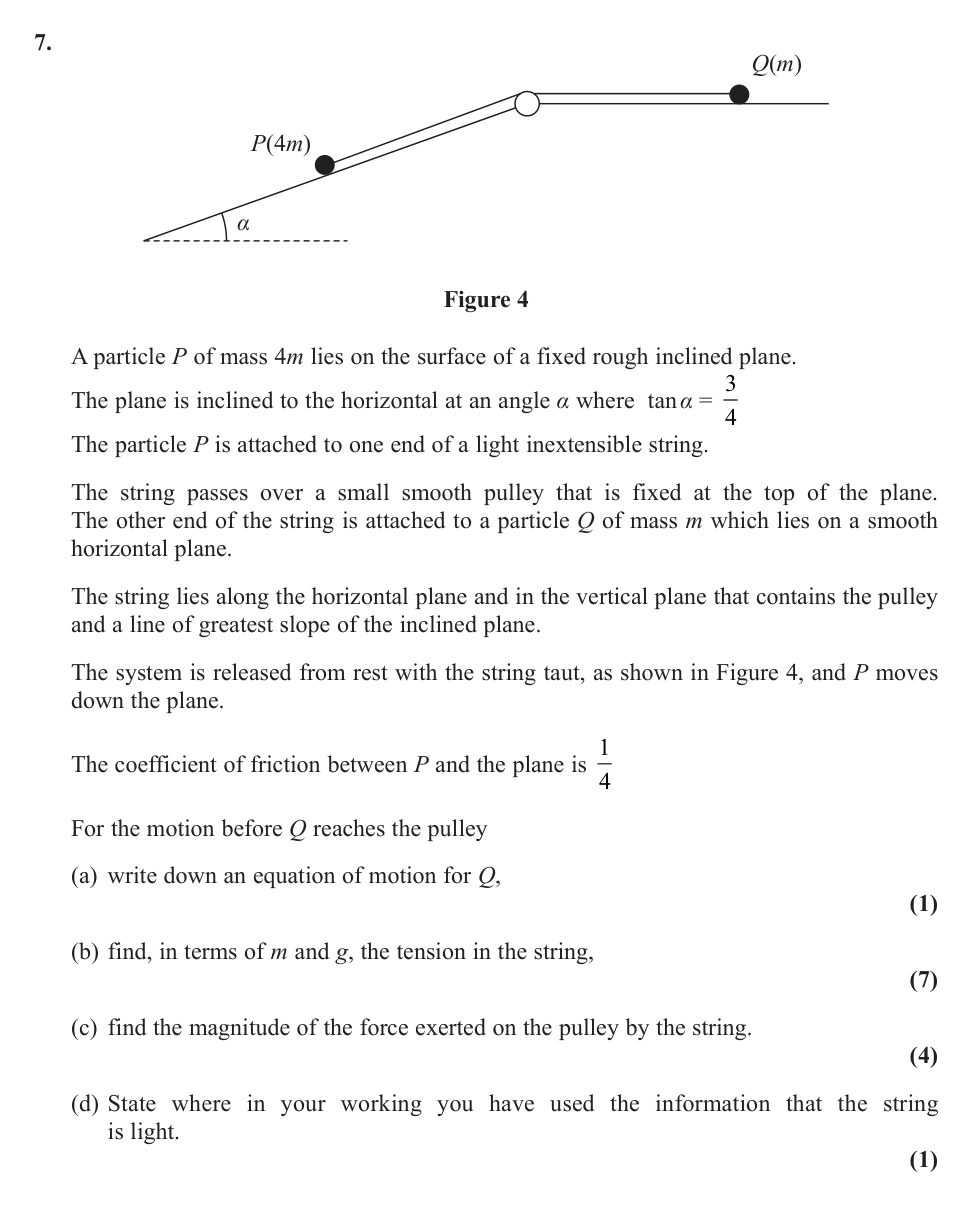
Q lies on a smooth horizontal plane. The only horizontal force on Q is the tension, so $T=ma$.
Use the trig ratios
Since $\tan\alpha=\dfrac34$, $\sin\alpha=\dfrac35$ and $\cos\alpha=\dfrac45$.
Find friction on P
For P, $R=4mg\cos\alpha=4mg\cdot\dfrac45=\dfrac{16mg}{5}$. With coefficient $\dfrac14$, friction is $F=\dfrac14R=\dfrac{4mg}{5}$.
Apply Newtons second law to P
P moves down the plane. Taking down the plane as positive: $4mg\sin\alpha-T-F=4ma$.
Substitute values
$4mg\cdot\dfrac35-T-\dfrac{4mg}{5}=4ma$, so $\dfrac{8mg}{5}-T=4ma$.
Use T = ma
From Q, $a=\dfrac{T}{m}$. Substitute into the equation for P: $\dfrac{8mg}{5}-T=4T$.
Find T
$\dfrac{8mg}{5}=5T$, so $T=\dfrac{8}{25}mg$.
Find the pulley resultant
The pulley is pulled by two tensions of magnitude $T$: one horizontal and one along the inclined string. Their resultant has components $T-T\cos\alpha$ horizontally and $T\sin\alpha$ vertically.
Calculate the resultant
Magnitude $=\sqrt{(T-T\cos\alpha)^2+(T\sin\alpha)^2}=T\sqrt{(1-\tfrac45)^2+(\tfrac35)^2}=\dfrac{T}{5}\sqrt{10}$. With $T=\dfrac{8}{25}mg$, the resultant is $\dfrac{8\sqrt{10}}{125}mg$.
Use the light-string model
The string is light, so the tension can be treated as the same on the P side and the Q side of the pulley.
Final answer
$(a)\ T=ma.\quad (b)\ T=\dfrac{8}{25}mg.\quad (c)\ \text{resultant}=\dfrac{8\sqrt{10}}{125}mg.\quad (d)$ Same tension was used on both sides of the pulley.
23. WME01/01 May/June 2021 · Q6
Hard13 marksShow worked solution
Use the trig ratios
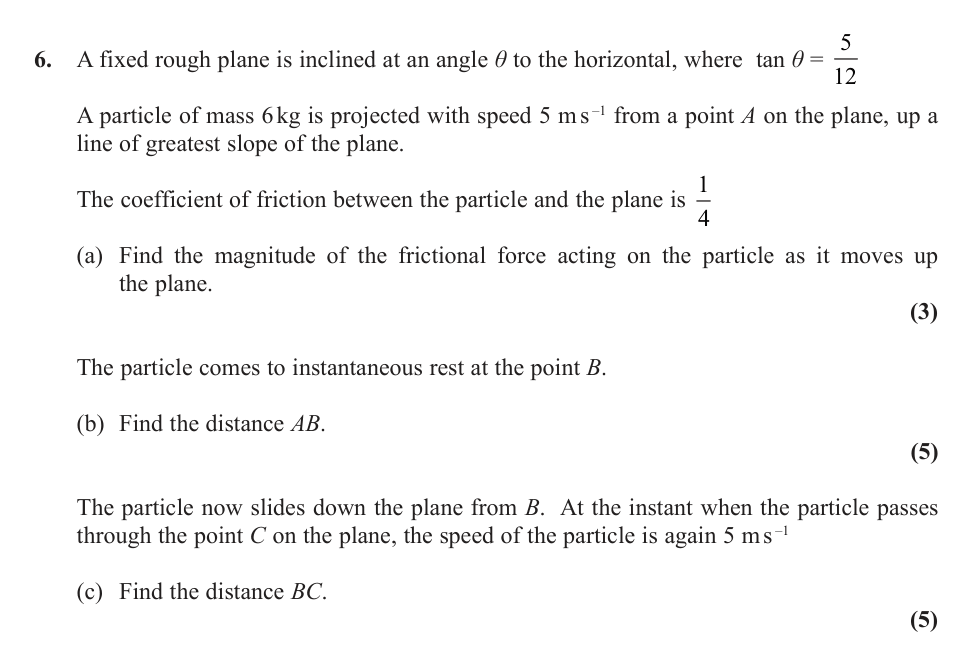
Since $\tan\theta=\dfrac5{12}$, $\sin\theta=\dfrac5{13}$ and $\cos\theta=\dfrac{12}{13}$.
With $\mu=\dfrac14$, $F=\dfrac14R=\dfrac{18g}{13}=13.6\ \mathrm{N}$ approximately.
Find acceleration while moving up
While moving up, both friction and the component of weight act down the plane. Taking up the plane as positive: $6a=-6g\sin\theta-F$.
Simplify the upward acceleration
$6a=-6g\cdot\dfrac5{13}-\dfrac{18g}{13}=-\dfrac{48g}{13}$, so $a=-\dfrac{8g}{13}$.
Find AB
Use $v^2=u^2+2as$ with $u=5$ and $v=0$: $0=25+2\left(-\dfrac{8g}{13}\right)AB$. Hence $AB=2.07\ldots\ \mathrm{m}$.
Find acceleration while sliding down
When sliding down, friction acts up the plane. Taking down the plane as positive: $6a=6g\sin\theta-F=\dfrac{30g}{13}-\dfrac{18g}{13}=\dfrac{12g}{13}$. Thus $a=\dfrac{2g}{13}$.
Find BC
Starting from rest at B and reaching speed $5$ at C: $25=2\left(\dfrac{2g}{13}\right)BC$. Hence $BC=8.29\ldots\ \mathrm{m}$.
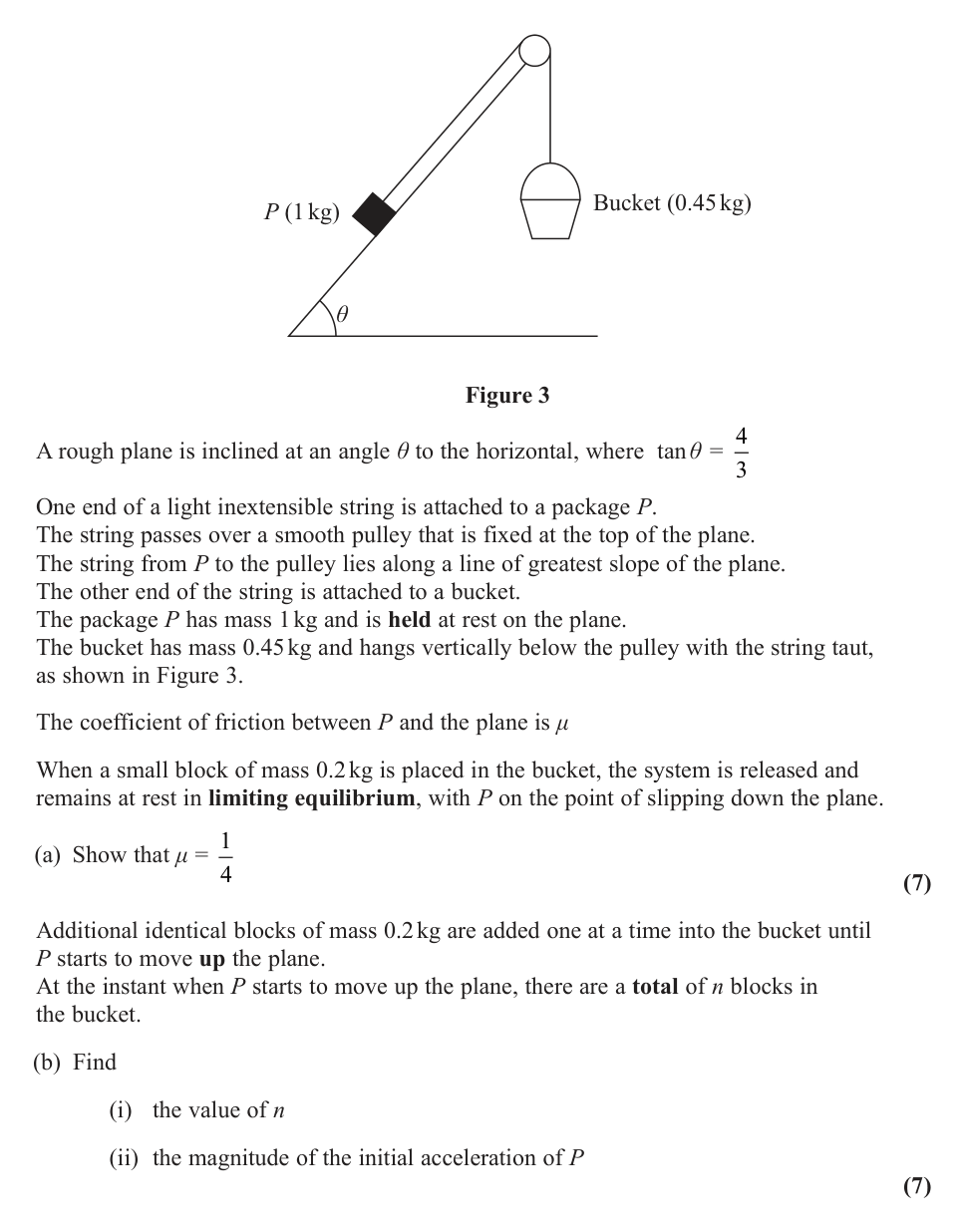
Since $\tan\theta=\dfrac43$, use a $3$-$4$-$5$ triangle: $\sin\theta=\dfrac45$ and $\cos\theta=\dfrac35$.
Use limiting equilibrium in part (a)
With one $0.2$ kg block in the bucket, the bucket side has mass $0.45+0.2=0.65$ kg. Since the package is on the point of slipping down the plane, friction on P acts up the plane.
Find the friction force
The tension equals the bucket weight, so $T=0.65g$. Along the plane for P in equilibrium, $T+F=g\sin\theta$. Hence $0.65g+F=\dfrac45g$, so $F=\dfrac{3g}{20}$.
Find the normal reaction and mu
Perpendicular to the plane, $R=g\cos\theta=\dfrac35g$. Since $F=\mu R$, $\mu=\dfrac{F}{R}=\dfrac{3g/20}{3g/5}=\dfrac14$.
Set the condition for upward motion
When P is about to move up the plane, friction acts down the plane. With $n$ blocks in the bucket, the bucket-side mass is $0.45+0.2n$. The bucket weight must exceed the downslope resistance: $(0.45+0.2n)g>g\sin\theta+\mu R$.
Find n
Using $g\sin\theta=\dfrac45g$ and $\mu R=\dfrac14\cdot\dfrac35g=\dfrac{3g}{20}$, the condition is $0.45+0.2n>\dfrac45+\dfrac{3}{20}=0.95$. Hence $0.2n>0.50$, so $n>2.5$ and the least integer is $n=3$.
Apply Newtons second law after motion begins
For $n=3$, the bucket-side mass is $0.45+0.6=1.05$ kg and the total moving mass is $1+1.05=2.05$ kg. The driving force is $1.05g-\dfrac45g-\dfrac{3g}{20}=0.10g$.
Find the acceleration
Using $F=ma$, $0.10g=2.05a$, so $a=\dfrac{0.10g}{2.05}=\dfrac{2g}{41}=0.478\ \mathrm{m\,s^{-2}}$ to 3 significant figures.
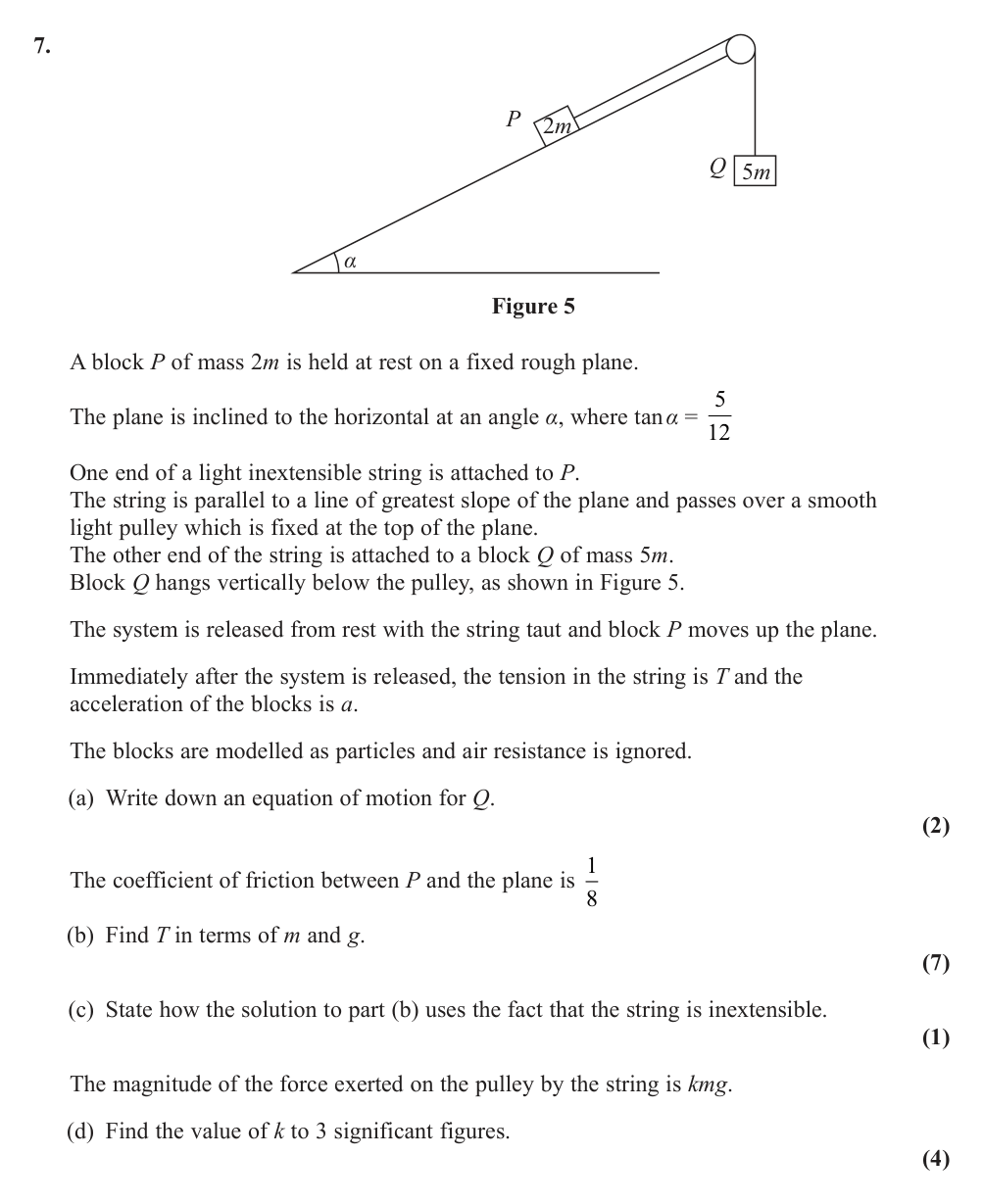
Part (c): State how solution uses fact that string is inextensible
An inextensible string means the string cannot stretch. This has the following consequence: For an inextensible string over a pulley: The magnitude of acceleration of both connected particles must be equal. In this problem: $|a_P| = |a_Q| = a$ How this was used in part (b): When we wrote the equations of motion: ; For P: $T - mg = 2ma$ ; For Q: $5mg - T = 5ma$ We used the same acceleration $a$ for both particles because the string is inextensible. If the string could stretch, the two particles could have different accelerations.
Part (d): Find value of k (force on pulley = kmg) - Identify the angle between tensions
The string from Q is vertical (downward). The string from P is along the plane at angle $\alpha$ to horizontal. Angle between the two strings = $90^\circ + \alpha$
Part (d): Find value of k (force on pulley = kmg) - Use vector components
Let's take horizontal (right) and vertical (up) as positive directions. Tension from Q: ; Horizontal component: $0$ ; Vertical component: $-T = -\frac{15mg}{7}$ (downward) Tension from P along plane: The plane makes angle $\alpha$ with horizontal, so: ; Horizontal component: $-T\cos\alpha = -\frac{15mg}{7} \times \frac{12}{13} = -\frac{180mg}{91}$ ; Vertical component: $T\sin\alpha = \frac{15mg}{7} \times \frac{5}{13} = \frac{75mg}{91}$
Part (d): Find value of k (force on pulley = kmg) - Find resultant
$(a)\ 5mg-T=5ma.\quad (b)\ T=\dfrac{15mg}{7}.\quad (c)\ \text{both particles have the same magnitude of acceleration}.\quad (d)\ k=2.38$.
26. WME01/01 October 2021 · Q7
Hard14 marksShow worked solution
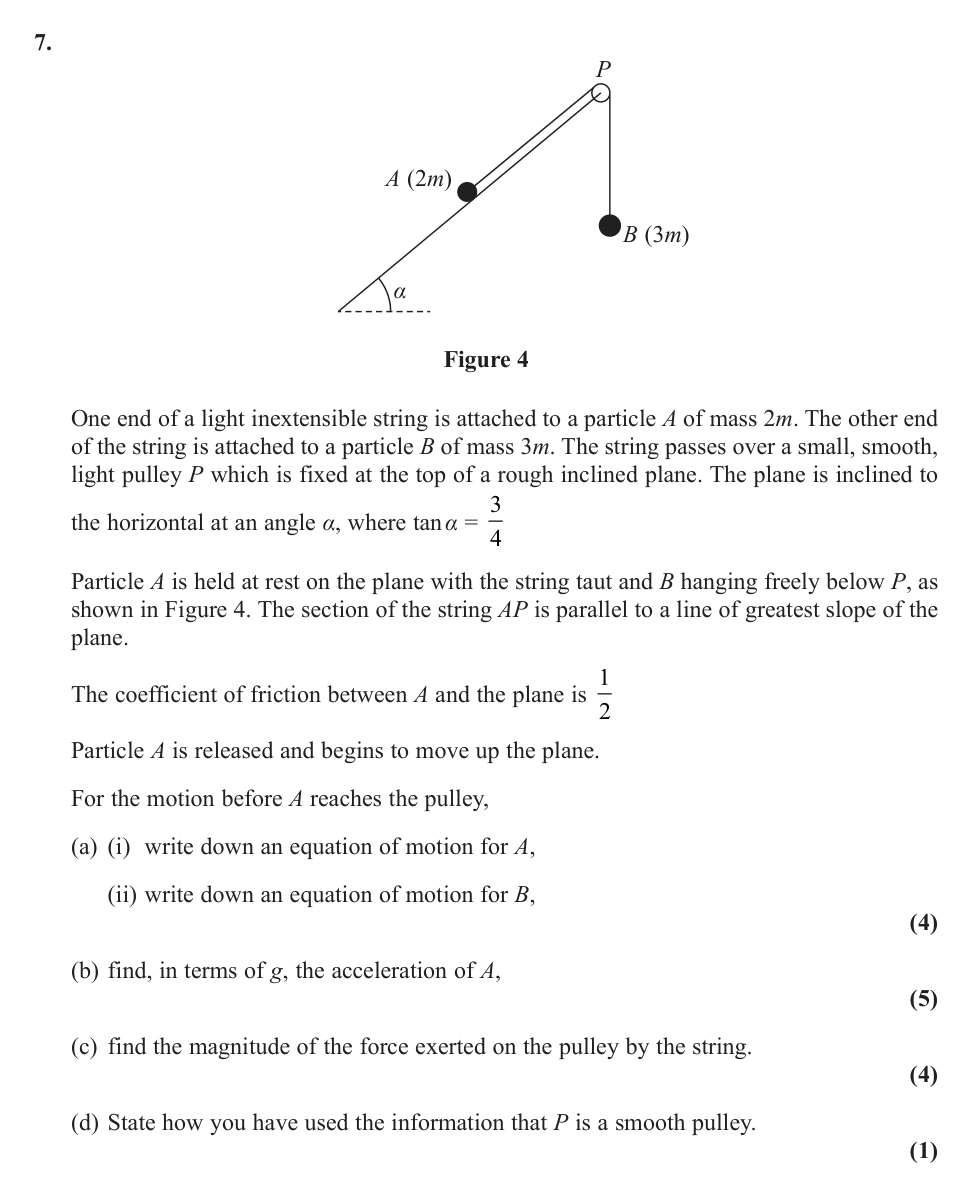
Equation for A
A moves up the plane, so friction and the component of weight act down the plane. Taking up the plane as positive: $T-2mg\sin\alpha-F=2ma$.
Equation for B
B moves downward. Taking downward as positive: $3mg-T=3ma$.
Find friction on A
Since $\tan\alpha=\dfrac34$, $\sin\alpha=\dfrac35$ and $\cos\alpha=\dfrac45$. The normal reaction on A is $R=2mg\cos\alpha=\dfrac{8mg}{5}$, so $F=\dfrac12R=\dfrac{4mg}{5}$.
Simplify A's equation
$T-2mg\cdot\dfrac35-\dfrac{4mg}{5}=2ma$, so $T-2mg=2ma$.
Solve with B's equation
From B, $T=3mg-3ma$. Substitute into $T-2mg=2ma$: $3mg-3ma-2mg=2ma$. Thus $mg=5ma$ and $a=\dfrac{g}{5}$.
Find the tension
Using $3mg-T=3m\left(\dfrac{g}{5}\right)$ gives $T=3mg-\dfrac{3mg}{5}=\dfrac{12mg}{5}$.
Find the pulley resultant
The two tensions are one vertical and one along the plane. Components of the resultant are $T\cos\alpha$ horizontally and $T+T\sin\alpha$ vertically.
Calculate the magnitude
Resultant $=T\sqrt{\cos^2\alpha+(1+\sin\alpha)^2}=T\sqrt{(\tfrac45)^2+(\tfrac85)^2}=\dfrac{4\sqrt5}{5}T$. With $T=\dfrac{12mg}{5}$, this is $\dfrac{48\sqrt5}{25}mg$.
Use the smooth pulley information
The pulley is smooth, so the tension is the same on both sides of the pulley.
Final answer
$(a)(i)\ T-2mg\sin\alpha-F=2ma.\quad (a)(ii)\ 3mg-T=3ma.\quad (b)\ a=\dfrac{g}{5}.\quad (c)\ \text{resultant}=\dfrac{48\sqrt5}{25}mg.\quad (d)$ The tension is the same on both sides of the pulley.
27. WME01/01 May/June 2024 · Q8
Hard15 marksShow worked solution
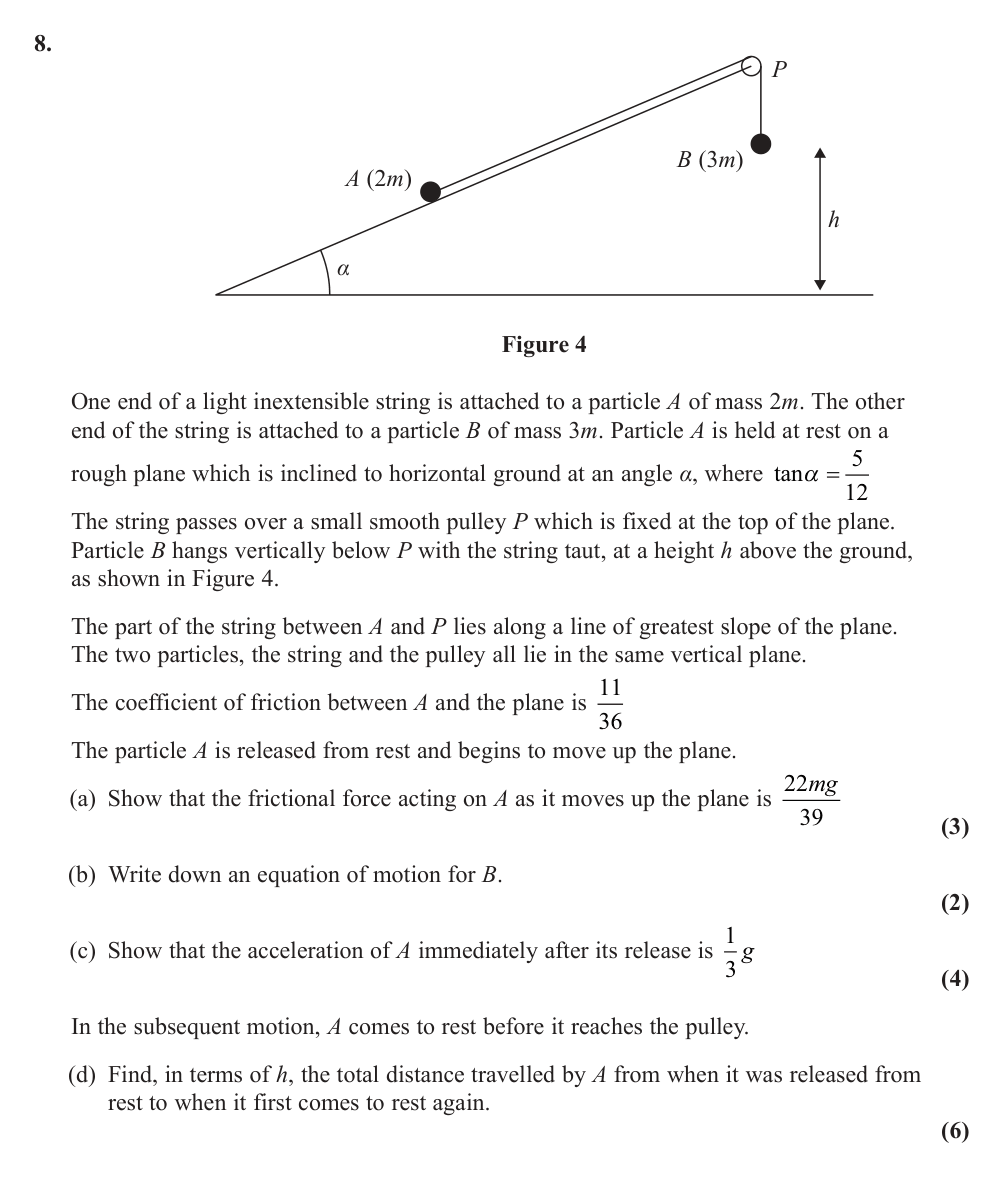
Use the trig ratios
Here $\tan\alpha=\dfrac{5}{12}$, so $\sin\alpha=\dfrac{5}{13}$ and $\cos\alpha=\dfrac{12}{13}$.
Show the frictional force on A
For A, $R=2mg\cos\alpha=2mg\cdot\dfrac{12}{13}=\dfrac{24mg}{13}$. Since $\mu=\dfrac{11}{36}$, $F=\mu R=\dfrac{11}{36}\cdot\dfrac{24mg}{13}=\dfrac{22mg}{39}$.
Write the equation for B
B moves down as A moves up. Taking downward as positive for B: $3mg-T=3ma$.
Write the equation for A
Taking up the plane as positive for A: $T-2mg\sin\alpha-F=2ma$. Substituting $\sin\alpha=\dfrac{5}{13}$ and $F=\dfrac{22mg}{39}$ gives $T-\dfrac{10mg}{13}-\dfrac{22mg}{39}=2ma$.
Show the acceleration
From B, $T=3mg-3ma$. Substitute into A equation: $3mg-3ma-\dfrac{10mg}{13}-\dfrac{22mg}{39}=2ma$. The constant part is $\dfrac{5mg}{3}$, so $\dfrac{5mg}{3}=5ma$ and $a=\dfrac{g}{3}$.
Find the speed when B reaches the ground
While B descends distance $h$, A moves distance $h$ up the plane from rest with acceleration $g/3$. Thus $v^2=2\left(\dfrac{g}{3}\right)h=\dfrac{2gh}{3}$.
Find the later deceleration of A
After B reaches the ground, the string no longer pulls A. The forces down the plane on A are $2mg\sin\alpha+F=\dfrac{10mg}{13}+\dfrac{22mg}{39}=\dfrac{4mg}{3}$. Since A has mass $2m$, its deceleration is $\dfrac{2g}{3}$.
Find the extra distance and total distance
Let the extra distance be $d$. Using $0=v^2-2\left(\dfrac{2g}{3}\right)d$ with $v^2=\dfrac{2gh}{3}$ gives $d=\dfrac{h}{2}$. Total distance travelled by A is $h+\dfrac{h}{2}=\dfrac{3h}{2}$.
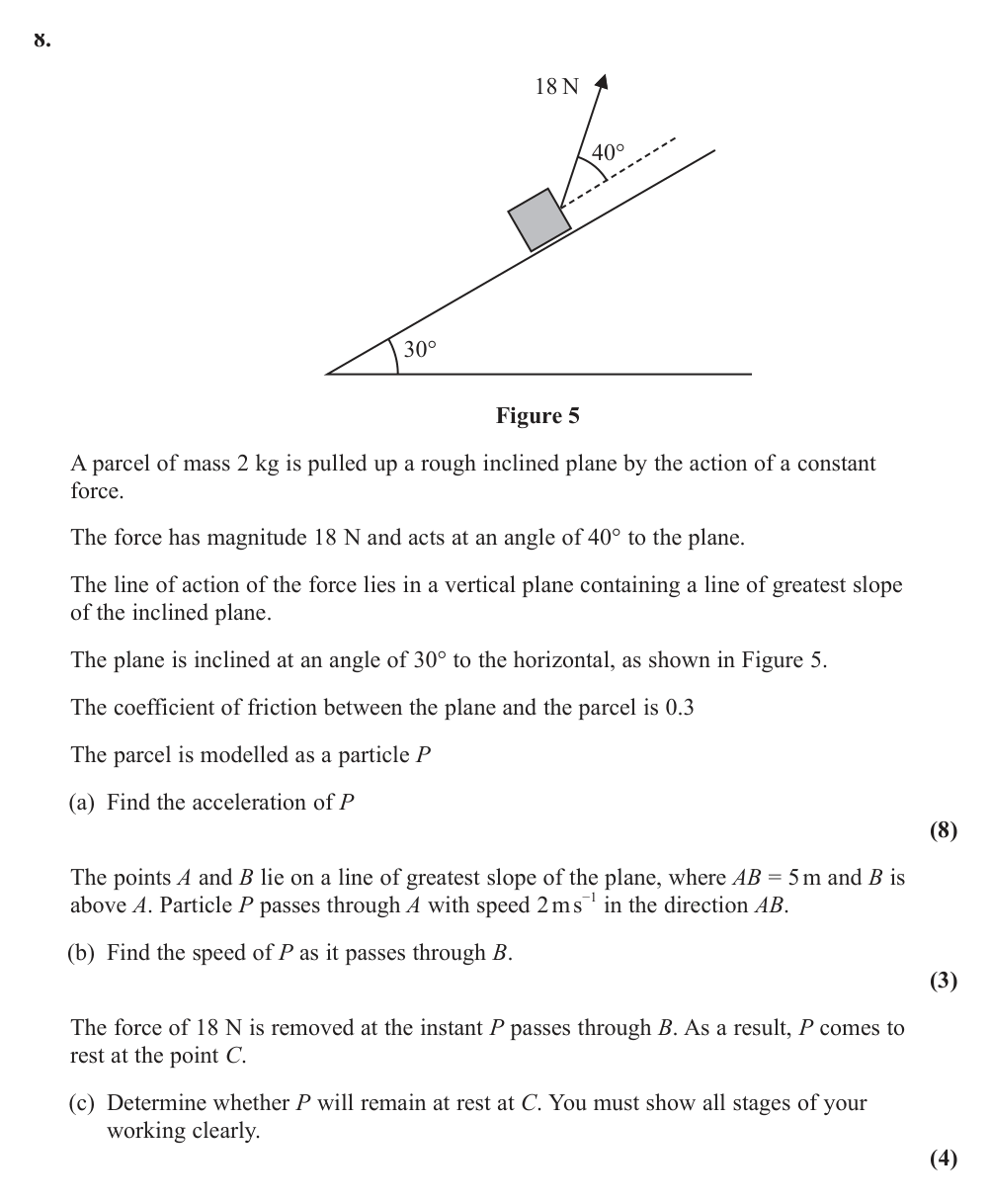
Using $g=9.8$, this gives $a=1.18\ldots\ \mathrm{m\,s^{-2}}$ up the plane.
Find the speed at B
From A to B, $u=2$, $s=5$ and $a=1.18\ldots$. Use $v^2=u^2+2as$: $v^2=2^2+2(1.18\ldots)(5)$.
State the speed
$v=3.98\ldots\ \mathrm{m\,s^{-1}}$, about $4.0\ \mathrm{m\,s^{-1}}$.
Check rest after the force is removed
At C, with the pulling force removed, $R=2g\cos30^\circ$. The maximum friction is $0.3R=0.3(2g\cos30^\circ)=5.09\ldots\ \mathrm{N}$.
Compare with the downslope weight component
The component of weight down the plane is $2g\sin30^\circ=9.8\ \mathrm{N}$. Since $9.8>5.09\ldots$, friction is not large enough to hold P at rest, so P will not remain at rest at C.
Final answer
$(a)\ a=1.18\ \mathrm{m\,s^{-2}}\ \text{up the plane}.\quad (b)\ v=3.98\ \mathrm{m\,s^{-1}}\approx4.0\ \mathrm{m\,s^{-1}}.\quad (c)$ P will not remain at rest at C.
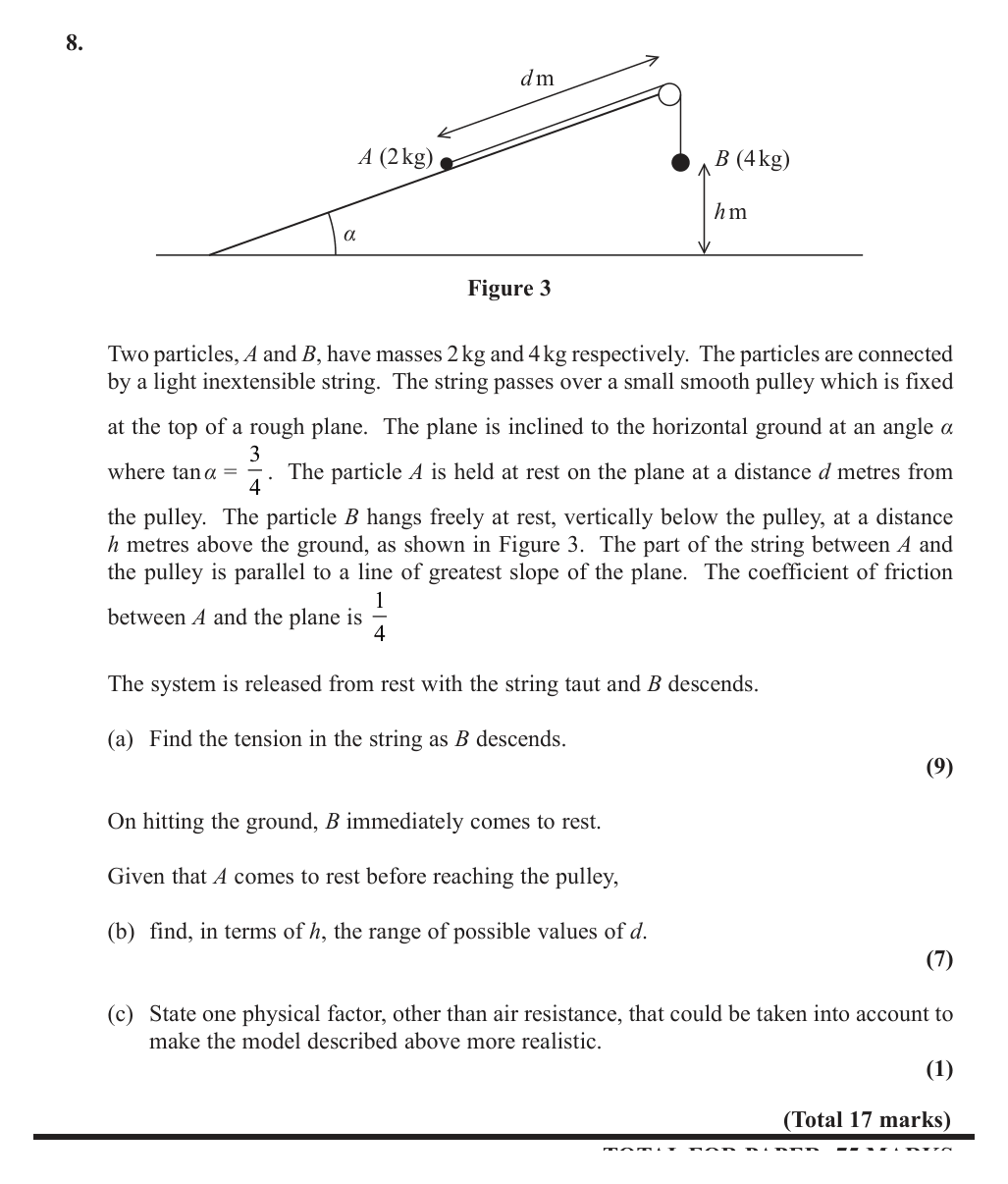
29. WME01/01 January 2021 · Q8
Hard17 marksShow worked solution
Use the trig ratios
Since $\tan\alpha=\dfrac34$, $\sin\alpha=\dfrac35$ and $\cos\alpha=\dfrac45$.
Find friction on A
For A, $R=2g\cos\alpha=\dfrac{8g}{5}$. With coefficient $\dfrac14$, friction is $F=\dfrac14R=\dfrac{2g}{5}$.
Equation for A
A moves up the plane. Taking up the plane as positive: $T-2g\sin\alpha-F=2a$.
Simplify A's equation
$T-2g\cdot\dfrac35-\dfrac{2g}{5}=2a$, so $T-\dfrac{8g}{5}=2a$.
Equation for B
B descends. Taking downward as positive: $4g-T=4a$.
Solve for T
From A, $T=2a+\dfrac{8g}{5}$. From B, $T=4g-4a$. Equating gives $6a=\dfrac{12g}{5}$, so $a=\dfrac{2g}{5}$. Then $T=4g-4\left(\dfrac{2g}{5}\right)=\dfrac{12g}{5}$ N.
Find speed when B reaches the ground
Before B hits the ground, both particles move distance $h$ from rest with acceleration $\dfrac{2g}{5}$. Thus $v^2=2\left(\dfrac{2g}{5}\right)h=\dfrac{4gh}{5}$.
Find extra distance after B stops
After B hits the ground, A continues up the plane. The forces down the plane on A are $2g\sin\alpha+F=\dfrac{6g}{5}+\dfrac{2g}{5}=\dfrac{8g}{5}$, so its deceleration is $\dfrac{4g}{5}$.
Calculate extra distance
Let the extra distance be $s$. Then $0=\dfrac{4gh}{5}-2\left(\dfrac{4g}{5}\right)s$, so $s=\dfrac{h}{2}$.
Find the range for d
A travels total distance $h+\dfrac{h}{2}=\dfrac{3h}{2}$ before stopping. Since it comes to rest before reaching the pulley, $d>\dfrac{3h}{2}$.
Name a more realistic factor
A more realistic model could include friction at the pulley.
Final answer
$(a)\ T=\dfrac{12g}{5}\ \mathrm{N}=23.5\ \mathrm{N}.\quad (b)\ d>\dfrac{3h}{2}.\quad (c)$ A more realistic model could include friction at the pulley.
 Elite Mathematics