Newton's Second Law: past paper questions & worked solutions
Every Newton's Second Law question from the WME01 papers in our bank, 2019–2026, sorted from easiest to hardest. Try each one first, then open the worked solution.
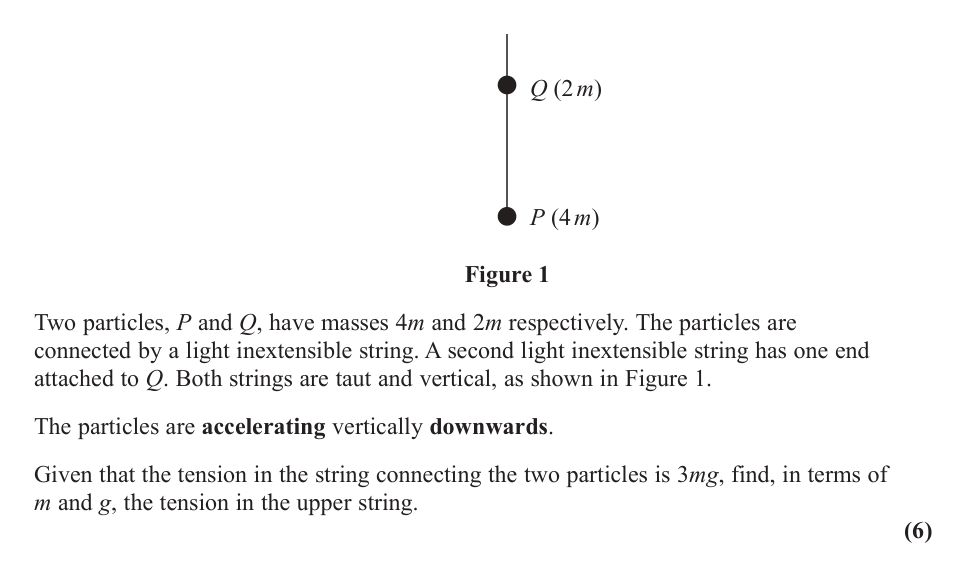
For P, take downward as positive. Its weight is $4mg$ and the tension in the string between P and Q is $3mg$ upward, so $4mg-3mg=4ma$.
Find the acceleration
The equation gives $mg=4ma$, hence $a=\dfrac{g}{4}$ downward.
Write the equation for Q
For Q, downward forces are its weight $2mg$ and the lower string tension $3mg$. The upper string tension $T$ acts upward. Taking downward as positive: $2mg+3mg-T=2ma$.
Easy6 marks · main topic: MomentsShow worked solution
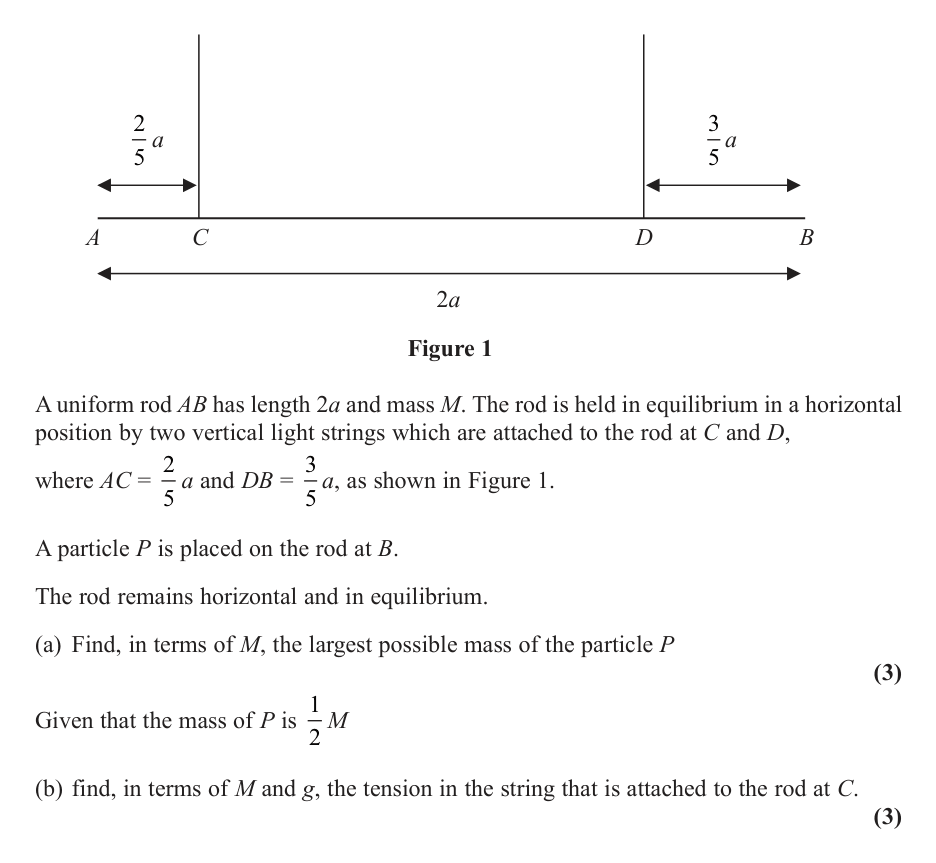
Set the distances
The rod length is $2a$. The centre of mass is at the midpoint, distance $a$ from A. Also $AC=\dfrac{2a}{5}$ and $AD=2a-\dfrac{3a}{5}=\dfrac{7a}{5}$.
Use the largest mass condition
For the largest possible mass at B, the string at C is just slack and the rod is about to tilt about D.
Take moments about D
Let the particle mass be $X$. The distance from D to B is $\dfrac{3a}{5}$ and the distance from D to the rod's centre of mass is $\dfrac{2a}{5}$. Hence $Xg\left(\dfrac{3a}{5}\right)=Mg\left(\dfrac{2a}{5}\right)$.
Find the largest mass
Cancel $ga/5$: $3X=2M$, so $X=\dfrac{2M}{3}$.
Use the given mass
Now the particle has mass $\dfrac12M$. Let the tensions at C and D be $T_C$ and $T_D$.
Take moments about D
About D, $T_C(a)+\dfrac12Mg\left(\dfrac{3a}{5}\right)=Mg\left(\dfrac{2a}{5}\right)$.
Find the tension at C
$T_Ca+\dfrac{3}{10}Mga=\dfrac{2}{5}Mga$, so $T_C=\dfrac{1}{10}Mg$.
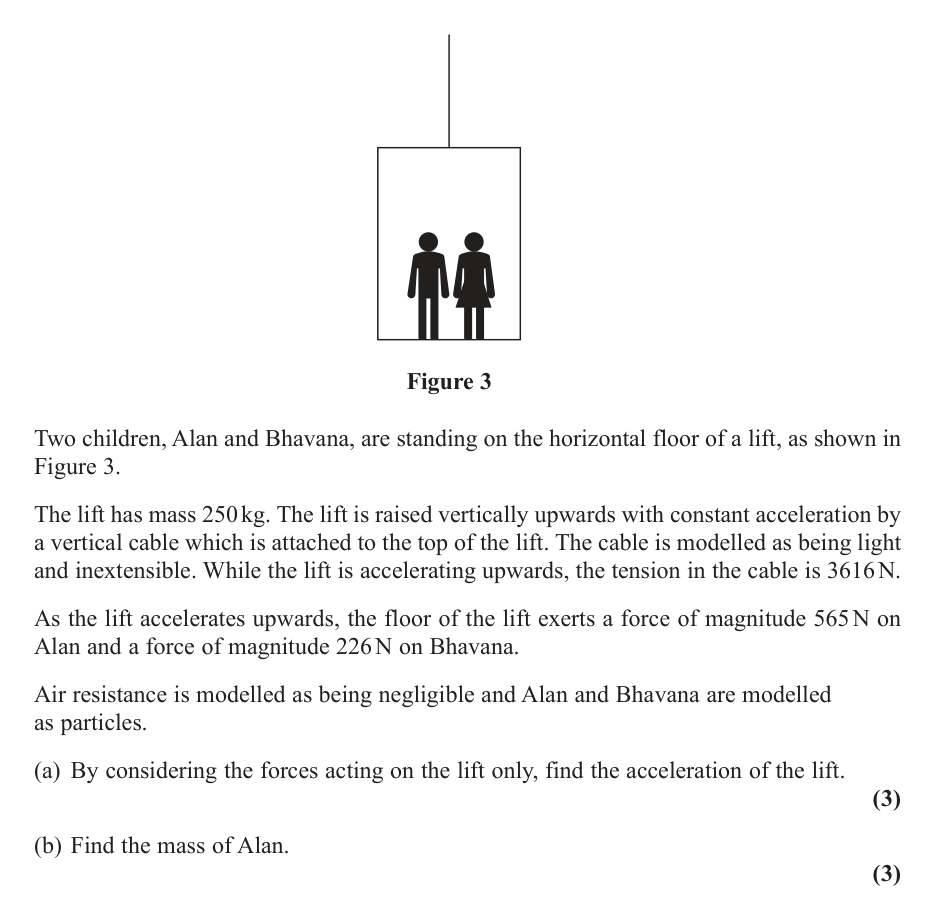
For the lift, the upward force is the cable tension $3616$ N. Downward forces on the lift are its own weight $250g$ and the contact forces from Alan and Bhavana, $565$ N and $226$ N.
Apply Newtons second law
Taking upward as positive: $3616-250g-565-226=250a$.
Find the acceleration
$3616-2450-565-226=250a$, so $375=250a$ and $a=1.5\ \mathrm{m\,s^{-2}}$.
Consider Alan
Let Alan's mass be $m_A$. The upward force on Alan is $565$ N and his weight is $m_Ag$.
Find Alan's mass
$565-m_Ag=m_A(1.5)$, so $565=m_A(9.8+1.5)=11.3m_A$. Hence $m_A=50\ \mathrm{kg}$.
Final answer
$(a)\ a=1.5\ \mathrm{m\,s^{-2}}.\quad (b)\ \text{mass of Alan}=50\ \mathrm{kg}$.
6. WME01/01 May/June 2021 · Q4
Easy6 marksShow worked solution
Find total mass going up
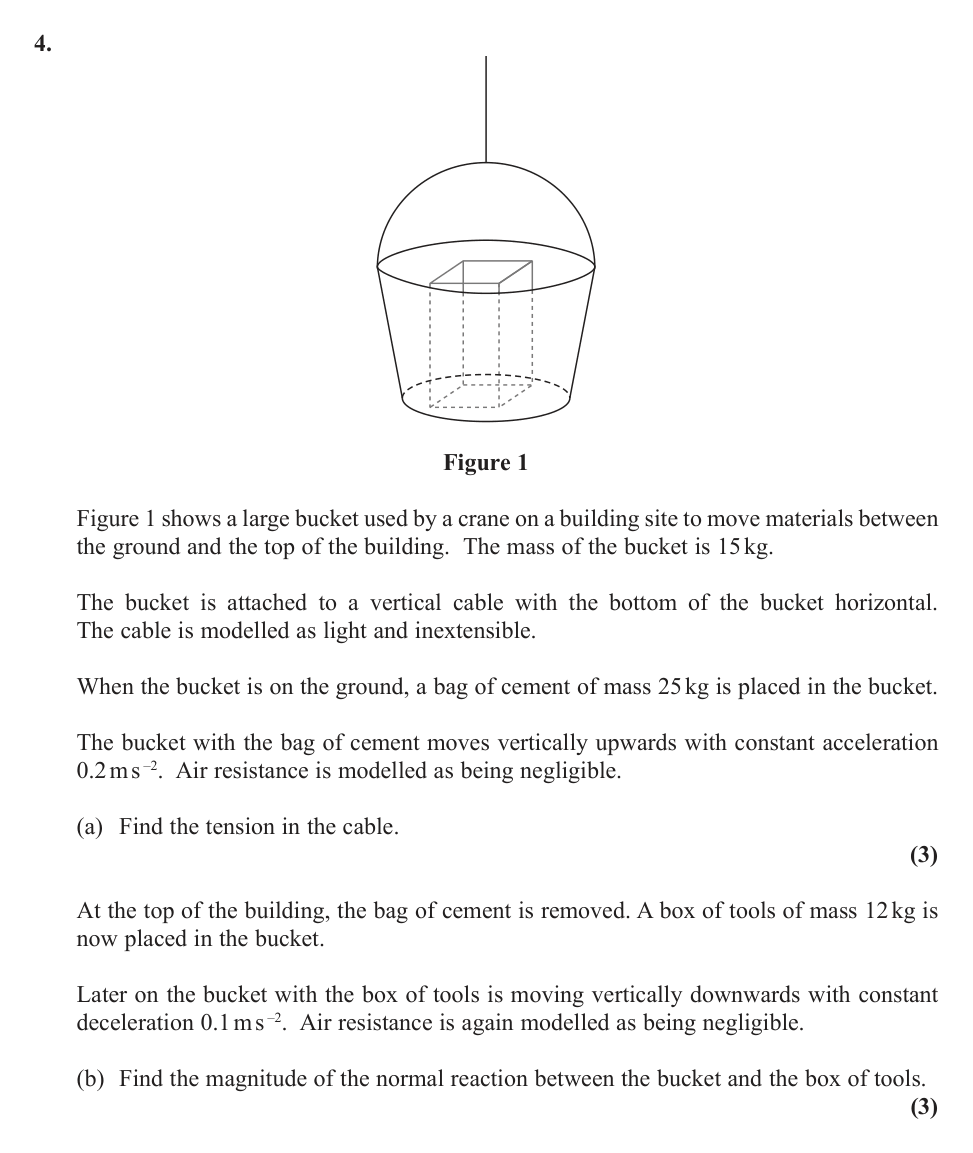
The bucket and cement have total mass $15+25=40$ kg and acceleration $0.2\ \mathrm{m\,s^{-2}}$ upward.
Apply Newtons second law
Taking upward as positive: $T-40g=40(0.2)$.
Find the tension
$T-392=8$, so $T=400\ \mathrm{N}$.
Interpret the downward deceleration
The bucket and tools are moving downward but decelerating, so their acceleration is upward with magnitude $0.1\ \mathrm{m\,s^{-2}}$.
Consider the box of tools
For the $12$ kg box, upward force is the normal reaction $R$, and downward force is weight $12g$.
Find R
$R-12g=12(0.1)$. Thus $R=117.6+1.2=118.8\ \mathrm{N}$, about $119\ \mathrm{N}$.
Medium7 marks · main topic: MomentsShow worked solution
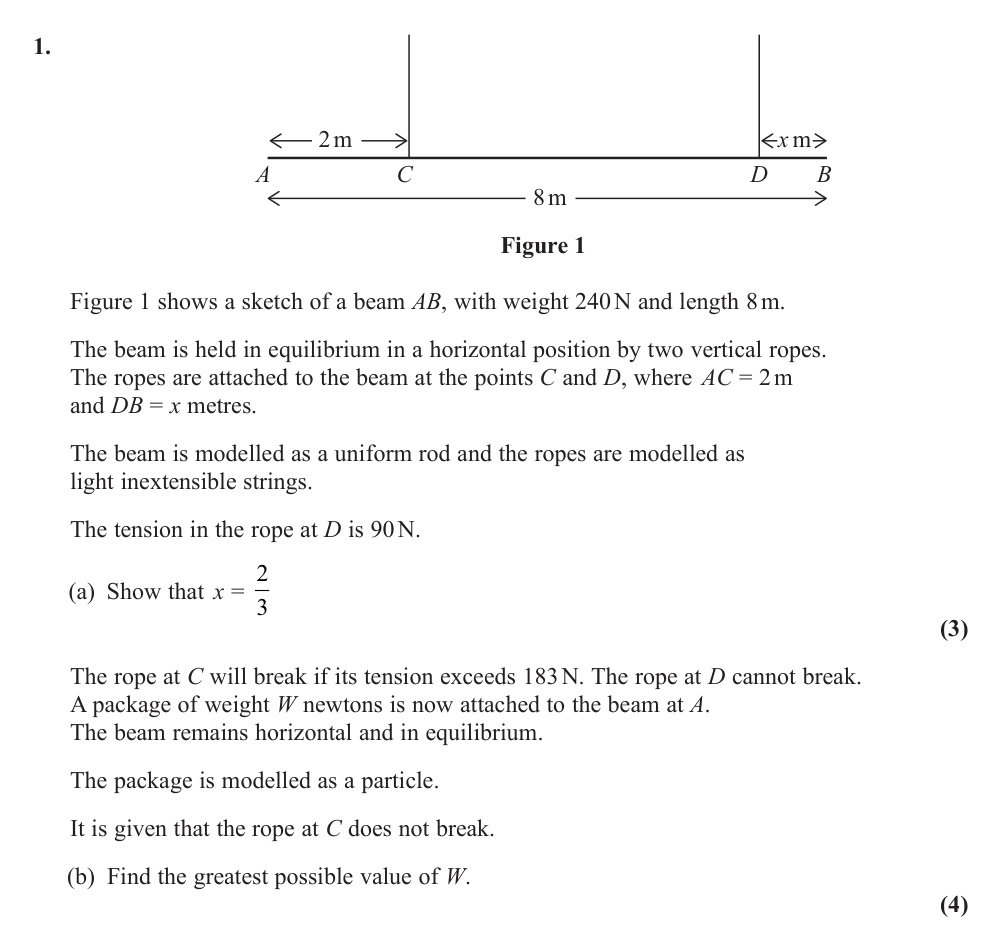
Part (a): Show that x = 2/3 - Identify distances from C
From the diagram: ; Distance AC = 2 m ; Distance CD = 8 - 2 - x = (6-x) m ; Distance from A to center = 4 m, so distance from C to center = 4 - 2 = 2 m
Part (a): Show that x = 2/3 - Take moments about C
The cable is inextensible, so the tractor and block move together with the same acceleration.
Final answer
$(a)\ R=5600\ \mathrm{N}.\quad (b)$ The tractor and block have the same acceleration.
14. WME01/01 January 2020 · Q2
Medium7 marks · main topic: MomentsShow worked solution
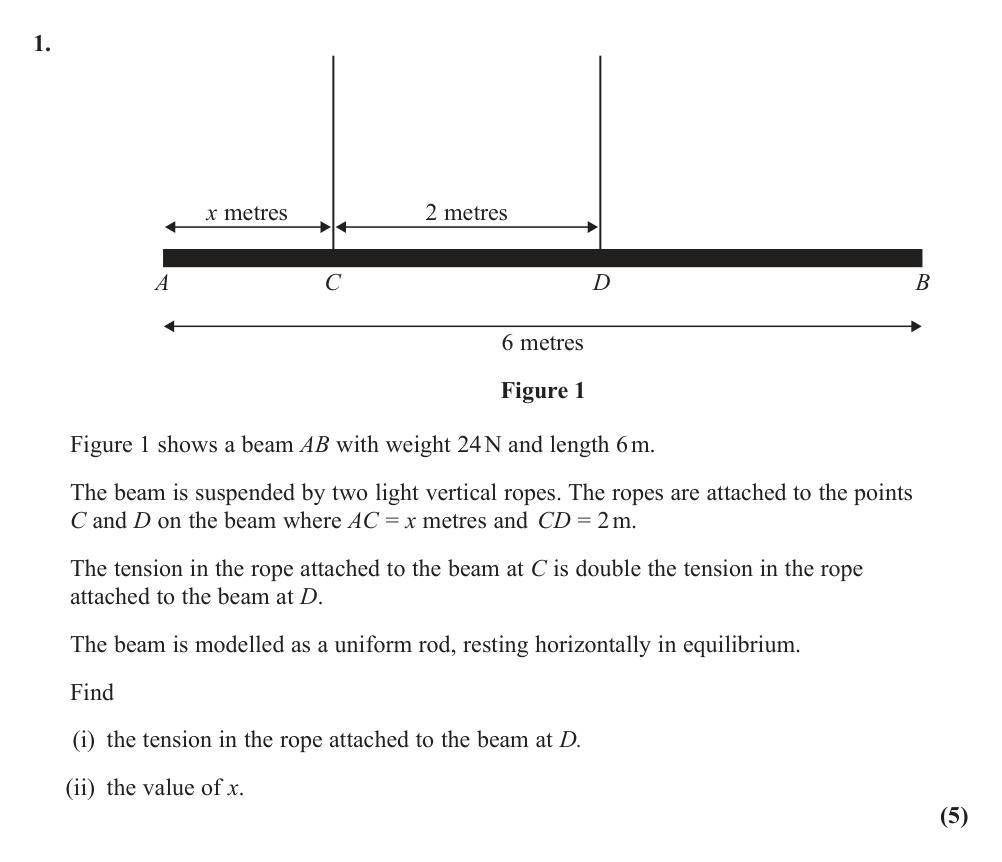
Set the tensions
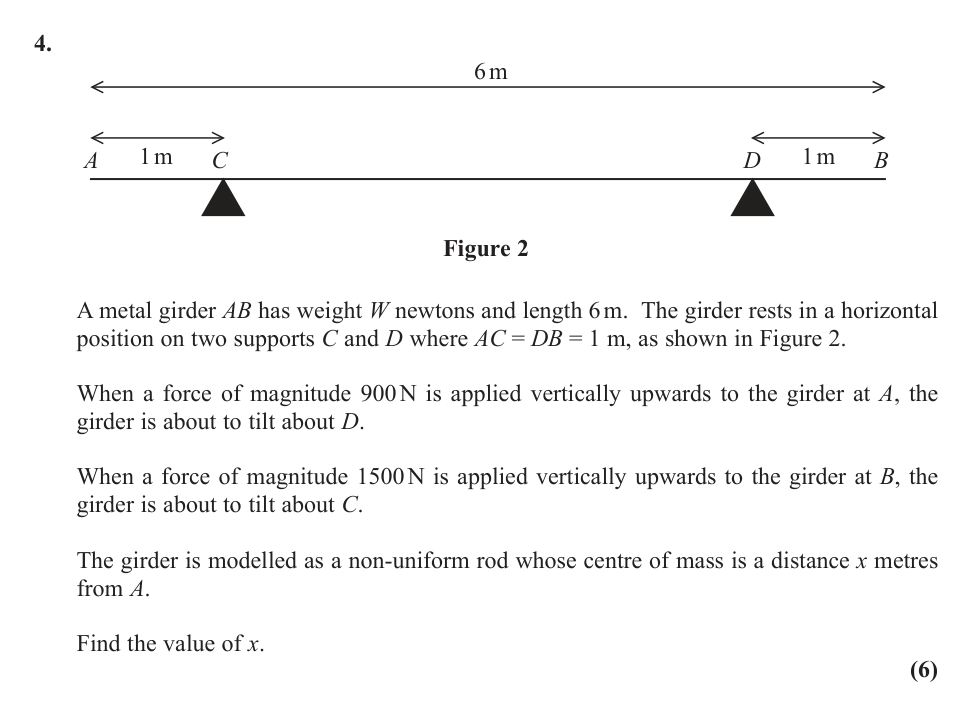
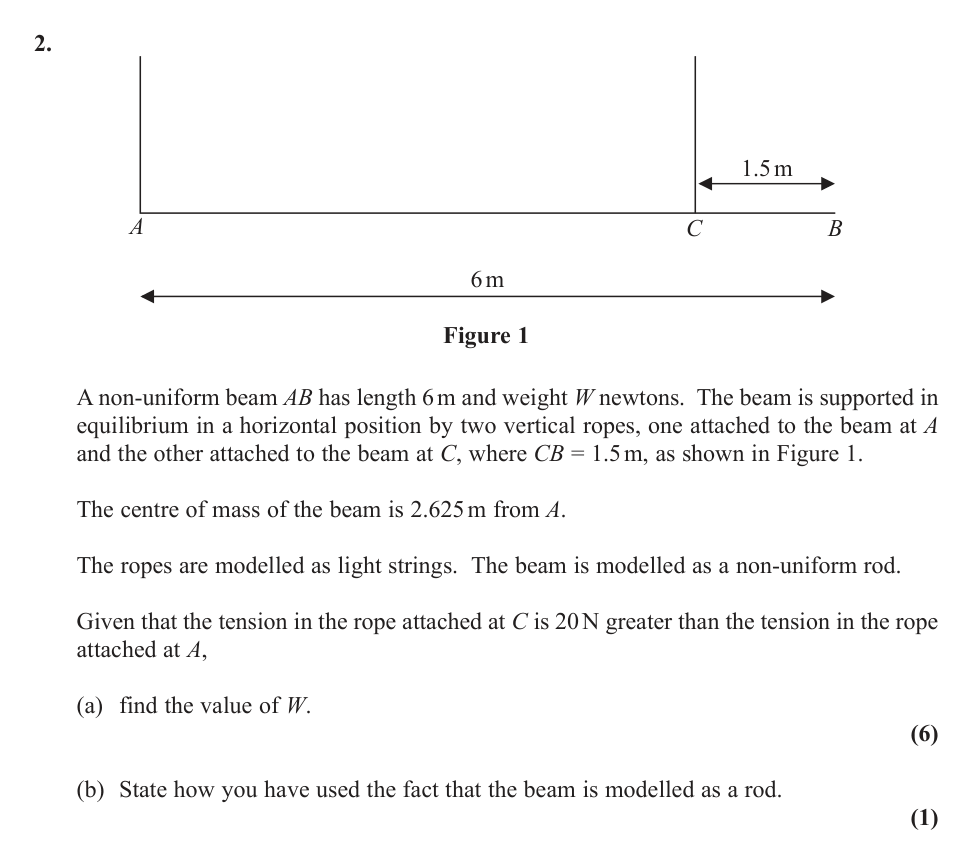
Let the tension at A be $T$. The tension at C is then $T+20$. Since $CB=1.5$ m and $AB=6$ m, $AC=4.5$ m.
Use vertical equilibrium
The upward tensions balance the weight: $T+(T+20)=W$, so $2T+20=W$.
Take moments about A
The centre of mass is $2.625$ m from A. Taking moments about A gives $4.5(T+20)=2.625W$.
Solve for W
From the moments equation, $T+20=\dfrac{2.625}{4.5}W=\dfrac{7}{12}W$. Also $T+20=\dfrac{W+20}{2}$. Hence $\dfrac{W+20}{2}=\dfrac{7W}{12}$, so $6W+120=7W$ and $W=120$ N.
State the modelling use
Modelling the beam as a rod means it stays straight and rigid, so the distances used in the moments equations do not change.
Final answer
$(a)\ W=120\ \mathrm{N}.\quad (b)$ The rod model keeps the beam straight and rigid, so the stated distances along the beam are fixed.
15. WME01/01 October 2019 · Q3
Medium7 marksShow worked solution
Use the trailer to find acceleration
For the trailer, take up the road as positive. The forces along the road are tension $2060$ N up the road, resistance $300$ N down the road, and weight component $400g\sin\alpha$ down the road.
Form the trailer equation
$2060-300-400g\sin\alpha=400a$. Since $\sin\alpha=\dfrac17$, this becomes $2060-300-400g\cdot\dfrac17=400a$.
Find the acceleration
Using $g=9.8$, $400g\cdot\dfrac17=560$. Hence $1200=400a$ and $a=3\ \mathrm{m\,s^{-2}}$.
Apply Newton's second law to the car
For the car: $D-420-800g\sin\alpha-2060=800a$.
Find the driving force
$D-420-800g\cdot\dfrac17-2060=800(3)$. Since $800g\cdot\dfrac17=1120$, $D=420+1120+2060+2400=6000$ N.
Final answer
$D=6000\ \mathrm{N}$.
16. WME01/01 January 2026 · Q3
Medium8 marks · main topic: ForcesShow worked solution
Add the three forces
The resultant force is $(2p\mathbf{i}-3p\mathbf{j})+(q\mathbf{i}+\mathbf{j})+(3\mathbf{i}-q\mathbf{j})=(2p+q+3)\mathbf{i}+(-3p+1-q)\mathbf{j}$.
Use the direction vector
The resultant acts in the direction $4\mathbf{i}-5\mathbf{j}$, so the ratio of the components is the same: $\dfrac{-3p+1-q}{2p+q+3}=\dfrac{-5}{4}$.
Show the required relation
Cross-multiplying gives $4(-3p+1-q)=-5(2p+q+3)$. Therefore $-12p+4-4q=-10p-5q-15$, so $2p-q=19$.
Find q when p is 7
With $p=7$, the relation gives $14-q=19$, hence $q=-5$.
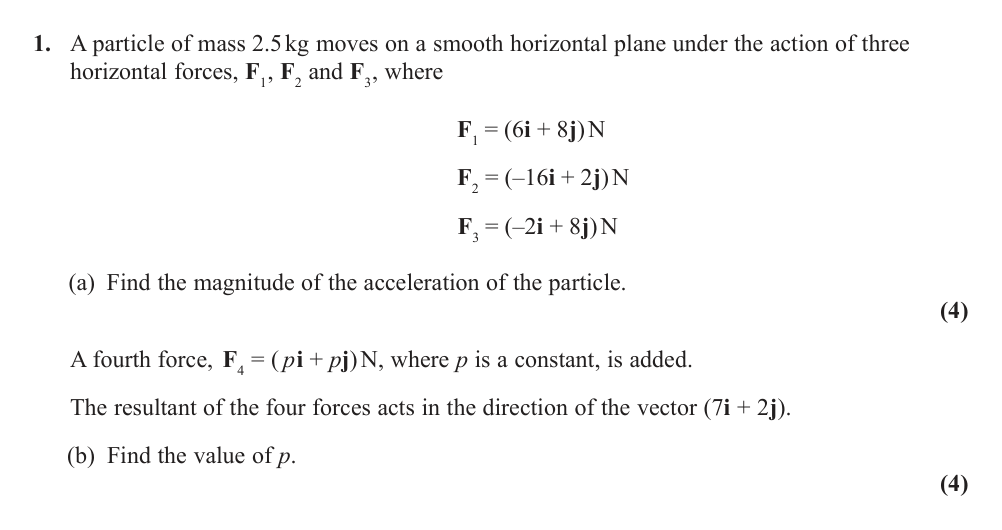
Apply Newtons second law
Substitute $p=7$ and $q=-5$ into the resultant: $\mathbf{F}=12\mathbf{i}-15\mathbf{j}$. Since the mass is $0.5$ kg, $\mathbf{F}=m\mathbf{a}$ gives $12\mathbf{i}-15\mathbf{j}=0.5\mathbf{a}$.
Find the acceleration
Dividing by $0.5$ gives $\mathbf{a}=24\mathbf{i}-30\mathbf{j}\ \mathrm{m\,s^{-2}}$.
The mass is $2.5$ kg, so $-12\mathbf{i}+18\mathbf{j}=2.5\mathbf{a}$. Hence $\mathbf{a}=-4.8\mathbf{i}+7.2\mathbf{j}\ \mathrm{m\,s^{-2}}$.
Find the magnitude of the acceleration
$|\mathbf{a}|=\sqrt{(-4.8)^2+7.2^2}=8.653\ldots$, so the magnitude is $8.7\ \mathrm{m\,s^{-2}}$ to 2 significant figures. Exactly, $|\mathbf{a}|=\dfrac{12\sqrt{13}}{5}$.
Add the fourth force
With $\mathbf{F}_4=p\mathbf{i}+p\mathbf{j}$, the new resultant is $(p-12)\mathbf{i}+(p+18)\mathbf{j}$.
Use the given direction
The resultant acts in the direction $7\mathbf{i}+2\mathbf{j}$, so $\dfrac{p-12}{p+18}=\dfrac{7}{2}$.
Solve for p
$2(p-12)=7(p+18)$, so $2p-24=7p+126$. Therefore $-150=5p$ and $p=-30$.
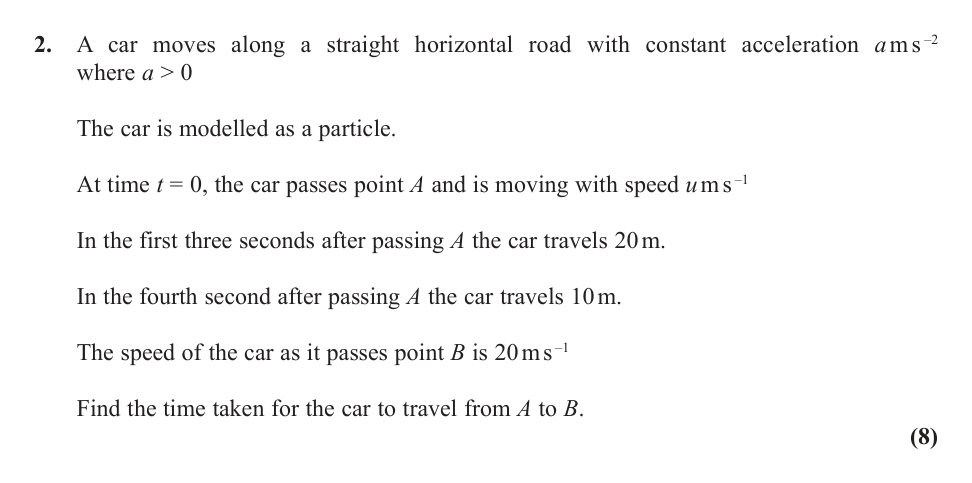
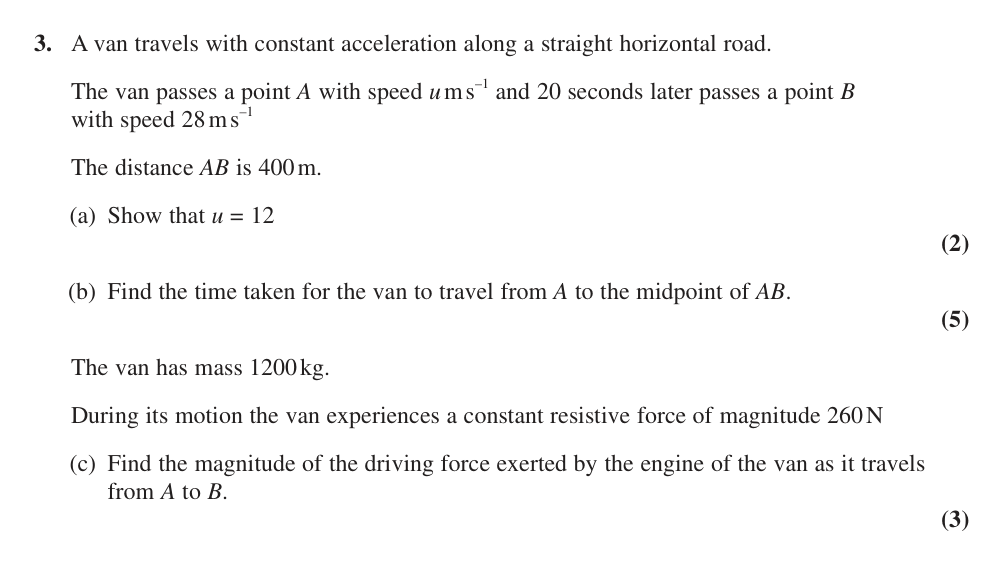
At B, speed is $20$. Use $v=u+at$: $20=\dfrac{25}{6}+\dfrac53t$.
Find the time
$\dfrac53t=20-\dfrac{25}{6}=\dfrac{95}{6}$, so $t=\dfrac{95}{10}=9.5\ \mathrm{s}$.
Final answer
$t=9.5\ \mathrm{s}$.
21. WME01/01 October 2019 · Q5
Medium8 marks · main topic: MomentsShow worked solution
Locate the key distances
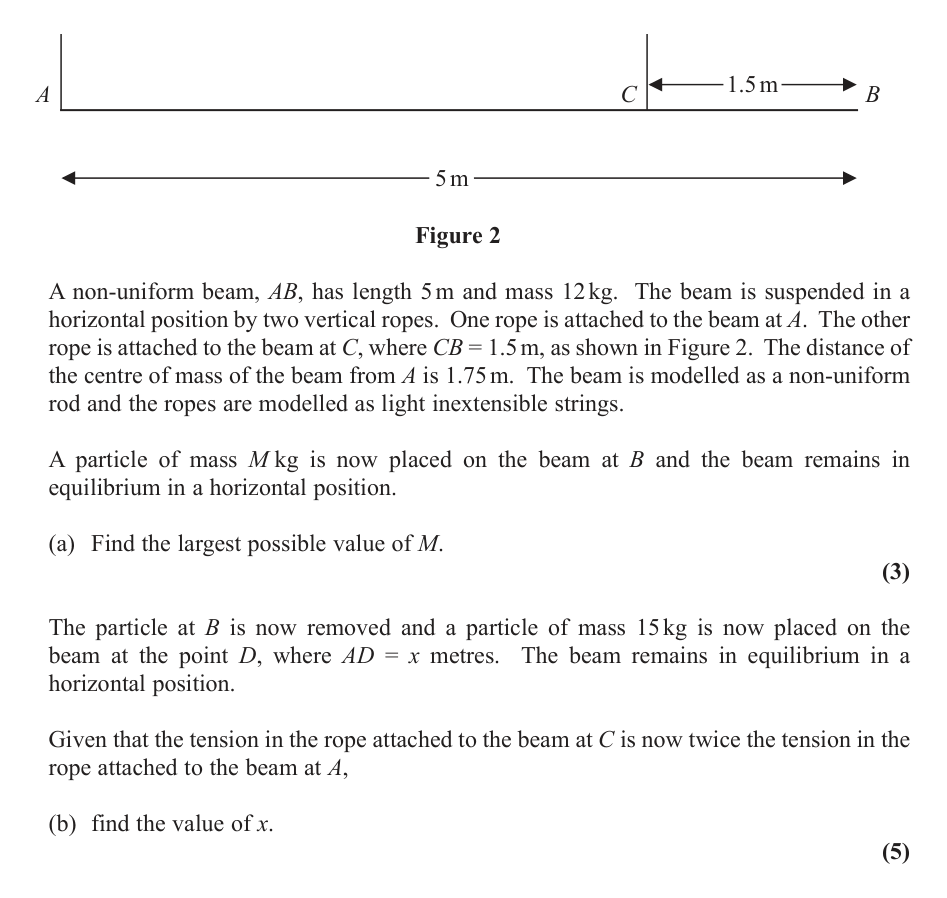
The beam is $5$ m long. Since $CB=1.5$ m, $AC=3.5$ m. The centre of mass is $1.75$ m from A, so it is also $1.75$ m from C.
Use the largest M condition
For the largest possible $M$ at B, the rope at A is just slack, so the beam is supported at C only.
Take moments about C
The particle at B is $1.5$ m to the right of C, and the beam's weight acts $1.75$ m to the left of C. Hence $Mg(1.5)=12g(1.75)$.
Find M
$M=\dfrac{12(1.75)}{1.5}=14$.
Set the tensions for part b
Let the tension at A be $T$. The tension at C is $2T$. Vertical equilibrium gives $T+2T=12g+15g=27g$, so $T=9g$ and the tension at C is $18g$.
Take moments about A
For the new particle at $AD=x$, moments about A give $18g(3.5)=12g(1.75)+15gx$.
Solve for x
Cancel $g$: $63=21+15x$. Thus $15x=42$ and $x=2.8$ m.
Final answer
$(a)\ M=14.\quad (b)\ x=2.8\ \mathrm{m}$.
22. WME01/01 January 2026 · Q4
Hard9 marks · main topic: MomentsShow worked solution
Set the distances
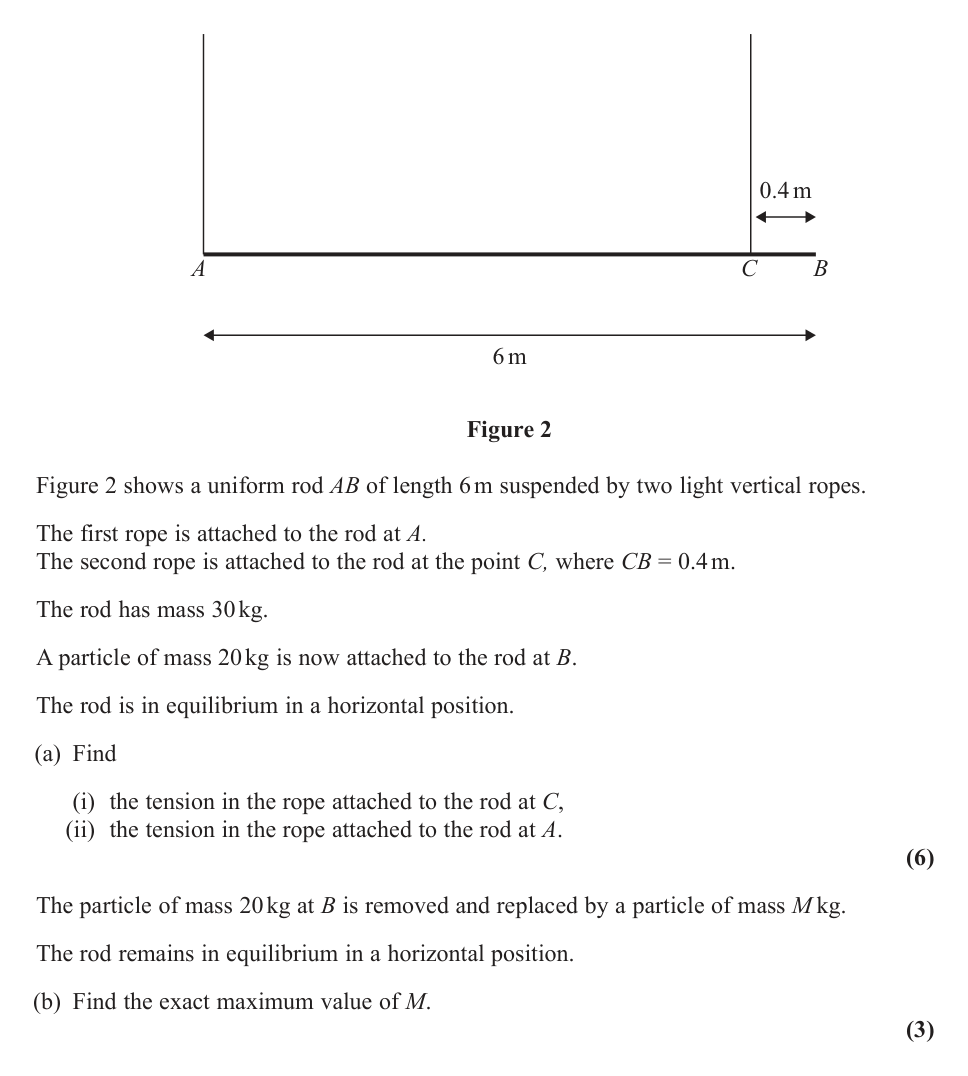
The rod is 6 m long and C is 0.4 m from B, so $AC=5.6$ m. The rod is uniform, so its weight $30g$ acts at the midpoint, 3 m from A. The 20 kg particle at B has weight $20g$.
Take moments about A
Moments about A remove the tension at A. Clockwise moments from the rod and particle equal the anticlockwise moment from the rope at C: $T_C(5.6)=30g(3)+20g(6)$.
Find the tension at C
$T_C(5.6)=210g$, so $T_C=37.5g=367.5\ \mathrm{N}$. To suitable accuracy, $T_C=368\ \mathrm{N}$, or $370\ \mathrm{N}$ to 2 significant figures.
Use vertical equilibrium
Vertically, $T_A+T_C=30g+20g=50g$. Therefore $T_A=50g-37.5g=12.5g=122.5\ \mathrm{N}$, so $T_A=123\ \mathrm{N}$, or $120\ \mathrm{N}$ to 2 significant figures.
Use the limiting case for maximum M
For the greatest possible mass at B, the rope at A is just slack, so $T_A=0$. Take moments about C: the clockwise moment of $Mg$ at B balances the anticlockwise moment of the rod weight.
Solve for M
The distance from C to B is $0.4$ m and the rod weight acts $5.6-3=2.6$ m to the left of C. Hence $Mg(0.4)=30g(2.6)$, so $M=\dfrac{78}{0.4}=195$.
Hard9 marks · main topic: MomentsShow worked solution
Find the reactions from vertical equilibrium
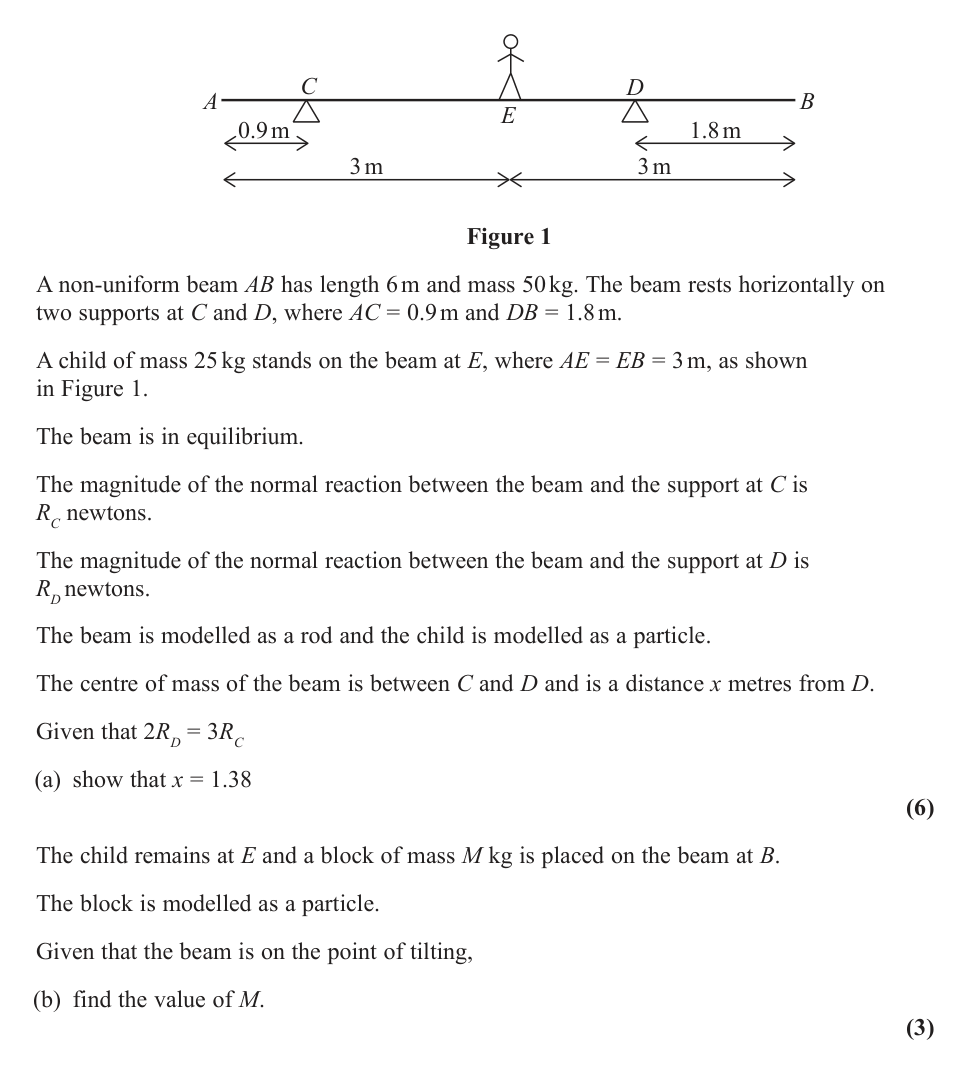
Vertically, $R_C+R_D=50g+25g=75g$. Given $2R_D=3R_C$, we have $R_D=1.5R_C$. Therefore $2.5R_C=75g$, so $R_C=30g$ and $R_D=45g$.
Set the distances from D
$D$ is $6-1.8=4.2$ m from A. The support C is $4.2-0.9=3.3$ m to the left of D, the child at E is $4.2-3=1.2$ m to the left of D, and the centre of mass is $x$ m to the left of D.
Take moments about D
Balancing moments about D gives $50gx+25g(1.2)=R_C(3.3)$.
Show x is 1.38
Substitute $R_C=30g$: $50x+30=99$, so $50x=69$ and $x=\dfrac{69}{50}=1.38$.
Use the tilting condition with the block
When the block at B is on the point of making the beam tilt, the beam is about to pivot about D and the reaction at C is zero.
Take moments about D for the block
The child and the beam act to the left of D, and the block at B acts $1.8$ m to the right of D. Hence $25g(1.2)+50g(1.38)=Mg(1.8)$.
Find M
$30+69=1.8M$, so $M=\dfrac{99}{1.8}=55$.
Final answer
$(a)\ x=1.38.\quad (b)\ M=55$.
24. WME01/01 January 2023 · Q5
Hard9 marks · main topic: Constant Acceleration in 1DShow worked solution
Use average speed from P to Q
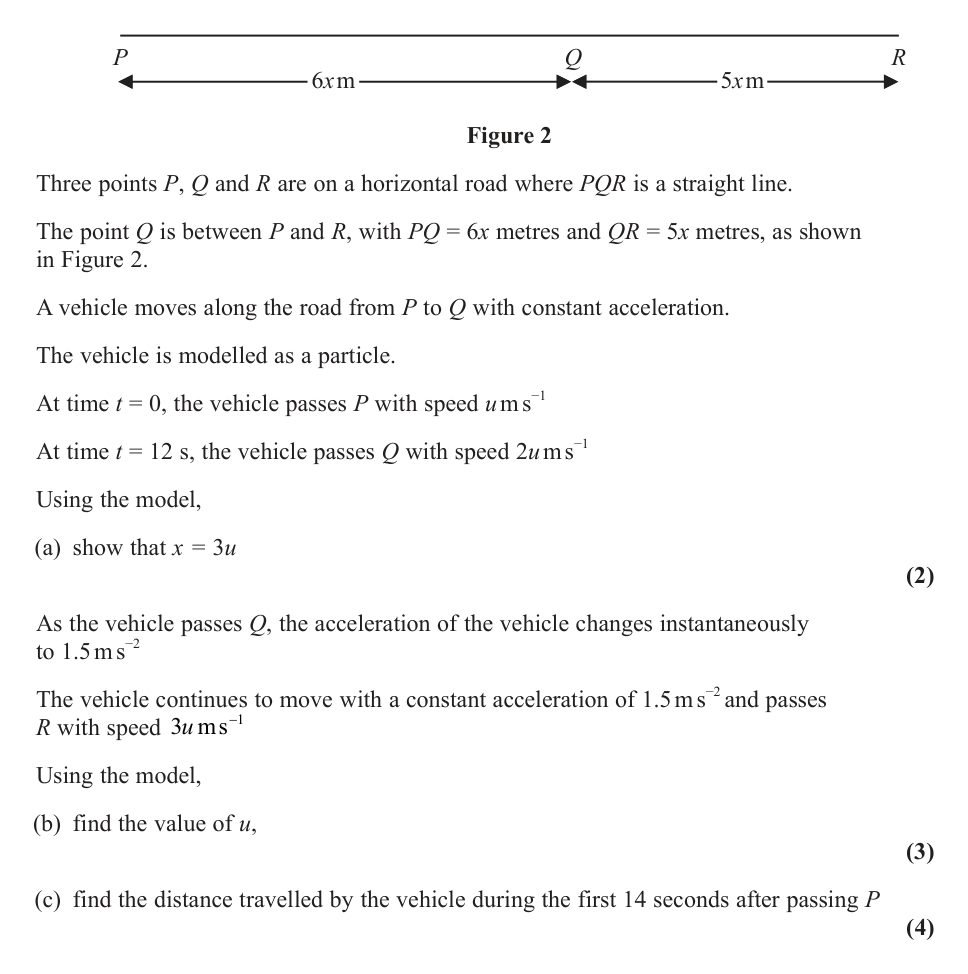
From P to Q, the speed changes uniformly from $u$ to $2u$ over $12$ s. The average speed is $\dfrac{u+2u}{2}=\dfrac{3u}{2}$.
Show x = 3u
Distance $PQ=6x$, so $6x=\dfrac{3u}{2}\cdot12=18u$. Hence $x=3u$.
Use Q to R
The distance $QR=5x=15u$. The speed changes from $2u$ to $3u$ with acceleration $1.5\ \mathrm{m\,s^{-2}}$.
Find u
Use $v^2=u^2+2as$: $(3u)^2=(2u)^2+2(1.5)(15u)$. Thus $9u^2=4u^2+45u$, so $5u^2=45u$ and $u=9$.
Find the first 12 seconds distance
In the first $12$ seconds, the distance is $PQ=6x=18u=18(9)=162$ m.
Find the next 2 seconds distance
From $t=12$ to $t=14$, the vehicle starts this part at speed $2u=18$ and accelerates at $1.5$. Distance $=18(2)+\dfrac12(1.5)(2^2)=36+3=39$ m.
Add the distances
Total distance in the first $14$ seconds is $162+39=201\ \mathrm{m}$.
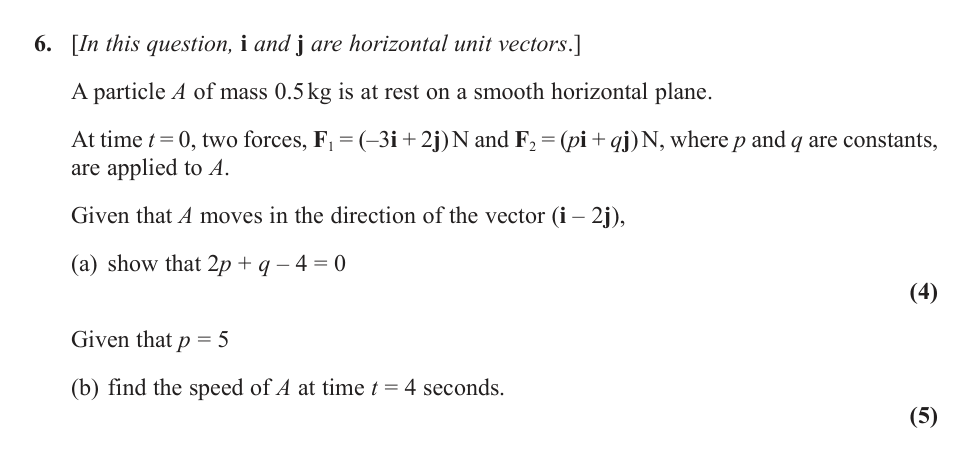
Since the particle starts from rest, its motion is in the direction of the resultant force. This direction is $\mathbf{i}-2\mathbf{j}$, so $\dfrac{q+2}{p-3}=-2$.
Show the relation
$q+2=-2(p-3)=-2p+6$, hence $2p+q-4=0$.
Find q when p = 5
Substitute $p=5$ into $2p+q-4=0$: $10+q-4=0$, so $q=-6$.
Find the resultant force
The resultant force is $(5-3)\mathbf{i}+(-6+2)\mathbf{j}=2\mathbf{i}-4\mathbf{j}$ N.
Find acceleration
The mass is $0.5$ kg, so $\mathbf{a}=\dfrac{2\mathbf{i}-4\mathbf{j}}{0.5}=4\mathbf{i}-8\mathbf{j}$.
Find velocity at t = 4
Starting from rest, $\mathbf{v}=\mathbf{a}t=(4\mathbf{i}-8\mathbf{j})4=16\mathbf{i}-32\mathbf{j}$.
Find the speed
Speed $=\sqrt{16^2+(-32)^2}=\sqrt{1280}=16\sqrt5\ \mathrm{m\,s^{-1}}$, about $36\ \mathrm{m\,s^{-1}}$.
Hard9 marks · main topic: Working with VectorsShow worked solution
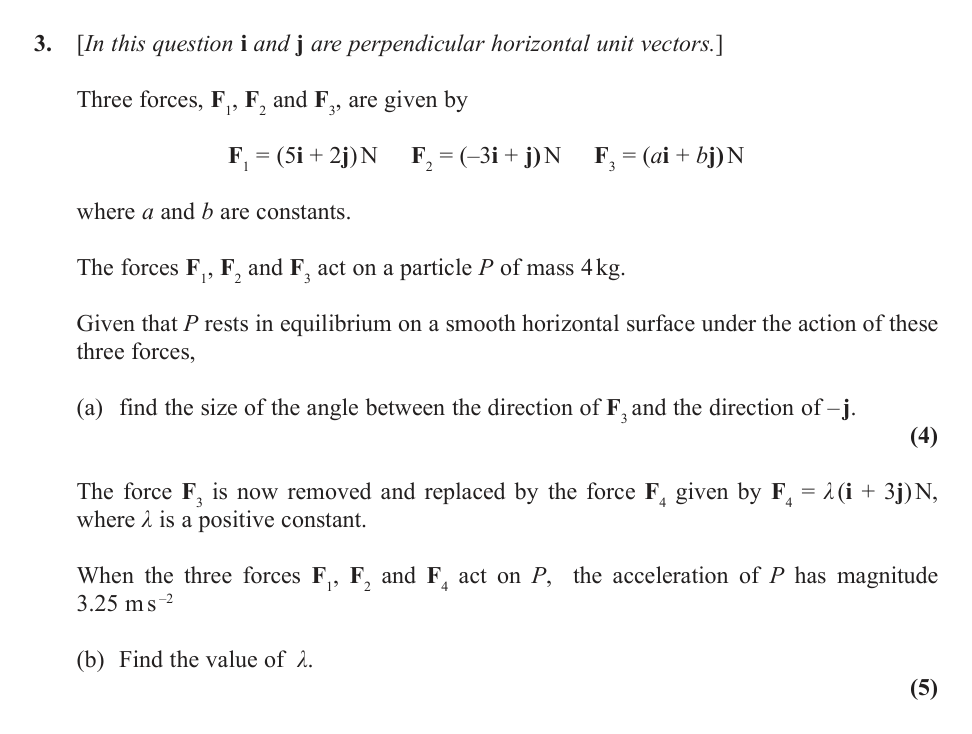
Find F3 from equilibrium
Equilibrium gives $\mathbf{F}_1+\mathbf{F}_2+\mathbf{F}_3=\mathbf{0}$. Now $\mathbf{F}_1+\mathbf{F}_2=(5\mathbf{i}+2\mathbf{j})+(-3\mathbf{i}+\mathbf{j})=2\mathbf{i}+3\mathbf{j}$.
Write F3
So $\mathbf{F}_3=-2\mathbf{i}-3\mathbf{j}$.
Find the angle with -j
The vector $-\mathbf{j}$ points vertically downward. For $\mathbf{F}_3=-2\mathbf{i}-3\mathbf{j}$, the angle from $-\mathbf{j}$ satisfies $\tan\theta=\dfrac{2}{3}$.
State the angle
$\theta=33.7^\circ$, so the angle is about $34^\circ$.
Find the new resultant force
With $\mathbf{F}_4=\lambda(\mathbf{i}+3\mathbf{j})$, the resultant is $(2+\lambda)\mathbf{i}+(3+3\lambda)\mathbf{j}$.
Use the acceleration magnitude
The mass is $4$ kg and acceleration magnitude is $3.25$, so the resultant force magnitude is $4(3.25)=13$ N.
Form the equation
$(2+\lambda)^2+(3+3\lambda)^2=13^2$.
Solve for lambda
Expanding gives $10\lambda^2+22\lambda-156=0$. The roots are $3$ and $-5.2$, and since $\lambda$ is positive, $\lambda=3$.
Hard10 marks · main topic: MomentsShow worked solution
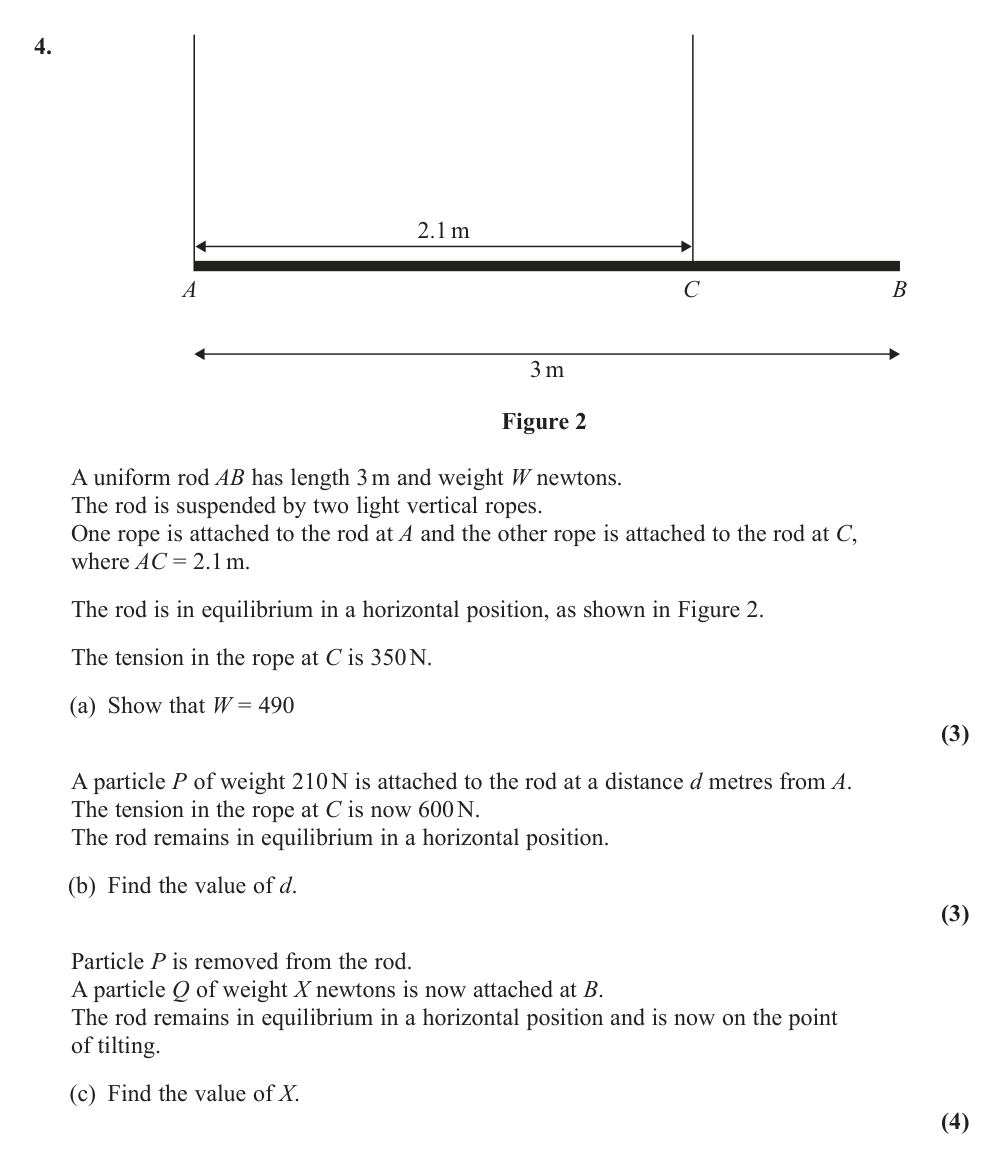
Use moments to find W
Take moments about A. The rope at C is $2.1$ m from A and the weight of the uniform rod acts at its midpoint, $1.5$ m from A. Hence $350(2.1)=W(1.5)$.
Show W is 490
$735=1.5W$, so $W=490\ \mathrm{N}$.
Set up moments with particle P
When P is attached, the tension at C is $600$ N. Taking moments about A: $600(2.1)=490(1.5)+210d$.
Find d
$1260=735+210d$, so $525=210d$ and $d=2.5$.
Use the tilting condition
When Q is attached at B and the rod is on the point of tilting, the rope at A is just slack. The rod is about to tilt about C.
Find X
Take moments about C. The rod weight acts $2.1-1.5=0.6$ m to the left of C, and Q acts $3-2.1=0.9$ m to the right. Thus $490(0.6)=X(0.9)$, so $X=\dfrac{980}{3}\ \mathrm{N}$.
Hard10 marks · main topic: Momentum, Impulse & CollisionsShow worked solution
Use conservation of momentum
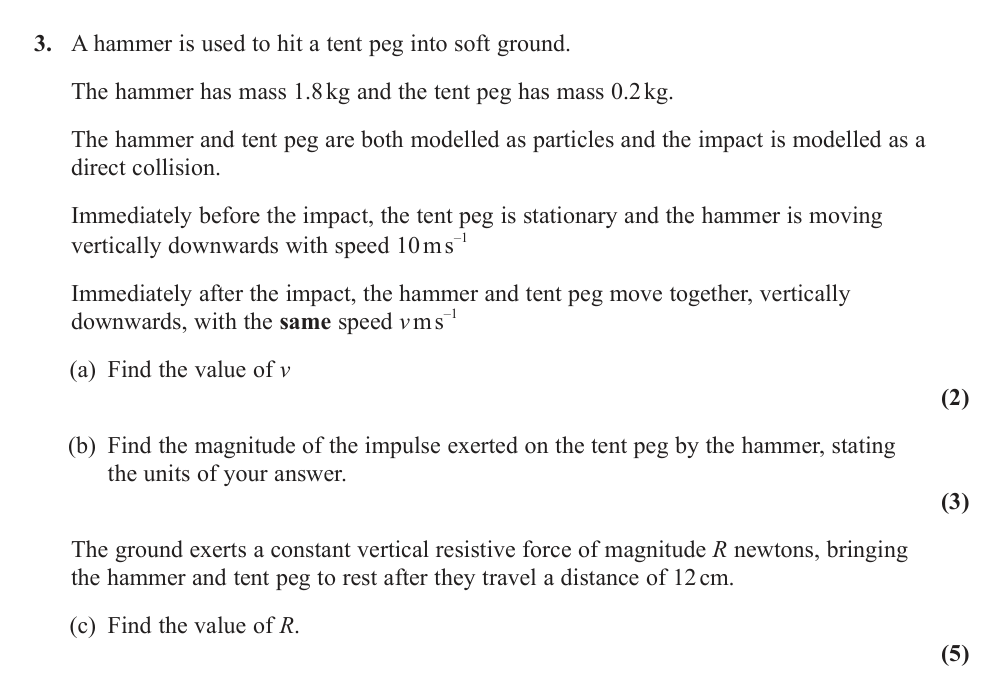
Take downward as positive during the impact. Before impact, the hammer has momentum $1.8(10)$ and the peg has momentum $0$. After impact, the combined mass is $1.8+0.2=2.0$ kg.
Find the common speed
$1.8(10)=2.0v$, so $18=2v$ and $v=9\ \mathrm{m\,s^{-1}}$.
Use impulse on the peg
The peg changes from rest to speed $9\ \mathrm{m\,s^{-1}}$ downward. The impulse magnitude is $0.2(9-0)=1.8\ \mathrm{N\,s}$.
Find the deceleration in the ground
The hammer and peg move together from speed $9$ to rest over $0.12$ m. With downward positive, $0=9^2+2a(0.12)$, so $a=-337.5\ \mathrm{m\,s^{-2}}$.
Apply Newtons second law
For the combined mass $2.0$ kg, forces are weight $2g$ downward and resistance $R$ upward. With downward positive, $2g-R=2a$.
Find R
$19.6-R=2(-337.5)=-675$, so $R=694.6\ \mathrm{N}$, which is about $695\ \mathrm{N}$.
Hard10 marks · main topic: Working with VectorsShow worked solution
Use equilibrium
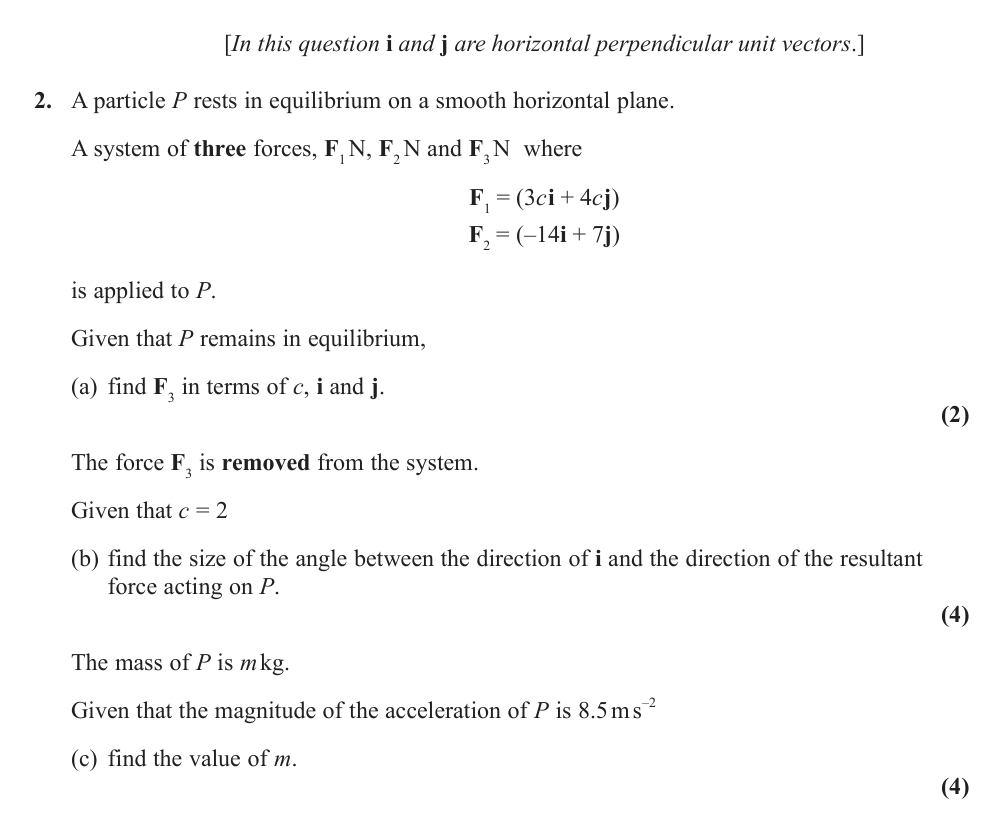
For equilibrium, $\mathbf{F}_1+\mathbf{F}_2+\mathbf{F}_3=\mathbf{0}$. Hence $\mathbf{F}_3=-(\mathbf{F}_1+\mathbf{F}_2)$.
Find F3
$\mathbf{F}_1+\mathbf{F}_2=(3c-14)\mathbf{i}+(4c+7)\mathbf{j}$, so $\mathbf{F}_3=(14-3c)\mathbf{i}+(-7-4c)\mathbf{j}$.
Find the resultant when c = 2
When $c=2$, $\mathbf{F}_1=6\mathbf{i}+8\mathbf{j}$ and $\mathbf{F}_2=-14\mathbf{i}+7\mathbf{j}$. Therefore the resultant is $-8\mathbf{i}+15\mathbf{j}$.
Find the angle
The resultant is in the second quadrant. Its angle from the positive $\mathbf{i}$ direction is $180^\circ-\tan^{-1}\left(\dfrac{15}{8}\right)=118.1^\circ$, so the angle is about $118^\circ$.
Find the magnitude of the resultant
$|\mathbf{R}|=\sqrt{(-8)^2+15^2}=17\ \mathrm{N}$.
Use F = ma
The acceleration magnitude is $8.5\ \mathrm{m\,s^{-2}}$, so $17=8.5m$. Hence $m=2$.
Hard10 marks · main topic: Momentum, Impulse & CollisionsShow worked solution
Use conservation of momentum
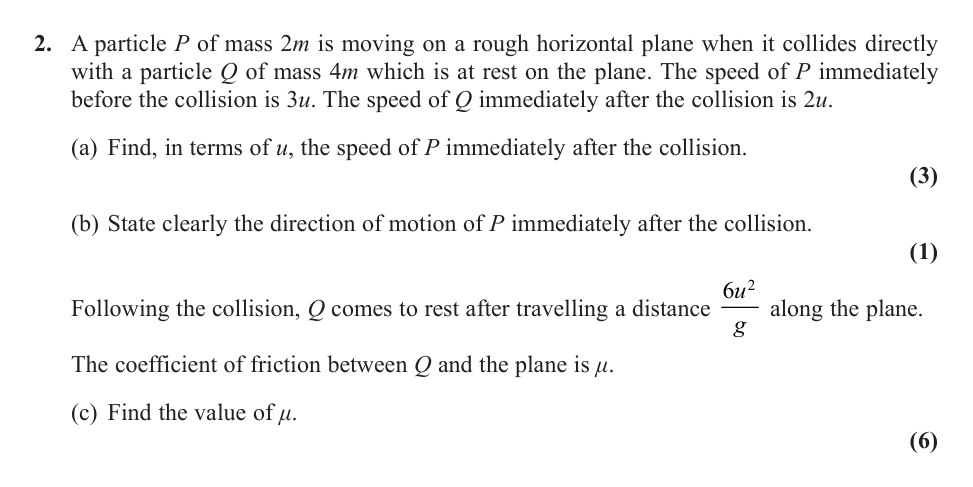
Take P's original direction as positive. Before collision, P has velocity $3u$ and Q is at rest. After collision, Q has velocity $2u$. Let P's velocity be $v$.
Find P velocity
$2m(3u)=2mv+4m(2u)$. Thus $6mu=2mv+8mu$, so $2mv=-2mu$ and $v=-u$.
State speed and direction
The speed of P is $u$. The negative sign shows that P moves in the opposite direction after the collision.
Find the deceleration of Q
After collision, Q starts with speed $2u$ and stops after distance $\dfrac{6u^2}{g}$. Use $v^2=u^2+2as$: $0=(2u)^2+2a\left(\dfrac{6u^2}{g}\right)$.
Simplify acceleration
$0=4u^2+\dfrac{12au^2}{g}$, so $a=-\dfrac{g}{3}$. The deceleration magnitude is $\dfrac{g}{3}$.
Use friction on Q
For Q, $R=4mg$, so friction is $\mu R=4\mu mg$. This friction produces deceleration: $4\mu mg=4m\cdot\dfrac{g}{3}$.
Find mu
Cancel $4mg$: $\mu=\dfrac13$.
Final answer
$(a)\ \text{speed of P}=u.\quad (b)\ \text{P reverses direction}.\quad (c)\ \mu=\dfrac13$.
32. WME01/01 October 2021 · Q5
Hard10 marks · main topic: ForcesShow worked solution
Use the trig ratios
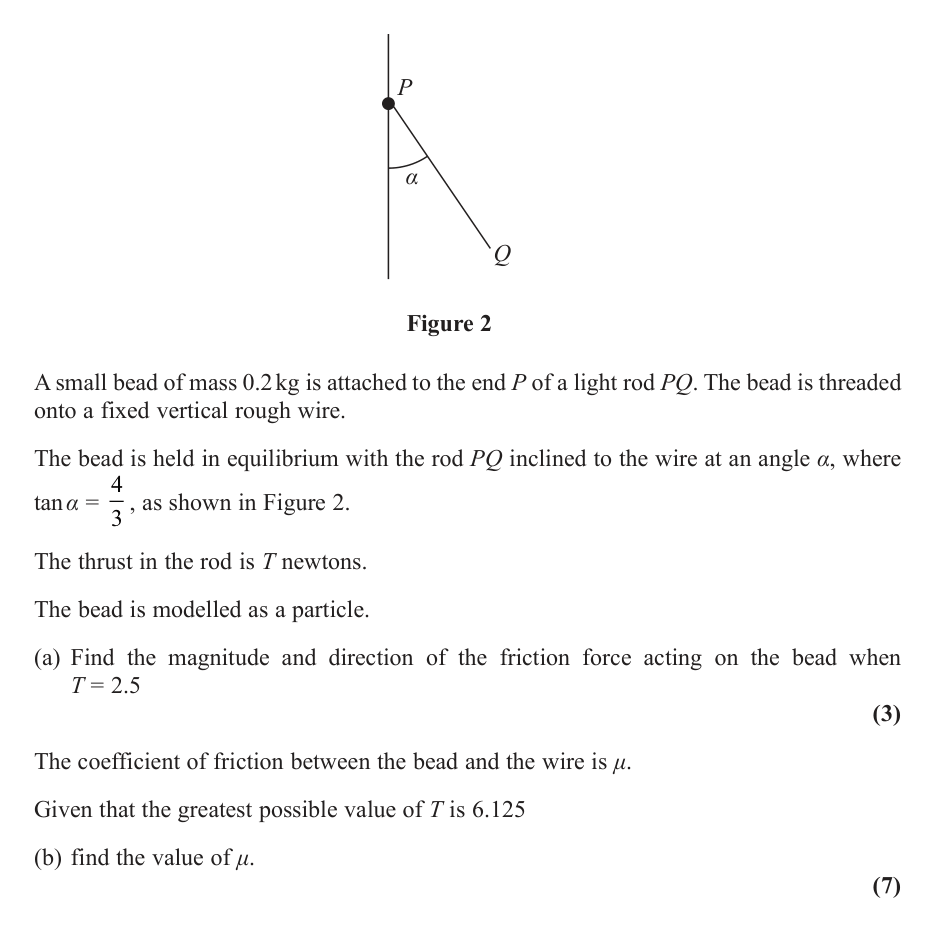
Since $\tan\alpha=\dfrac43$, $\sin\alpha=\dfrac45$ and $\cos\alpha=\dfrac35$.
Resolve vertically when T = 2.5
The vertical component of the thrust is $2.5\cos\alpha=2.5\cdot\dfrac35=1.5$ N upward. The weight is $0.2g=1.96$ N downward.
Find friction and direction
For equilibrium, friction must supply the missing upward force: $F=1.96-1.5=0.46\ \mathrm{N}$. So friction acts upwards.
Use greatest T
When $T=6.125$, the vertical component of the thrust is larger than the weight, so friction acts downward at the limiting value.
Find normal reaction
The normal reaction is the horizontal component of the thrust: $R=6.125\sin\alpha=6.125\cdot\dfrac45=4.9\ \mathrm{N}$.
Find limiting friction
Vertical equilibrium gives $0.2g+F=6.125\cos\alpha$. Thus $1.96+F=6.125\cdot\dfrac35=3.675$, so $F=1.715$ N.
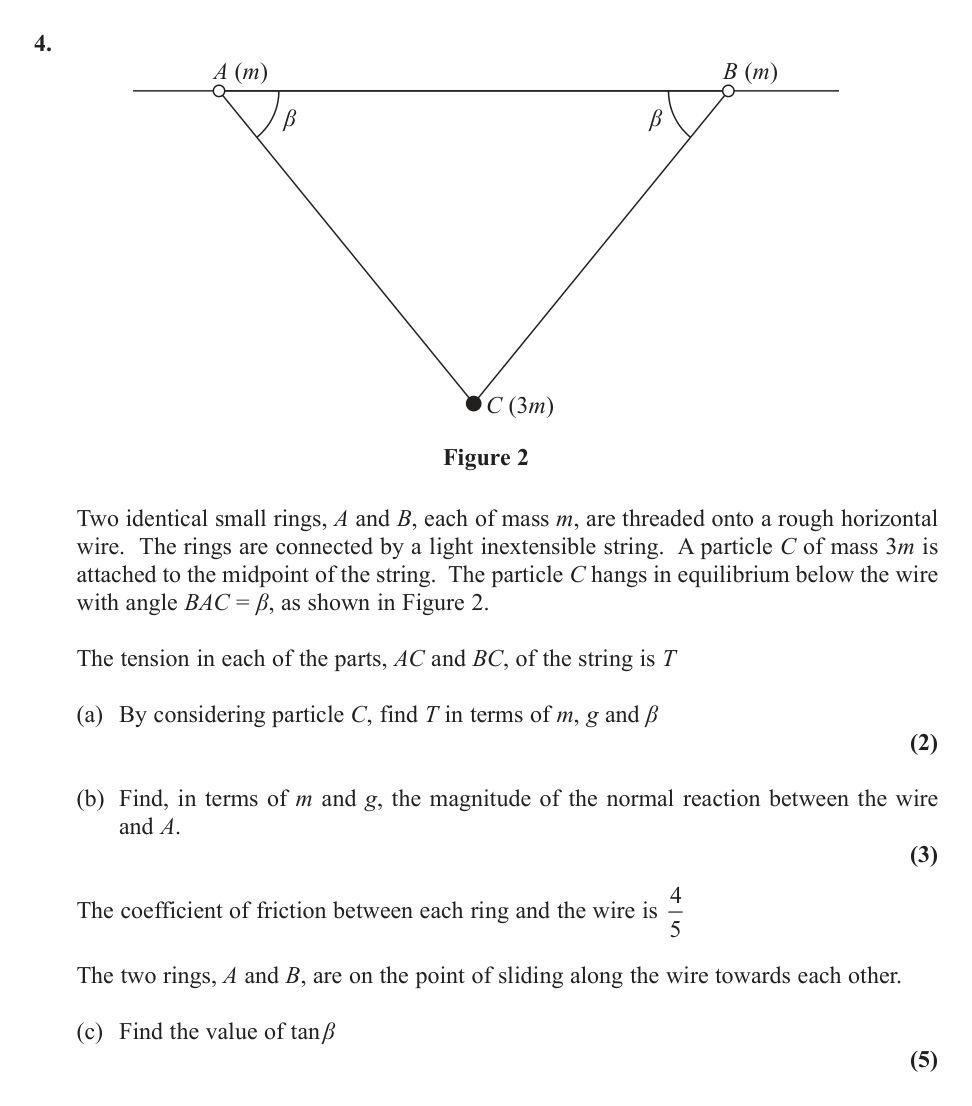
Hard10 marks · main topic: ForcesShow worked solution
Resolve forces on C
The two tensions are equal and symmetric. Their vertical components support the weight of C, so $2T\sin\beta=3mg$. Hence $T=\dfrac{3mg}{2\sin\beta}$.
Resolve vertically for ring A
For ring A, the normal reaction balances its own weight and the downward vertical component of the string tension: $R=mg+T\sin\beta$.
Find the normal reaction
From $2T\sin\beta=3mg$, we have $T\sin\beta=\dfrac32mg$. Therefore $R=mg+\dfrac32mg=\dfrac52mg$.
Use limiting friction
The rings are just about to slide towards each other, so friction is limiting. With $\mu=\dfrac45$, $F=\mu R=\dfrac45\cdot\dfrac52mg=2mg$.
Resolve horizontally for a ring
The horizontal component of the tension is balanced by friction: $T\cos\beta=F=2mg$.
Find tan beta
Substitute $T=\dfrac{3mg}{2\sin\beta}$: $\dfrac{3mg}{2\sin\beta}\cos\beta=2mg$. Hence $\dfrac32\cot\beta=2$, so $\cot\beta=\dfrac43$ and $\tan\beta=\dfrac34$.
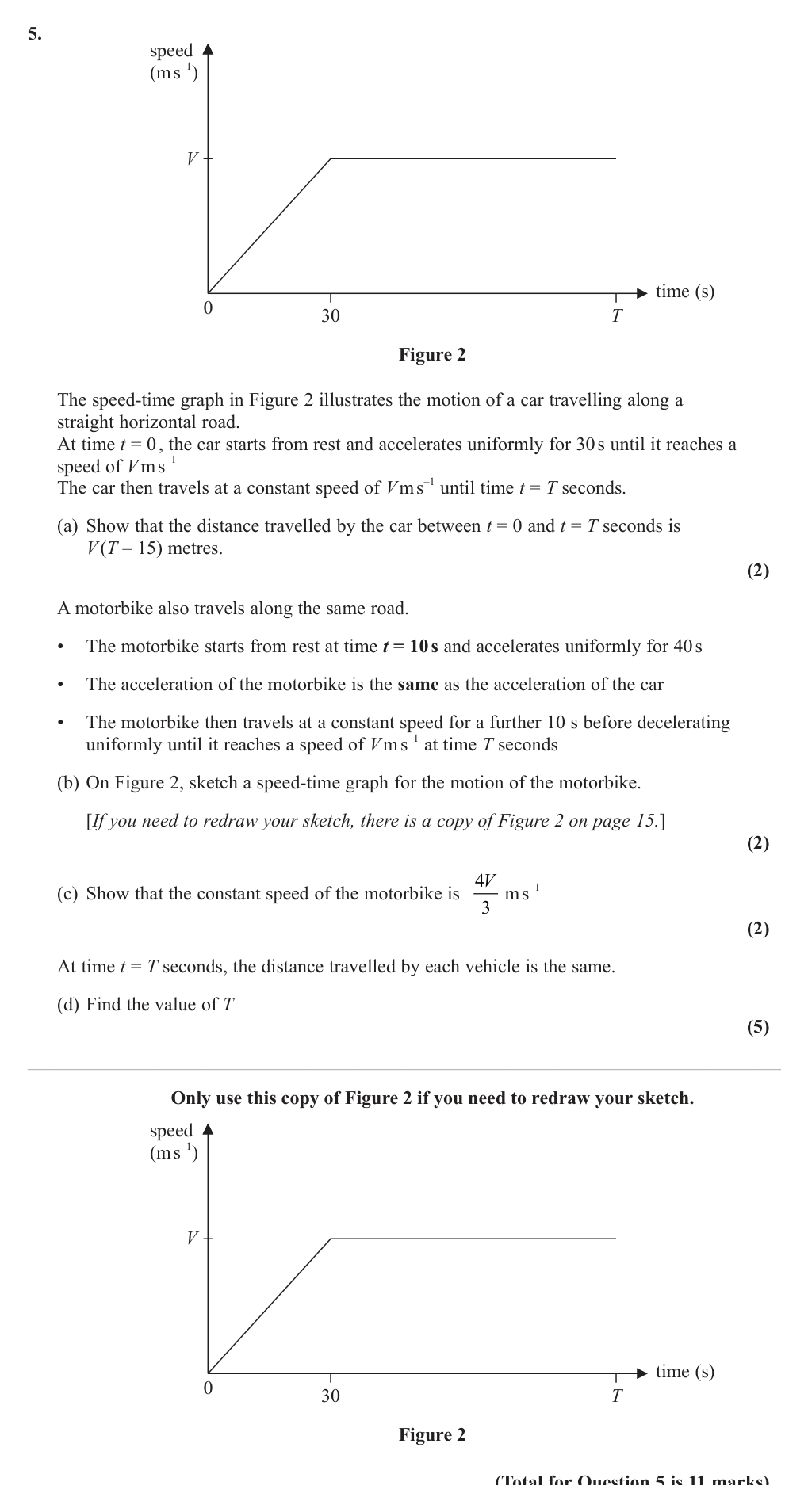
Hard11 marks · main topic: Kinematics GraphsShow worked solution
Find the car distance
The car graph is a triangle from $0$ to $30$ plus a rectangle from $30$ to $T$. Distance $=\dfrac12(30)V+V(T-30)$.
Simplify the car distance
$\dfrac12(30)V+V(T-30)=15V+VT-30V=V(T-15)$, as required.
Describe the motorbike graph
The motorbike starts at $(10,0)$, accelerates with the same gradient as the car until $t=50$, then travels at constant speed until $t=60$, then decelerates linearly to $(T,V)$.
Find the motorbike constant speed
The car acceleration is $\dfrac{V}{30}$. The motorbike accelerates for $40$ s, so its speed is $40\cdot\dfrac{V}{30}=\dfrac{4V}{3}$.
Find the motorbike distance
Its distance is $\dfrac12(40)\left(\dfrac{4V}{3}\right)+10\left(\dfrac{4V}{3}\right)+\dfrac12\left(\dfrac{4V}{3}+V\right)(T-60)$.
Simplify the motorbike distance
This becomes $\dfrac{80V}{3}+\dfrac{40V}{3}+\dfrac{7V}{6}(T-60)=40V+\dfrac{7V}{6}(T-60)=\dfrac{7VT}{6}-30V$.
Equate the two distances
At time $T$, the distances are equal: $V(T-15)=\dfrac{7VT}{6}-30V$. Divide by $V$ to get $T-15=\dfrac{7T}{6}-30$.
Find T
Multiplying by $6$ gives $6T-90=7T-180$, so $T=90$.
Final answer
$(a)\ \text{car distance}=V(T-15)$. $(b)$ Motorbike graph starts at $t=10$, reaches $\dfrac{4V}{3}$ at $t=50$, stays constant to $t=60$, then falls to $V$ at $t=T$. $(c)\ \text{constant speed}=\dfrac{4V}{3}.\quad (d)\ T=90$.
35. WME01/01 May/June 2023 · Q7
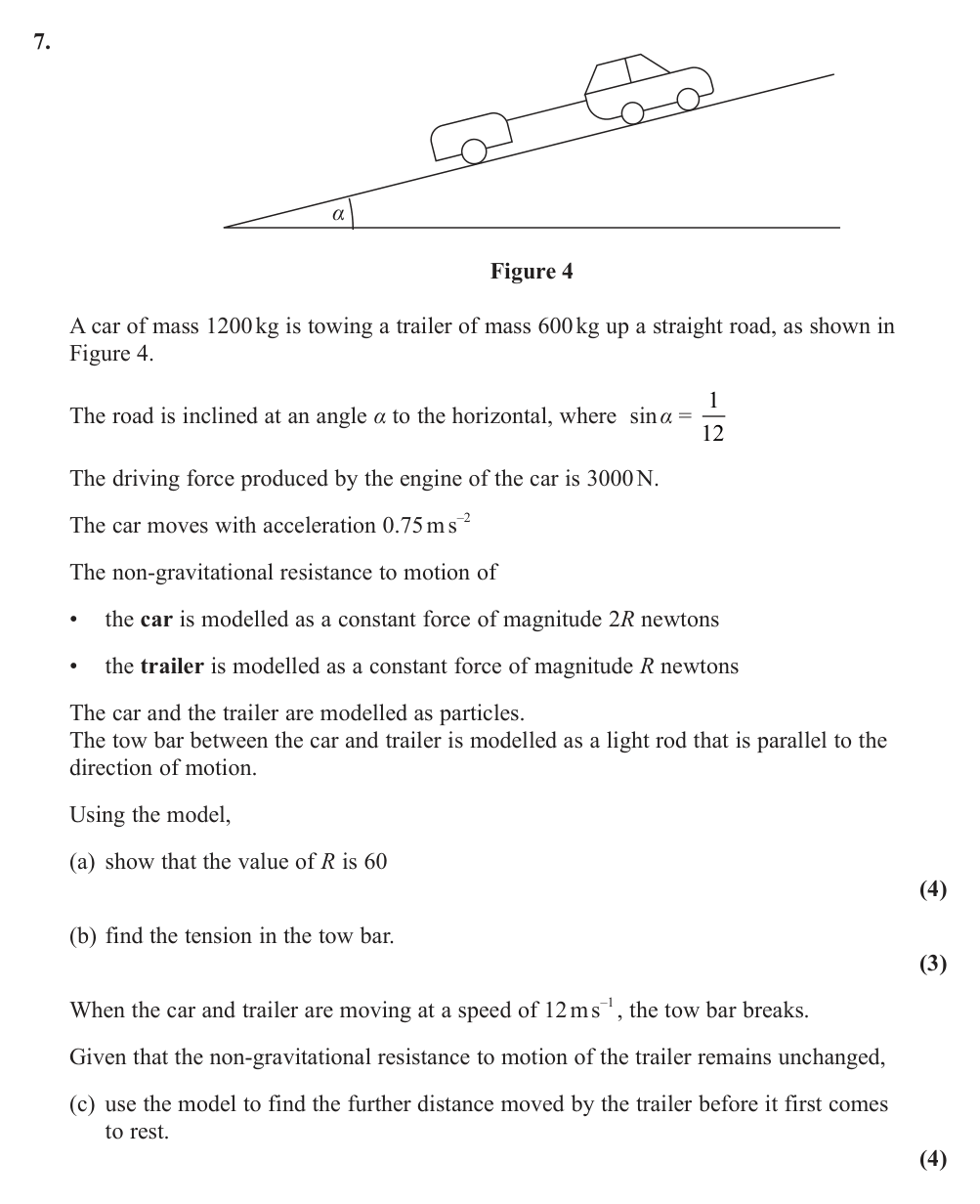
Hard11 marksShow worked solution
Use the whole system
For car plus trailer, the total mass is $1800$ kg and the total resistance is $2R+R=3R$. Taking up the slope as positive: $3000-1800g\sin\alpha-3R=1800(0.75)$.
Show R is 60
Since $\sin\alpha=\dfrac1{12}$, $1800g\sin\alpha=1800\cdot9.8\cdot\dfrac1{12}=1470$. So $3000-1470-3R=1350$, giving $180=3R$ and $R=60\ \mathrm{N}$.
Apply Newtons second law to the trailer
For the trailer while it is being towed, $T-600g\sin\alpha-R=600(0.75)$.
Find the tow-bar tension
$T-600\cdot9.8\cdot\dfrac1{12}-60=450$, so $T-490-60=450$ and $T=1000\ \mathrm{N}$.
Find the trailer acceleration after the break
After the tow bar breaks, the trailer is still moving up the slope, but the component of weight and resistance act down the slope. Taking up the slope as positive: $-600g\sin\alpha-60=600a$.
Simplify the acceleration
$-490-60=600a$, so $a=-\dfrac{550}{600}=-\dfrac{11}{12}\ \mathrm{m\,s^{-2}}$.
Find the stopping distance
With initial speed $12\ \mathrm{m\,s^{-1}}$ and final speed $0$, use $v^2=u^2+2as$: $0=12^2+2\left(-\dfrac{11}{12}\right)d$. Hence $d=\dfrac{864}{11}=78.5\ldots\ \mathrm{m}$.
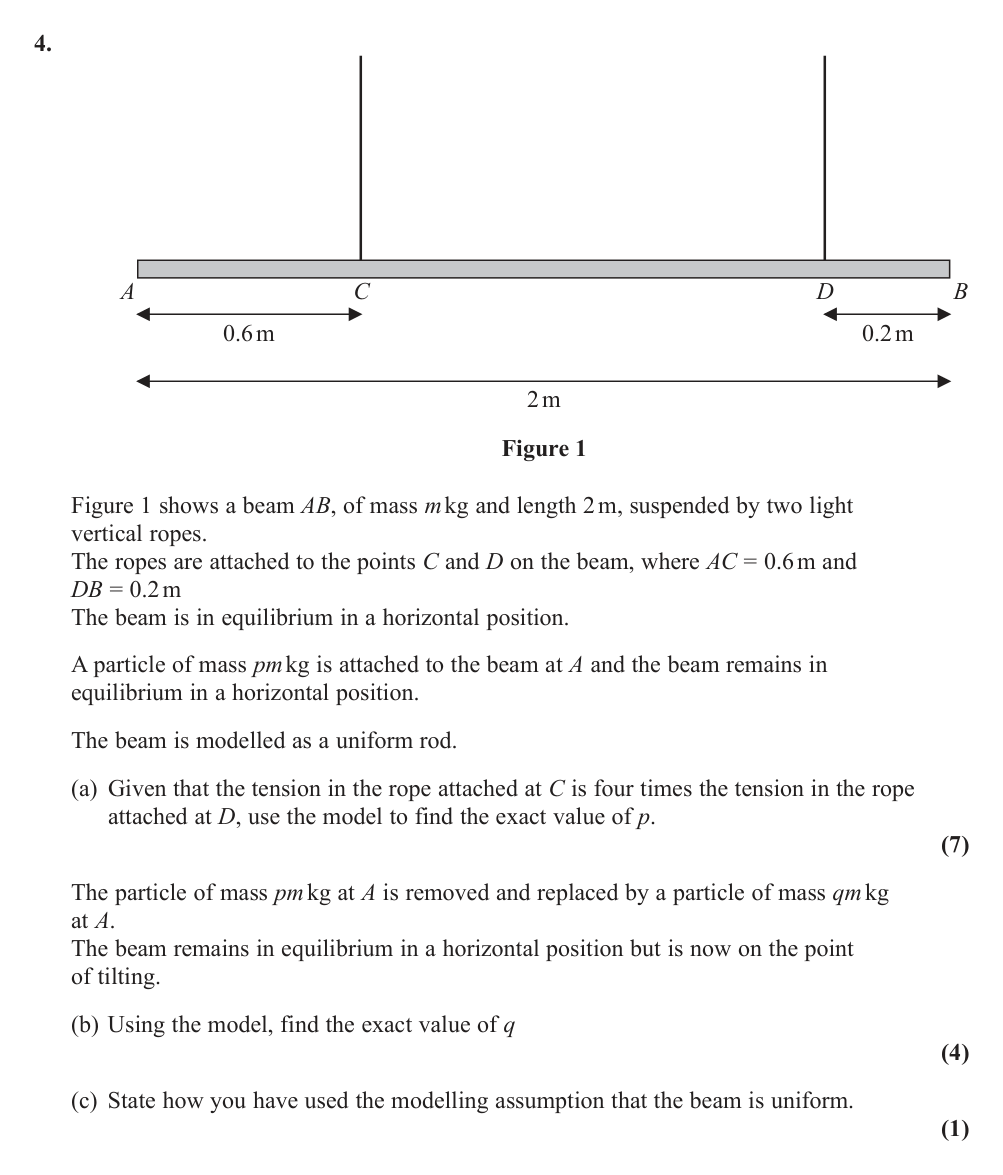
Hard12 marks · main topic: MomentsShow worked solution
Set the geometry
The beam is $2$ m long. Since $AC=0.6$ m and $DB=0.2$ m, point D is $1.8$ m from A. The uniform beam has weight $mg$ acting $1.0$ m from A.
Name the tensions
Let the tension at D be $T$. The tension at C is four times this, so it is $4T$.
Use vertical equilibrium
$4T+T=pmg+mg$, so $5T=(p+1)mg$.
Take moments about A
The particle at A has no moment about A. Hence $4T(0.6)+T(1.8)=mg(1.0)$.
Find T
$2.4T+1.8T=mg$, so $4.2T=mg$ and $T=\dfrac{5mg}{21}$.
Find p
Substitute into $5T=(p+1)mg$: $5\cdot\dfrac{5mg}{21}=(p+1)mg$. Thus $p+1=\dfrac{25}{21}$ and $p=\dfrac{4}{21}$.
Use the tilting condition
When the particle of mass $qm$ is at A and the beam is on the point of tilting, the rope at D is just slack, so its tension is zero.
Take moments about C
About C, the particle at A has moment $qmg(0.6)$ and the beam weight has moment $mg(0.4)$ in the opposite direction. Thus $qmg(0.6)=mg(0.4)$, giving $q=\dfrac{2}{3}$.
Use the modelling assumption
The beam is uniform, so its centre of mass is at the midpoint of the beam and its weight acts there.
Final answer
$(a)\ p=\dfrac{4}{21}.\quad (b)\ q=\dfrac{2}{3}.\quad (c)$ The beam weight acts at its midpoint.
37. WME01/01 May/June 2022 · Q4
Hard12 marks · main topic: ForcesShow worked solution
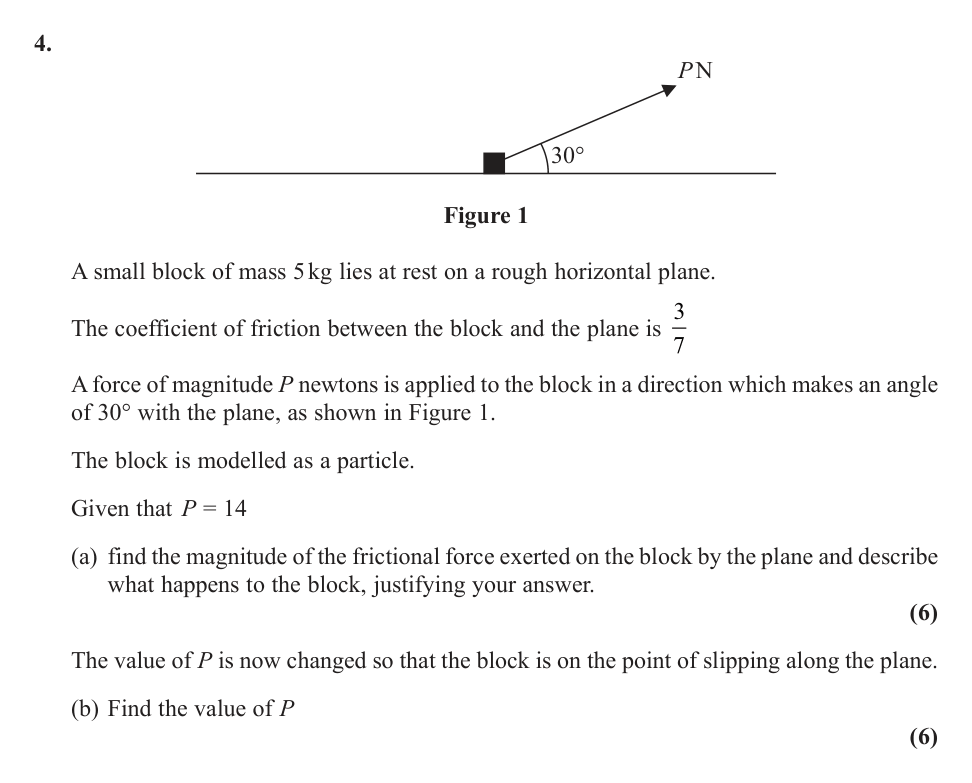
Find the normal reaction when P = 14
Resolve vertically. The upward component of the applied force is $14\sin30^\circ$, so $R+14\sin30^\circ=5g$.
Calculate R
$R+7=49$, so $R=42\ \mathrm{N}$.
Find the maximum friction
$F_{\max}=\mu R=\dfrac37(42)=18\ \mathrm{N}$.
Compare with the horizontal pull
The horizontal component of the applied force is $14\cos30^\circ=12.1\ldots\ \mathrm{N}$. Since this is less than the maximum possible friction, the block does not move.
State the actual friction
For equilibrium, the actual friction equals the horizontal pull, so $F=12.1\ \mathrm{N}$ approximately.
Set up the limiting case
When the block is on the point of slipping, friction is limiting. Resolve vertically: $R+P\sin30^\circ=5g$, so $R=5g-P\sin30^\circ$.
Resolve horizontally
At the limiting case, $P\cos30^\circ=\dfrac37R=\dfrac37(5g-P\sin30^\circ)$.
$(a)\ F=12.1\ \mathrm{N}\ \text{approximately, and the block does not move}.\quad (b)\ P=19.4\ \mathrm{N}\ \text{approximately}$.
38. WME01/01 January 2022 · Q6
Hard12 marks · main topic: Working with VectorsShow worked solution
Use F = ma
The total force is $(p\mathbf{i}+q\mathbf{j})+(2q\mathbf{i}+p\mathbf{j})=(p+2q)\mathbf{i}+(p+q)\mathbf{j}$. Since the mass is $2$ kg and acceleration is $\mathbf{i}-\mathbf{j}$, the total force is $2\mathbf{i}-2\mathbf{j}$.
Equate components
$p+2q=2$ and $p+q=-2$.
Find p and q
Subtract the equations to get $q=4$. Then $p+4=-2$, so $p=-6$.
Find the angle with j
The acceleration is $\mathbf{i}-\mathbf{j}$. Its dot product with $\mathbf{j}$ is $-1$, so the angle with the positive $\mathbf{j}$ direction is obtuse. Since the components are equal in magnitude, the angle is $135^\circ$.
Hard12 marks · main topic: Kinematics GraphsShow worked solution
Describe the speed-time graph
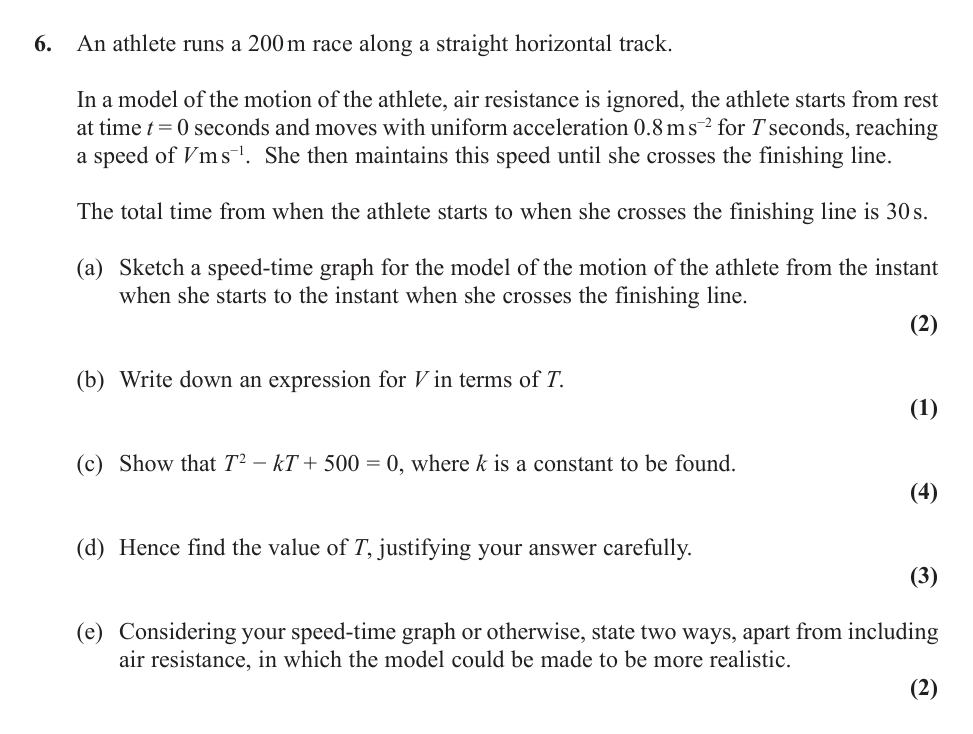
The graph starts at $(0,0)$, rises in a straight line with gradient $0.8$ until time $T$ and speed $V$, then stays horizontal at speed $V$ until $t=30$.
Write V in terms of T
Uniform acceleration gives $V=0.8T$.
Use area for the distance
The distance is the area under the speed-time graph: $\dfrac12TV+V(30-T)=200$.
Substitute V
Using $V=0.8T$: $\dfrac12T(0.8T)+(0.8T)(30-T)=200$.
Form the quadratic
$0.4T^2+24T-0.8T^2=200$, so $-0.4T^2+24T-200=0$. Multiplying by $-2.5$ gives $T^2-60T+500=0$, so $k=60$.
Solve and choose the valid root
$T^2-60T+500=(T-10)(T-50)=0$, so $T=10$ or $50$. Since the whole race lasts $30$ s, $T=10$.
Give two model improvements
A more realistic model could include reaction time at the start, and could replace the instantaneous change from acceleration to constant speed with a smoother transition.
Final answer
$(a)$ Speed-time graph rises linearly to $V$ at $t=T$, then is horizontal until $t=30$. $(b)\ V=0.8T.\quad (c)\ T^2-60T+500=0$, so $k=60$. $(d)\ T=10$. $(e)$ For example, include reaction time at the start and avoid the instantaneous change to constant speed.
40. WME01/01 October 2025 · Q5
Hard13 marks · main topic: Resolving Forces, Inclined PlanesShow worked solution
Part (a): Find P when box is on point of sliding - Resolve vertically
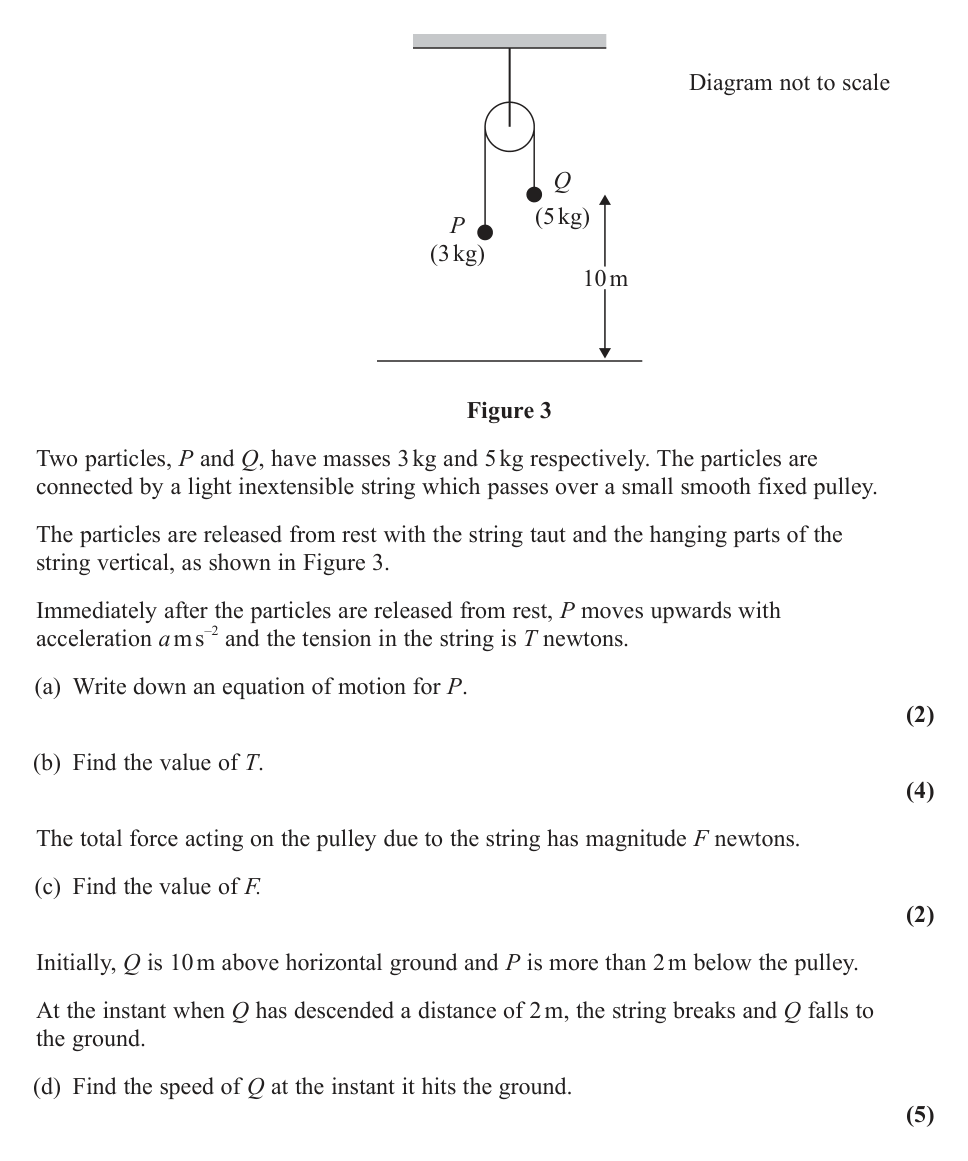
P has mass $3$ kg and moves upwards, so taking upwards as positive gives $T-3g=3a$.
Write the equation for Q
Q has mass $5$ kg and moves downwards, so taking downwards as positive for Q gives $5g-T=5a$.
Find acceleration and tension
Adding the two equations gives $2g=8a$, so $a=\dfrac{g}{4}$. Substitute into $T-3g=3a$: $T=3g+3\left(\dfrac{g}{4}\right)=\dfrac{15g}{4}=36.8\ \mathrm{N}$.
Find the force on the pulley
The pulley is pulled by two vertical tensions, each of magnitude $T$. Hence $F=2T=\dfrac{15g}{2}=73.5\ \mathrm{N}$.
Find Q speed when the string breaks
Before the string breaks, Q descends $2$ m from rest with acceleration $g/4$. Thus $v^2=2\left(\dfrac{g}{4}\right)(2)=g$, so $v=\sqrt{g}$.
Find the remaining fall
After the string breaks, Q is still $8$ m above the ground and accelerates freely under gravity. Let the impact speed be $w$. Then $w^2=v^2+2g(8)=g+16g=17g$.
Calculate the impact speed
$w=\sqrt{17g}=\sqrt{166.6}=12.9\ \mathrm{m\,s^{-1}}$ to 3 significant figures.
Hard13 marks · main topic: Resolving Forces, Inclined PlanesShow worked solution
Use the trig ratios
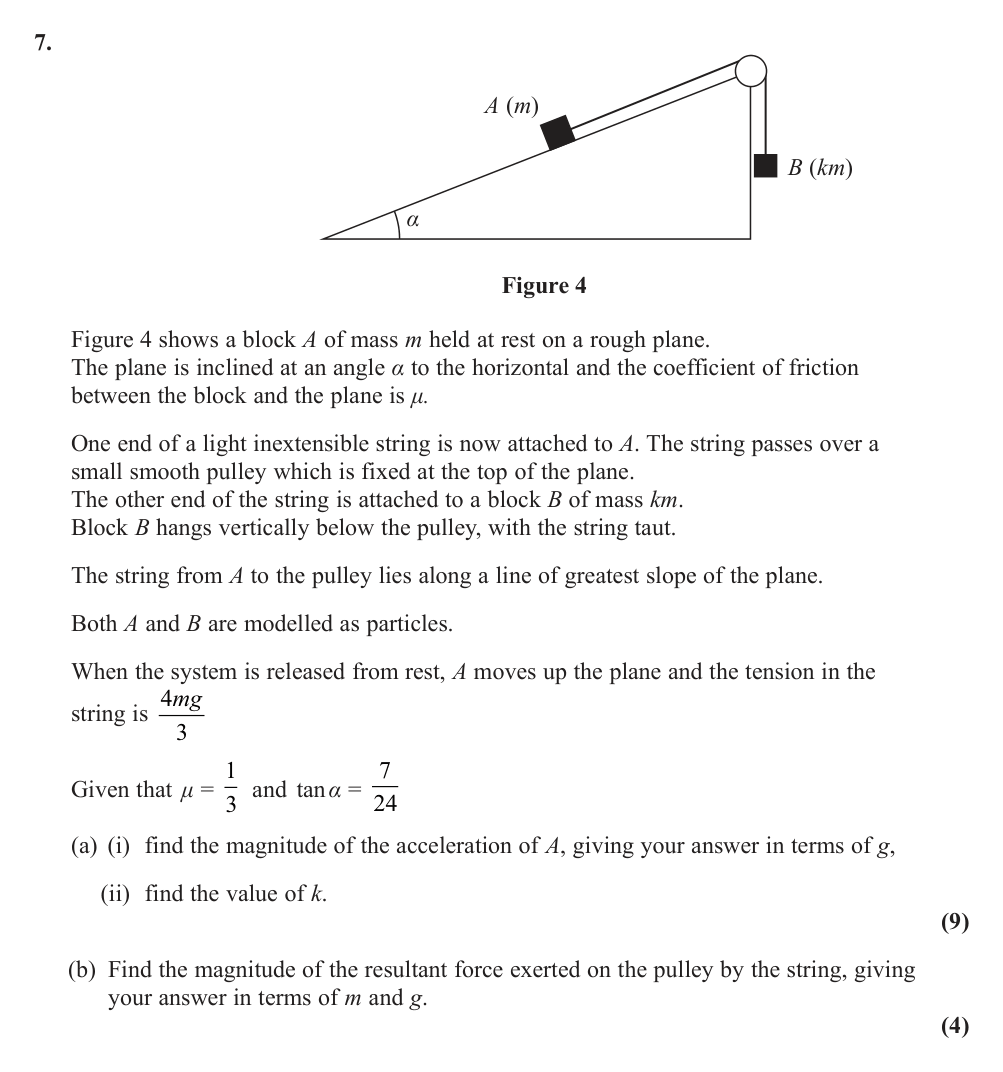
Given $\tan\alpha=\dfrac{7}{24}$, use $\sin\alpha=\dfrac{7}{25}$ and $\cos\alpha=\dfrac{24}{25}$.
Find friction on A
For block A, $R=mg\cos\alpha=\dfrac{24mg}{25}$. Since $\mu=\dfrac13$, friction is $F=\dfrac13R=\dfrac{8mg}{25}$.
Apply Newtons second law to A
A moves up the plane, so friction and the component of weight act down the plane. Taking up the plane as positive: $T-mg\sin\alpha-F=ma$.
Find the acceleration
Substitute $T=\dfrac43mg$, $mg\sin\alpha=\dfrac{7mg}{25}$ and $F=\dfrac{8mg}{25}$: $ma=\dfrac43mg-\dfrac{15mg}{25}=\left(\dfrac43-\dfrac35\right)mg=\dfrac{11mg}{15}$. Hence $a=\dfrac{11g}{15}$.
Apply Newtons second law to B
Block B moves downwards with the same acceleration. Taking downward as positive: $kmg-T=kma$.
Find k
Substitute $T=\dfrac43mg$ and $a=\dfrac{11g}{15}$: $kmg-\dfrac43mg=k m\dfrac{11g}{15}$. Divide by $mg$ to get $k-\dfrac43=\dfrac{11k}{15}$, so $15k-20=11k$ and $k=5$.
Resolve the force on the pulley
The pulley is pulled by two tensions of magnitude $T$. One is vertical and the other is along the plane. The horizontal component of the resultant is $T\cos\alpha$ and the vertical component is $T+T\sin\alpha$.
Find the resultant
The magnitude is $T\sqrt{\cos^2\alpha+(1+\sin\alpha)^2}$. With $\sin\alpha=\dfrac{7}{25}$ and $\cos\alpha=\dfrac{24}{25}$, this is $T\sqrt{\dfrac{576}{625}+\dfrac{1024}{625}}=\dfrac{8T}{5}$. Since $T=\dfrac43mg$, the resultant is $\dfrac{32}{15}mg$.
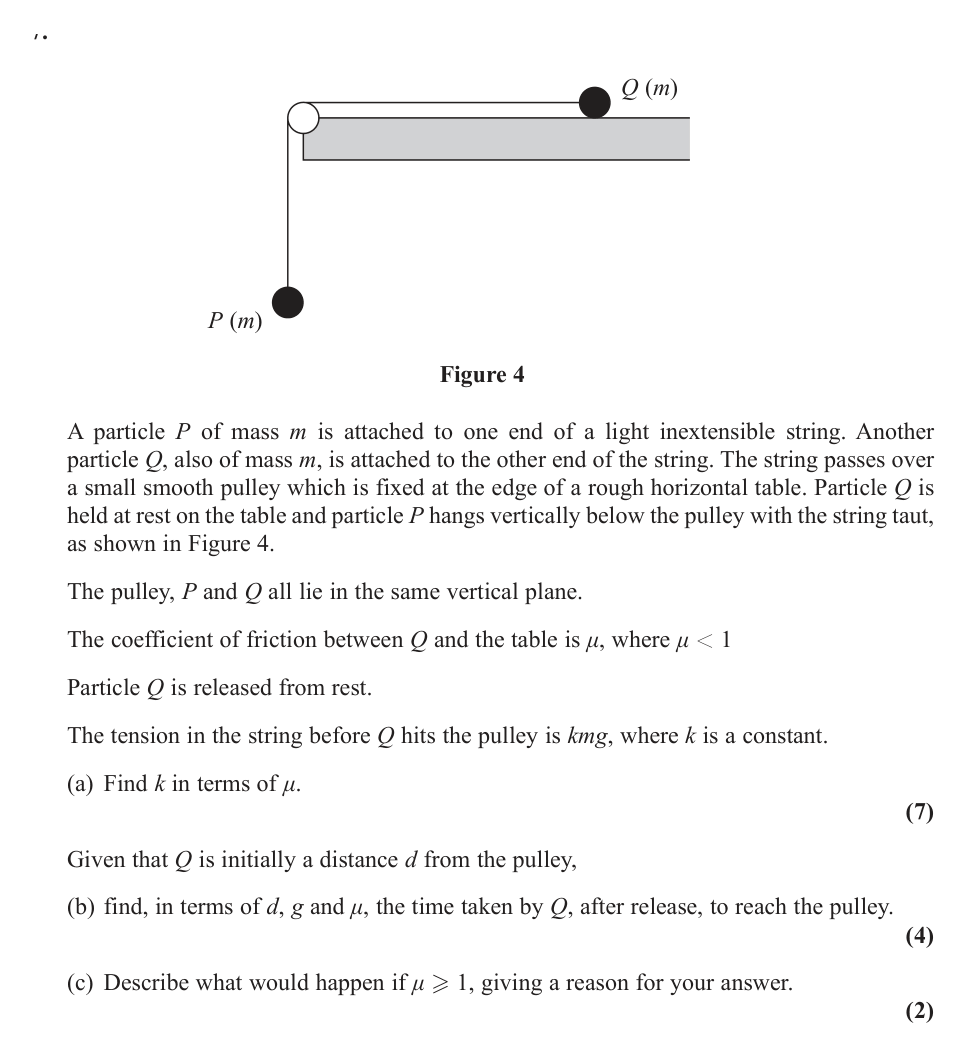
Q starts from rest and travels distance $d$, so $d=\dfrac12at^2=\dfrac12\cdot\dfrac{g(1-\mu)}{2}t^2$.
Find the time
$d=\dfrac{g(1-\mu)t^2}{4}$, so $t=\sqrt{\dfrac{4d}{g(1-\mu)}}$.
Consider mu at least 1
If $\mu\ge1$, the maximum available friction on Q is at least $mg$, so it can balance the pull caused by the hanging particle. The system would not start moving.
Final answer
$(a)\ k=\dfrac{1+\mu}{2}.\quad (b)\ t=\sqrt{\dfrac{4d}{g(1-\mu)}}.\quad (c)$ If $\mu\ge1$, the system would not move because friction can balance the pull from P.
44. WME01/01 January 2022 · Q7
Hard13 marks · main topic: Resolving Forces, Inclined PlanesShow worked solution
Write the equation for Q
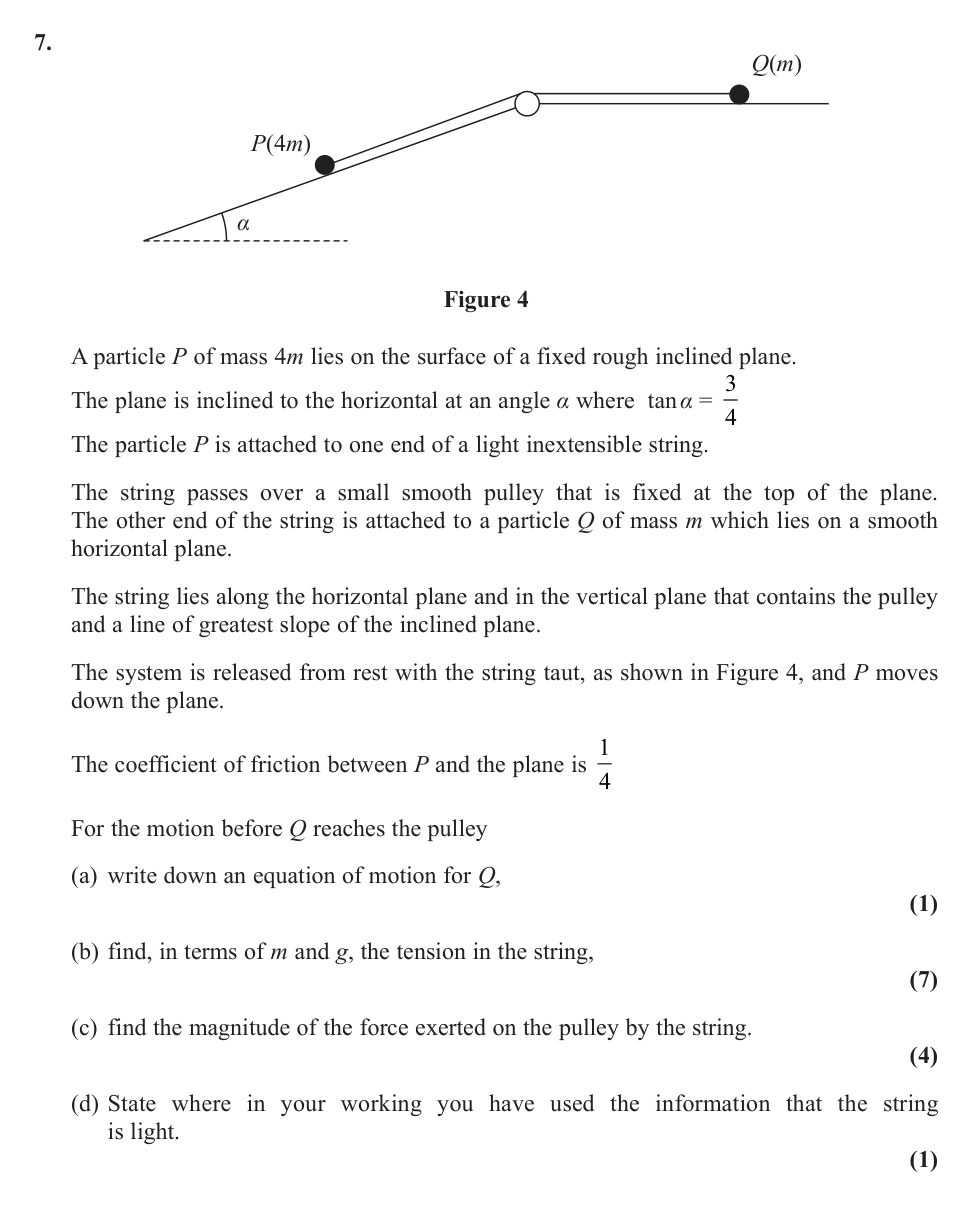
Q lies on a smooth horizontal plane. The only horizontal force on Q is the tension, so $T=ma$.
Use the trig ratios
Since $\tan\alpha=\dfrac34$, $\sin\alpha=\dfrac35$ and $\cos\alpha=\dfrac45$.
Find friction on P
For P, $R=4mg\cos\alpha=4mg\cdot\dfrac45=\dfrac{16mg}{5}$. With coefficient $\dfrac14$, friction is $F=\dfrac14R=\dfrac{4mg}{5}$.
Apply Newtons second law to P
P moves down the plane. Taking down the plane as positive: $4mg\sin\alpha-T-F=4ma$.
Substitute values
$4mg\cdot\dfrac35-T-\dfrac{4mg}{5}=4ma$, so $\dfrac{8mg}{5}-T=4ma$.
Use T = ma
From Q, $a=\dfrac{T}{m}$. Substitute into the equation for P: $\dfrac{8mg}{5}-T=4T$.
Find T
$\dfrac{8mg}{5}=5T$, so $T=\dfrac{8}{25}mg$.
Find the pulley resultant
The pulley is pulled by two tensions of magnitude $T$: one horizontal and one along the inclined string. Their resultant has components $T-T\cos\alpha$ horizontally and $T\sin\alpha$ vertically.
Calculate the resultant
Magnitude $=\sqrt{(T-T\cos\alpha)^2+(T\sin\alpha)^2}=T\sqrt{(1-\tfrac45)^2+(\tfrac35)^2}=\dfrac{T}{5}\sqrt{10}$. With $T=\dfrac{8}{25}mg$, the resultant is $\dfrac{8\sqrt{10}}{125}mg$.
Use the light-string model
The string is light, so the tension can be treated as the same on the P side and the Q side of the pulley.
Final answer
$(a)\ T=ma.\quad (b)\ T=\dfrac{8}{25}mg.\quad (c)\ \text{resultant}=\dfrac{8\sqrt{10}}{125}mg.\quad (d)$ Same tension was used on both sides of the pulley.
45. WME01/01 January 2026 · Q7
Hard14 marks · main topic: Resolving Forces, Inclined PlanesShow worked solution
Find the trigonometric ratios
Since $\tan\theta=\dfrac43$, use a $3$-$4$-$5$ triangle: $\sin\theta=\dfrac45$ and $\cos\theta=\dfrac35$.
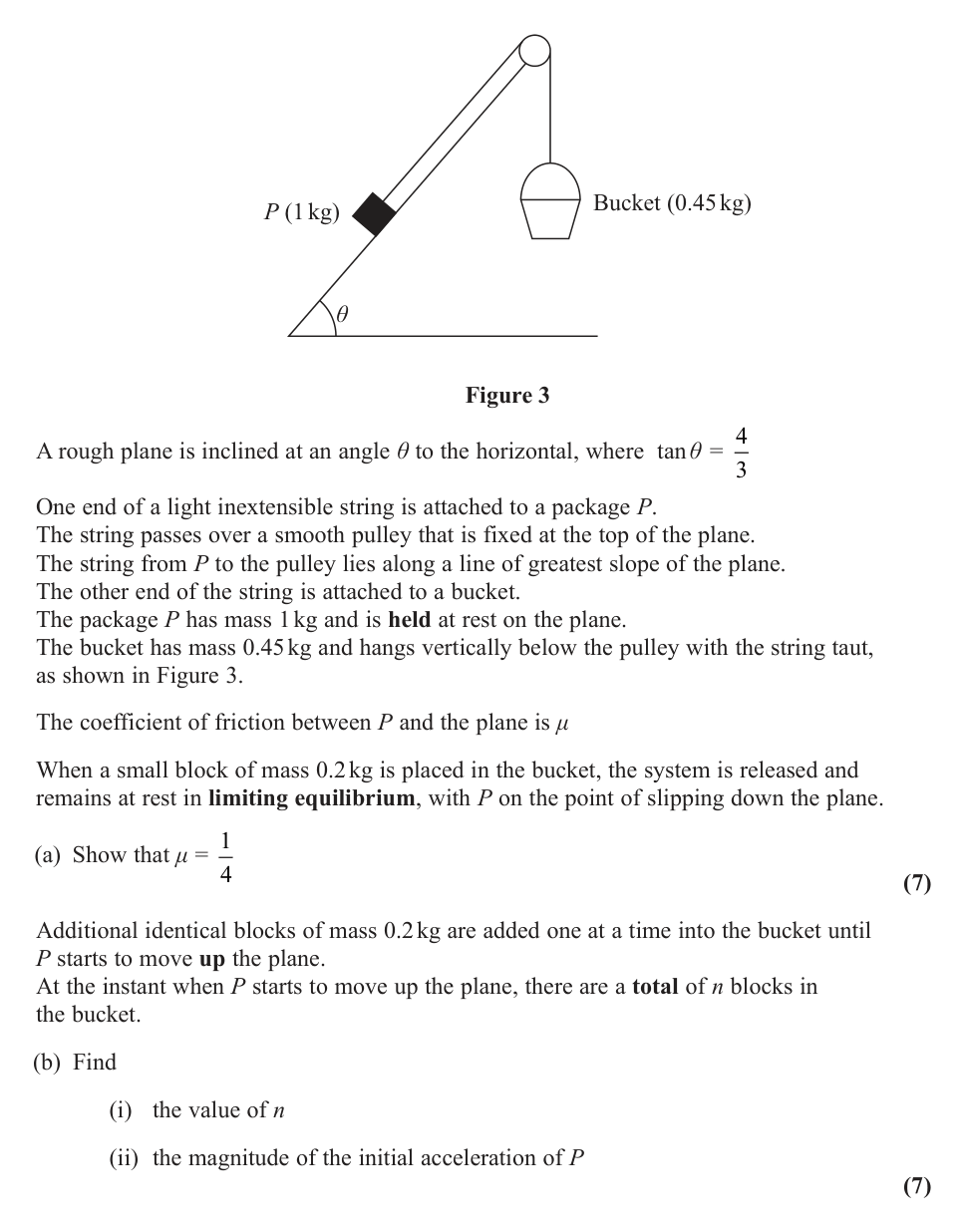
Use limiting equilibrium in part (a)
With one $0.2$ kg block in the bucket, the bucket side has mass $0.45+0.2=0.65$ kg. Since the package is on the point of slipping down the plane, friction on P acts up the plane.
Find the friction force
The tension equals the bucket weight, so $T=0.65g$. Along the plane for P in equilibrium, $T+F=g\sin\theta$. Hence $0.65g+F=\dfrac45g$, so $F=\dfrac{3g}{20}$.
Find the normal reaction and mu
Perpendicular to the plane, $R=g\cos\theta=\dfrac35g$. Since $F=\mu R$, $\mu=\dfrac{F}{R}=\dfrac{3g/20}{3g/5}=\dfrac14$.
Set the condition for upward motion
When P is about to move up the plane, friction acts down the plane. With $n$ blocks in the bucket, the bucket-side mass is $0.45+0.2n$. The bucket weight must exceed the downslope resistance: $(0.45+0.2n)g>g\sin\theta+\mu R$.
Find n
Using $g\sin\theta=\dfrac45g$ and $\mu R=\dfrac14\cdot\dfrac35g=\dfrac{3g}{20}$, the condition is $0.45+0.2n>\dfrac45+\dfrac{3}{20}=0.95$. Hence $0.2n>0.50$, so $n>2.5$ and the least integer is $n=3$.
Apply Newtons second law after motion begins
For $n=3$, the bucket-side mass is $0.45+0.6=1.05$ kg and the total moving mass is $1+1.05=2.05$ kg. The driving force is $1.05g-\dfrac45g-\dfrac{3g}{20}=0.10g$.
Find the acceleration
Using $F=ma$, $0.10g=2.05a$, so $a=\dfrac{0.10g}{2.05}=\dfrac{2g}{41}=0.478\ \mathrm{m\,s^{-2}}$ to 3 significant figures.
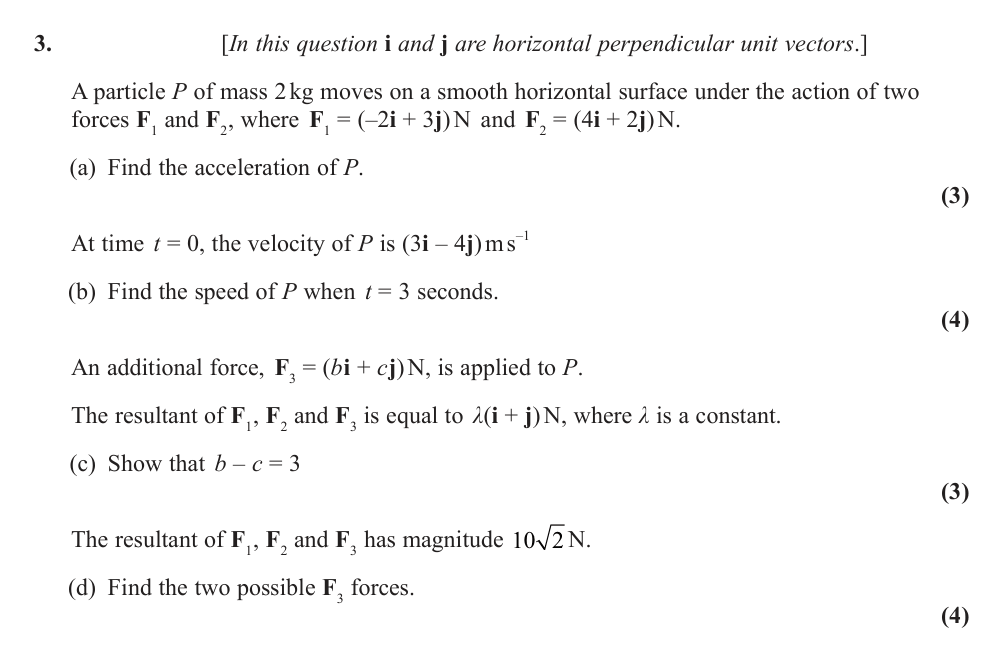
Part (c): Show that b - c = 3 - Apply the condition
Given that resultant = $\lambda(\mathbf{i} + \mathbf{j})$, we can write: $(2 + b)\mathbf{i} + (5 + c)\mathbf{j} = \lambda\mathbf{i} + \lambda\mathbf{j}$
Part (c): Show that b - c = 3 - Compare coefficients
For this to be in the form $\lambda(\mathbf{i} + \mathbf{j})$, the coefficients must be equal: $2 + b = \lambda$ $5 + c = \lambda$ Therefore: $2 + b = 5 + c$ $b = 5 + c - 2$ $b = 3 + c$ $b - c = 3$
Part (d): Find the two possible $\mathbf{F}_3$ forces - Use the magnitude condition
Resultant = $(2 + b)\mathbf{i} + (5 + c)\mathbf{j}$ Since resultant = $\lambda(\mathbf{i} + \mathbf{j})$, we have $2 + b = 5 + c = \lambda$ $|\mathbf{F}_{\text{resultant}}| = \lambda\sqrt{1^2 + 1^2} = \lambda\sqrt{2}$ Given: $|\mathbf{F}_{\text{resultant}}| = 10\sqrt{2}$ $\lambda\sqrt{2} = 10\sqrt{2}$ $\lambda = 10 \quad \text{or} \quad \lambda = -10$ (The negative value comes from considering the opposite direction)
Part (d): Find the two possible $\mathbf{F}_3$ forces - Find b and c for each value of $\lambda$
Case 1: $\lambda = 10$ $2 + b = 10 \quad \Rightarrow \quad b = 8$ $5 + c = 10 \quad \Rightarrow \quad c = 5$ Check: $b - c = 8 - 5 = 3$ ✓ Therefore: $\mathbf{F}_3 = 8\mathbf{i} + 5\mathbf{j}$ N Case 2: $\lambda = -10$ $2 + b = -10 \quad \Rightarrow \quad b = -12$ $5 + c = -10 \quad \Rightarrow \quad c = -15$ Check: $b - c = -12 - (-15) = 3$ ✓ Therefore: $\mathbf{F}_3 = -12\mathbf{i} - 15\mathbf{j}$ N
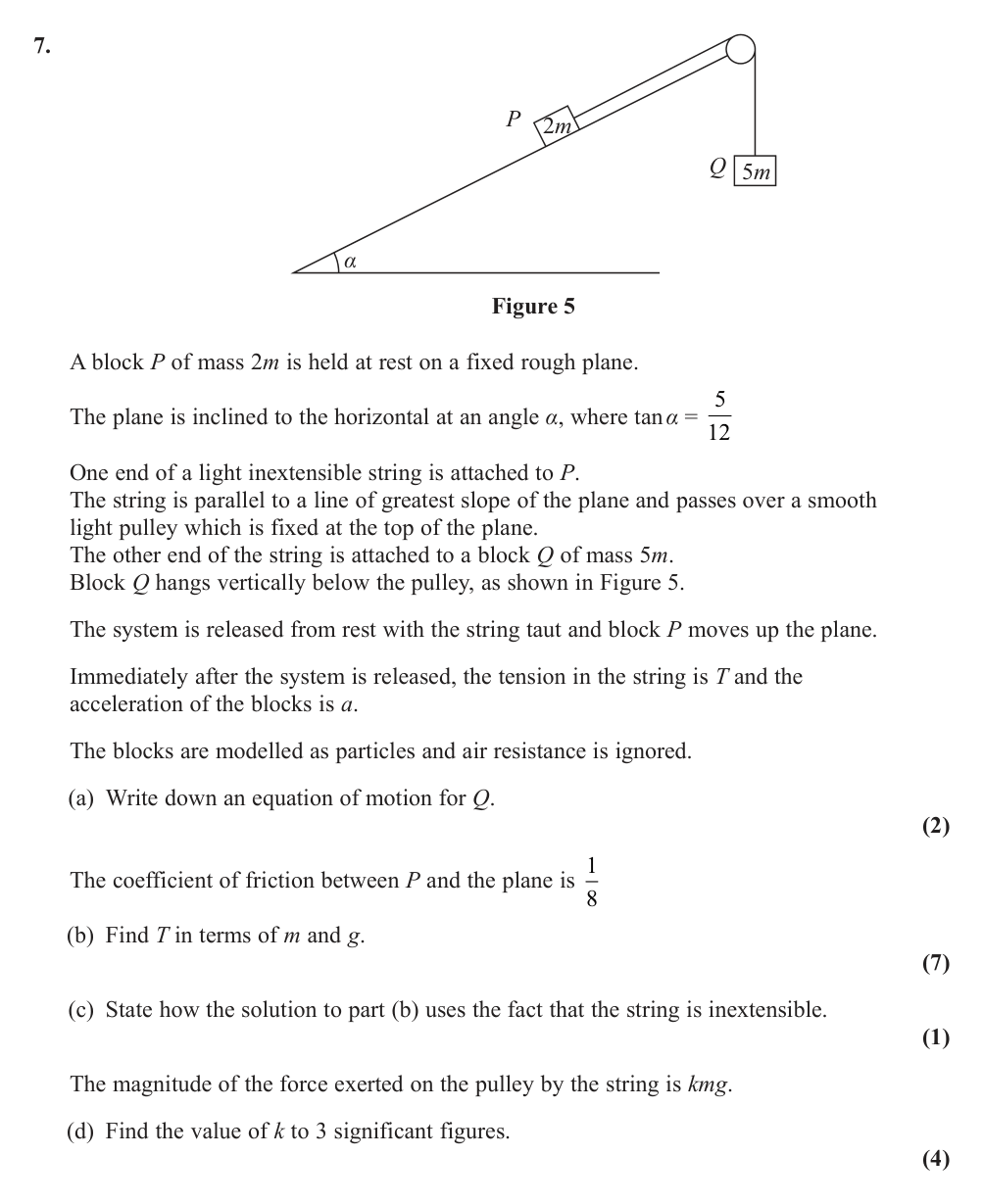
Part (c): State how solution uses fact that string is inextensible
An inextensible string means the string cannot stretch. This has the following consequence: For an inextensible string over a pulley: The magnitude of acceleration of both connected particles must be equal. In this problem: $|a_P| = |a_Q| = a$ How this was used in part (b): When we wrote the equations of motion: ; For P: $T - mg = 2ma$ ; For Q: $5mg - T = 5ma$ We used the same acceleration $a$ for both particles because the string is inextensible. If the string could stretch, the two particles could have different accelerations.
Part (d): Find value of k (force on pulley = kmg) - Identify the angle between tensions
The string from Q is vertical (downward). The string from P is along the plane at angle $\alpha$ to horizontal. Angle between the two strings = $90^\circ + \alpha$
Part (d): Find value of k (force on pulley = kmg) - Use vector components
Let's take horizontal (right) and vertical (up) as positive directions. Tension from Q: ; Horizontal component: $0$ ; Vertical component: $-T = -\frac{15mg}{7}$ (downward) Tension from P along plane: The plane makes angle $\alpha$ with horizontal, so: ; Horizontal component: $-T\cos\alpha = -\frac{15mg}{7} \times \frac{12}{13} = -\frac{180mg}{91}$ ; Vertical component: $T\sin\alpha = \frac{15mg}{7} \times \frac{5}{13} = \frac{75mg}{91}$
Part (d): Find value of k (force on pulley = kmg) - Find resultant
$(a)\ 5mg-T=5ma.\quad (b)\ T=\dfrac{15mg}{7}.\quad (c)\ \text{both particles have the same magnitude of acceleration}.\quad (d)\ k=2.38$.
48. WME01/01 May/June 2024 · Q5
Hard14 marks · main topic: Constant Acceleration in 1DShow worked solution
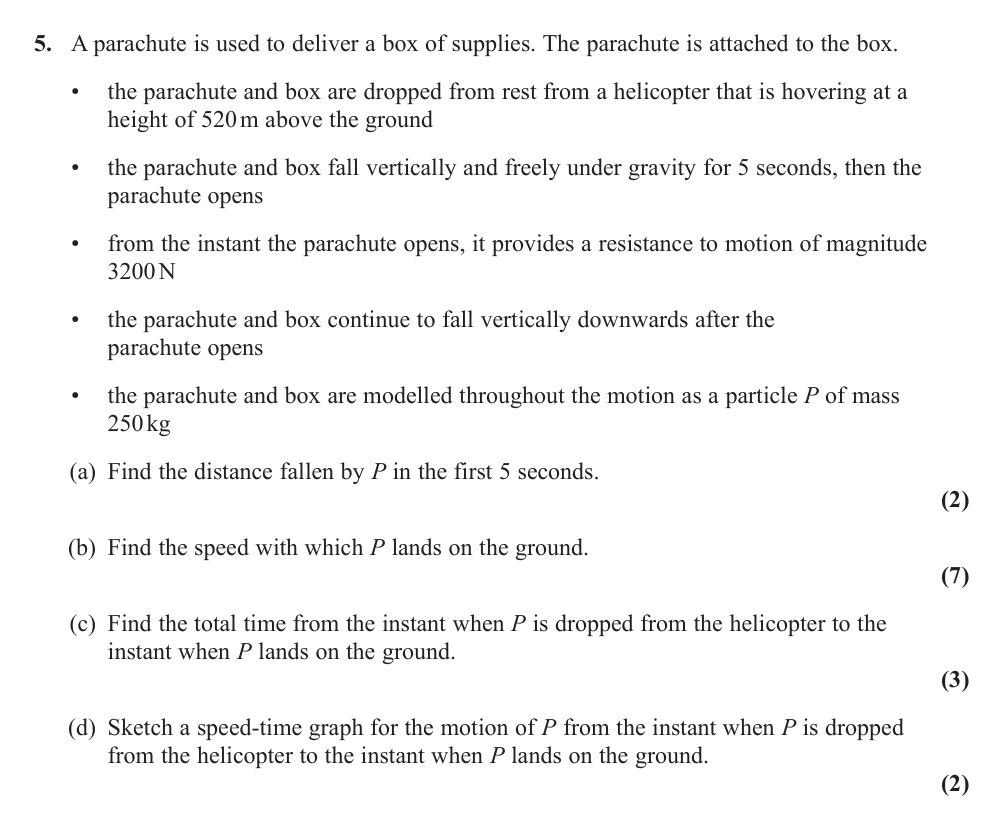
Find the first distance
For the first 5 seconds, P falls freely from rest. Using $s=ut+\dfrac12at^2$, $s=0+\dfrac12(9.8)(5^2)=122.5\ \mathrm{m}$.
Find the speed when the parachute opens
After 5 seconds of free fall, $v=0+9.8(5)=49\ \mathrm{m\,s^{-1}}$ downward.
Find the new acceleration
After the parachute opens, weight is $250g=2450$ N downward and resistance is $3200$ N upward. Taking downward as positive, the resultant is $2450-3200=-750$ N, so $a=\dfrac{-750}{250}=-3\ \mathrm{m\,s^{-2}}$.
Use the remaining distance
The remaining distance is $520-122.5=397.5$ m. Using $v^2=u^2+2as$: $v^2=49^2+2(-3)(397.5)=16$.
Find the landing speed
$v=4\ \mathrm{m\,s^{-1}}$, so P lands with speed $4\ \mathrm{m\,s^{-1}}$.
Find the time after the parachute opens
Using $v=u+at$, $4=49-3t$, so $t=15$ s after the parachute opens.
Find the total time and describe the graph
The total time is $5+15=20$ s. The speed-time graph rises linearly from $0$ to $49$ over the first 5 s, then falls linearly to $4$ at $t=20$; it does not meet the time-axis.
Final answer
$(a)\ 122.5\ \mathrm{m}\ \text{or}\ 123\ \mathrm{m}.\quad (b)\ 4\ \mathrm{m\,s^{-1}}.\quad (c)\ 20\ \mathrm{s}$. (d) Speed-time graph: straight line from $(0,0)$ to $(5,49)$ then straight line down to $(20,4)$.
49. WME01/01 October 2021 · Q7
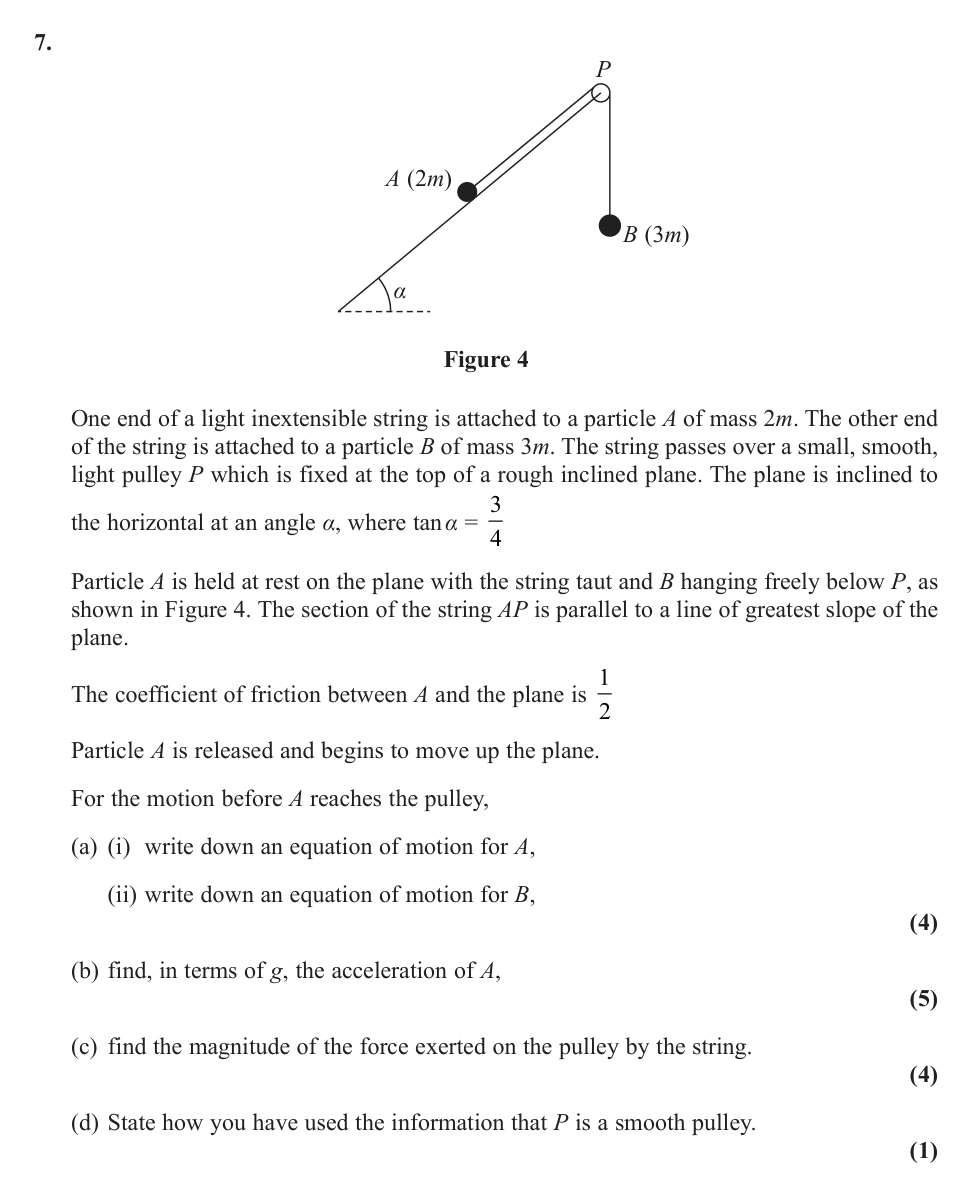
Hard14 marks · main topic: Resolving Forces, Inclined PlanesShow worked solution
Equation for A
A moves up the plane, so friction and the component of weight act down the plane. Taking up the plane as positive: $T-2mg\sin\alpha-F=2ma$.
Equation for B
B moves downward. Taking downward as positive: $3mg-T=3ma$.
Find friction on A
Since $\tan\alpha=\dfrac34$, $\sin\alpha=\dfrac35$ and $\cos\alpha=\dfrac45$. The normal reaction on A is $R=2mg\cos\alpha=\dfrac{8mg}{5}$, so $F=\dfrac12R=\dfrac{4mg}{5}$.
Simplify A's equation
$T-2mg\cdot\dfrac35-\dfrac{4mg}{5}=2ma$, so $T-2mg=2ma$.
Solve with B's equation
From B, $T=3mg-3ma$. Substitute into $T-2mg=2ma$: $3mg-3ma-2mg=2ma$. Thus $mg=5ma$ and $a=\dfrac{g}{5}$.
Find the tension
Using $3mg-T=3m\left(\dfrac{g}{5}\right)$ gives $T=3mg-\dfrac{3mg}{5}=\dfrac{12mg}{5}$.
Find the pulley resultant
The two tensions are one vertical and one along the plane. Components of the resultant are $T\cos\alpha$ horizontally and $T+T\sin\alpha$ vertically.
Calculate the magnitude
Resultant $=T\sqrt{\cos^2\alpha+(1+\sin\alpha)^2}=T\sqrt{(\tfrac45)^2+(\tfrac85)^2}=\dfrac{4\sqrt5}{5}T$. With $T=\dfrac{12mg}{5}$, this is $\dfrac{48\sqrt5}{25}mg$.
Use the smooth pulley information
The pulley is smooth, so the tension is the same on both sides of the pulley.
Final answer
$(a)(i)\ T-2mg\sin\alpha-F=2ma.\quad (a)(ii)\ 3mg-T=3ma.\quad (b)\ a=\dfrac{g}{5}.\quad (c)\ \text{resultant}=\dfrac{48\sqrt5}{25}mg.\quad (d)$ The tension is the same on both sides of the pulley.
50. WME01/01 January 2025 · Q7
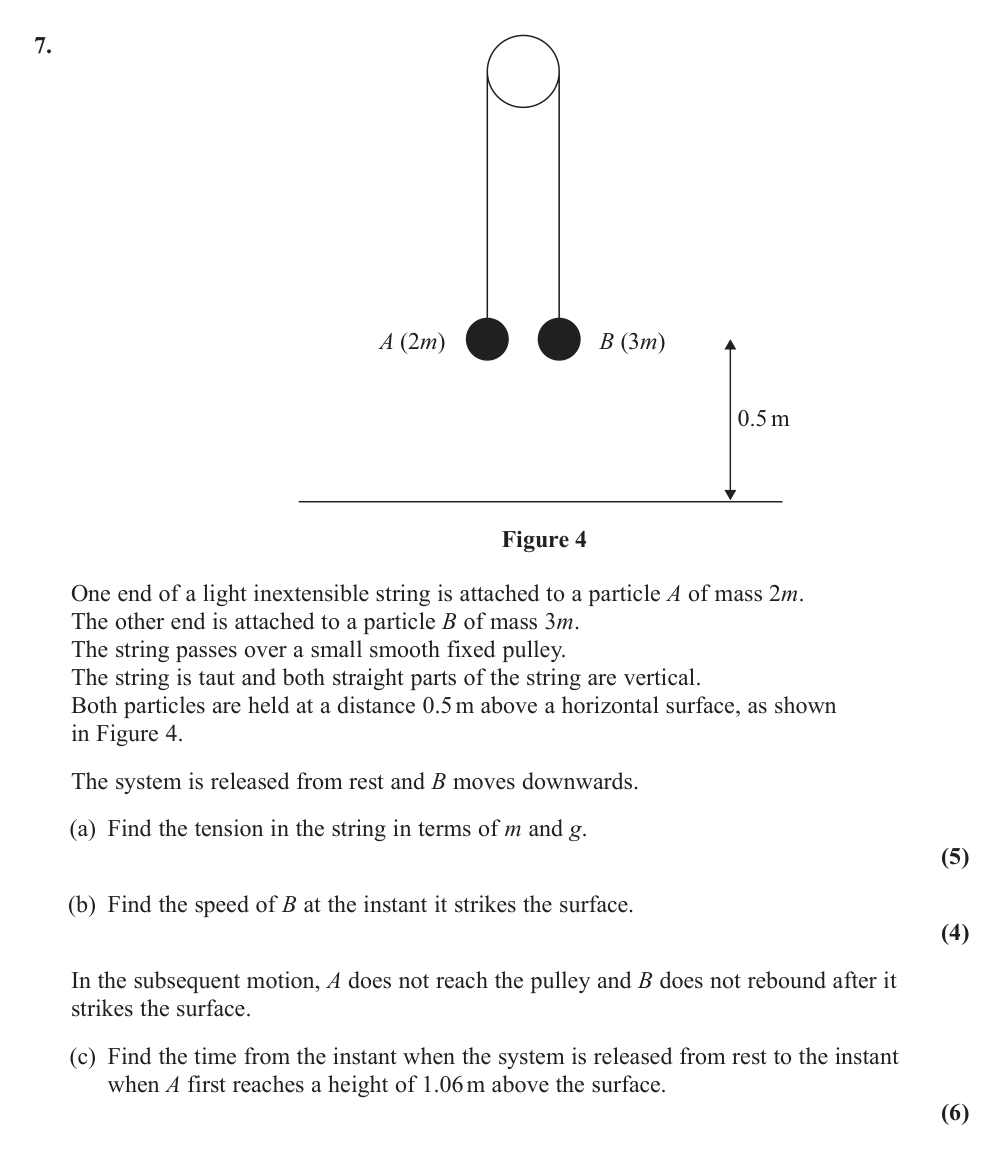
Hard15 marksShow worked solution
Write the equations of motion
B moves down and A moves up with the same acceleration $a$. For A: $T-2mg=2ma$. For B: $3mg-T=3ma$.
Find the acceleration
Adding the two equations gives $mg=5ma$, so $a=\dfrac{g}{5}$.
Find the tension
Use $T-2mg=2ma$: $T=2mg+2m\left(\dfrac{g}{5}\right)=\dfrac{12mg}{5}$.
Find the speed when B hits the surface
B starts from rest and moves $0.5$ m with acceleration $g/5$. Using $v^2=u^2+2as$, $v^2=2\left(\dfrac{g}{5}\right)(0.5)=\dfrac{g}{5}=1.96$.
Calculate the impact speed
$v=\sqrt{1.96}=1.4\ \mathrm{m\,s^{-1}}$.
Find the first time interval
The time until B hits the surface is found from $0.5=\dfrac12\left(\dfrac{g}{5}\right)t_1^2$. With $g=9.8$, $t_1=\dfrac{5}{7}=0.714285\ldots$ s.
Find the extra time after B stops
After B hits the surface, A continues upwards freely under gravity. It is then at height $1.00$ m and must rise another $0.06$ m with initial speed $1.4\ \mathrm{m\,s^{-1}}$. So $0.06=1.4t_2-4.9t_2^2$.
Find the total time
Solving $0.06=1.4t_2-4.9t_2^2$ gives the first positive time $t_2=0.0525\ldots$ s. Therefore the total time is $0.714285\ldots+0.0525\ldots=0.767\ \mathrm{s}$.
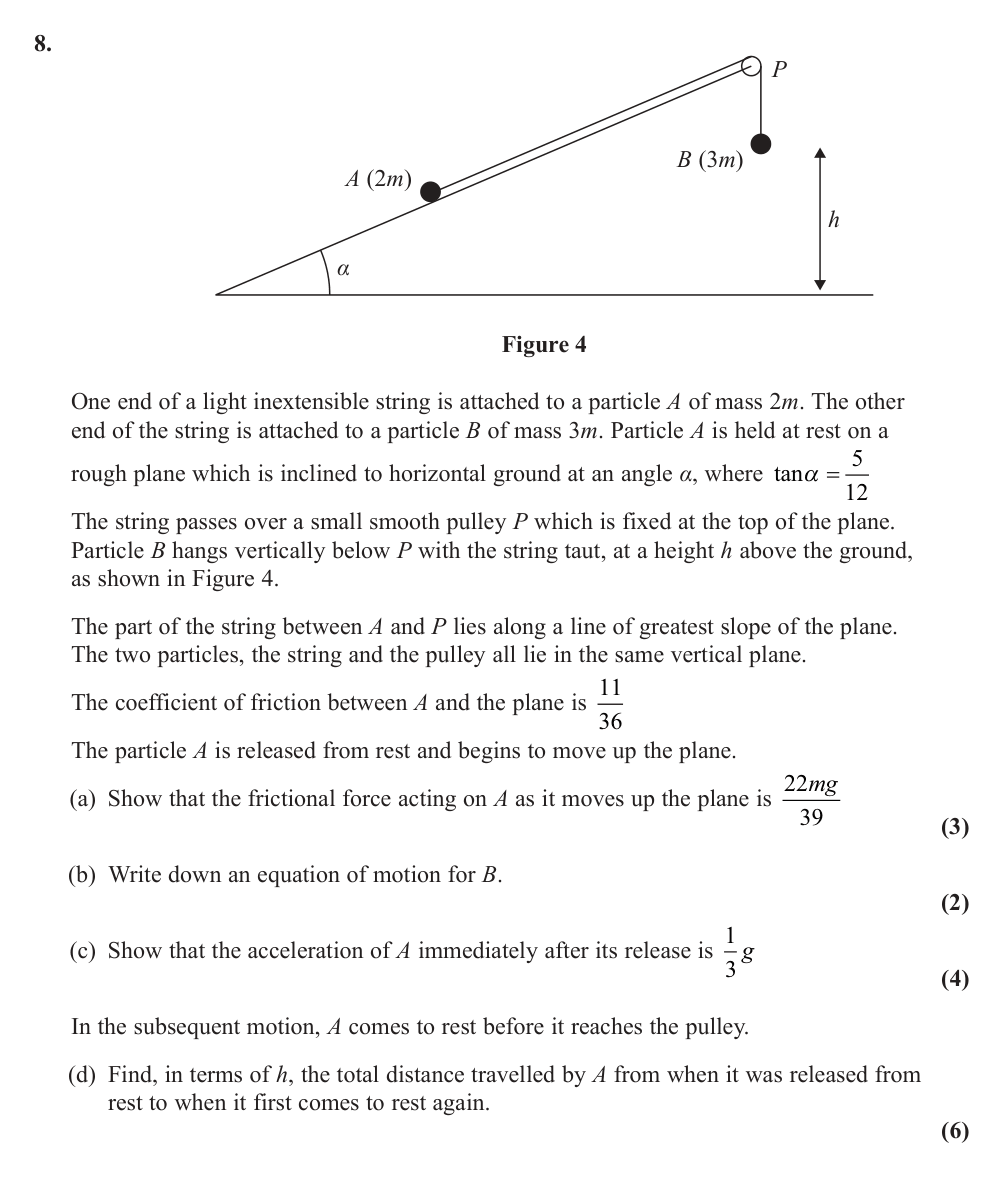
Hard15 marks · main topic: Resolving Forces, Inclined PlanesShow worked solution
Use the trig ratios
Here $\tan\alpha=\dfrac{5}{12}$, so $\sin\alpha=\dfrac{5}{13}$ and $\cos\alpha=\dfrac{12}{13}$.
Show the frictional force on A
For A, $R=2mg\cos\alpha=2mg\cdot\dfrac{12}{13}=\dfrac{24mg}{13}$. Since $\mu=\dfrac{11}{36}$, $F=\mu R=\dfrac{11}{36}\cdot\dfrac{24mg}{13}=\dfrac{22mg}{39}$.
Write the equation for B
B moves down as A moves up. Taking downward as positive for B: $3mg-T=3ma$.
Write the equation for A
Taking up the plane as positive for A: $T-2mg\sin\alpha-F=2ma$. Substituting $\sin\alpha=\dfrac{5}{13}$ and $F=\dfrac{22mg}{39}$ gives $T-\dfrac{10mg}{13}-\dfrac{22mg}{39}=2ma$.
Show the acceleration
From B, $T=3mg-3ma$. Substitute into A equation: $3mg-3ma-\dfrac{10mg}{13}-\dfrac{22mg}{39}=2ma$. The constant part is $\dfrac{5mg}{3}$, so $\dfrac{5mg}{3}=5ma$ and $a=\dfrac{g}{3}$.
Find the speed when B reaches the ground
While B descends distance $h$, A moves distance $h$ up the plane from rest with acceleration $g/3$. Thus $v^2=2\left(\dfrac{g}{3}\right)h=\dfrac{2gh}{3}$.
Find the later deceleration of A
After B reaches the ground, the string no longer pulls A. The forces down the plane on A are $2mg\sin\alpha+F=\dfrac{10mg}{13}+\dfrac{22mg}{39}=\dfrac{4mg}{3}$. Since A has mass $2m$, its deceleration is $\dfrac{2g}{3}$.
Find the extra distance and total distance
Let the extra distance be $d$. Using $0=v^2-2\left(\dfrac{2g}{3}\right)d$ with $v^2=\dfrac{2gh}{3}$ gives $d=\dfrac{h}{2}$. Total distance travelled by A is $h+\dfrac{h}{2}=\dfrac{3h}{2}$.
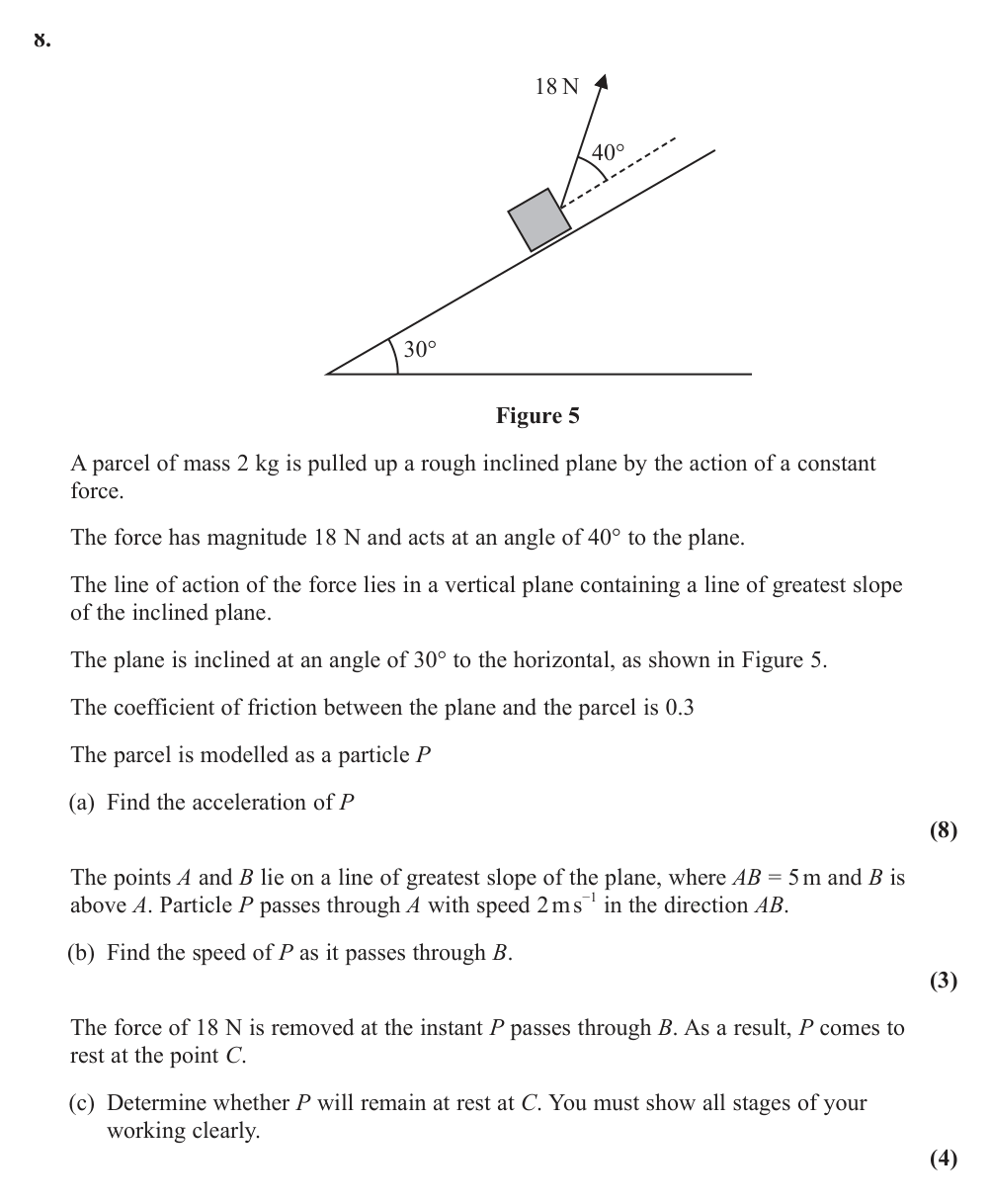
Using $g=9.8$, this gives $a=1.18\ldots\ \mathrm{m\,s^{-2}}$ up the plane.
Find the speed at B
From A to B, $u=2$, $s=5$ and $a=1.18\ldots$. Use $v^2=u^2+2as$: $v^2=2^2+2(1.18\ldots)(5)$.
State the speed
$v=3.98\ldots\ \mathrm{m\,s^{-1}}$, about $4.0\ \mathrm{m\,s^{-1}}$.
Check rest after the force is removed
At C, with the pulling force removed, $R=2g\cos30^\circ$. The maximum friction is $0.3R=0.3(2g\cos30^\circ)=5.09\ldots\ \mathrm{N}$.
Compare with the downslope weight component
The component of weight down the plane is $2g\sin30^\circ=9.8\ \mathrm{N}$. Since $9.8>5.09\ldots$, friction is not large enough to hold P at rest, so P will not remain at rest at C.
Final answer
$(a)\ a=1.18\ \mathrm{m\,s^{-2}}\ \text{up the plane}.\quad (b)\ v=3.98\ \mathrm{m\,s^{-1}}\approx4.0\ \mathrm{m\,s^{-1}}.\quad (c)$ P will not remain at rest at C.
53. WME01/01 May/June 2025 · Q8
Hard17 marksShow worked solution
Part (a): Write equation of motion for P - Identify forces on P
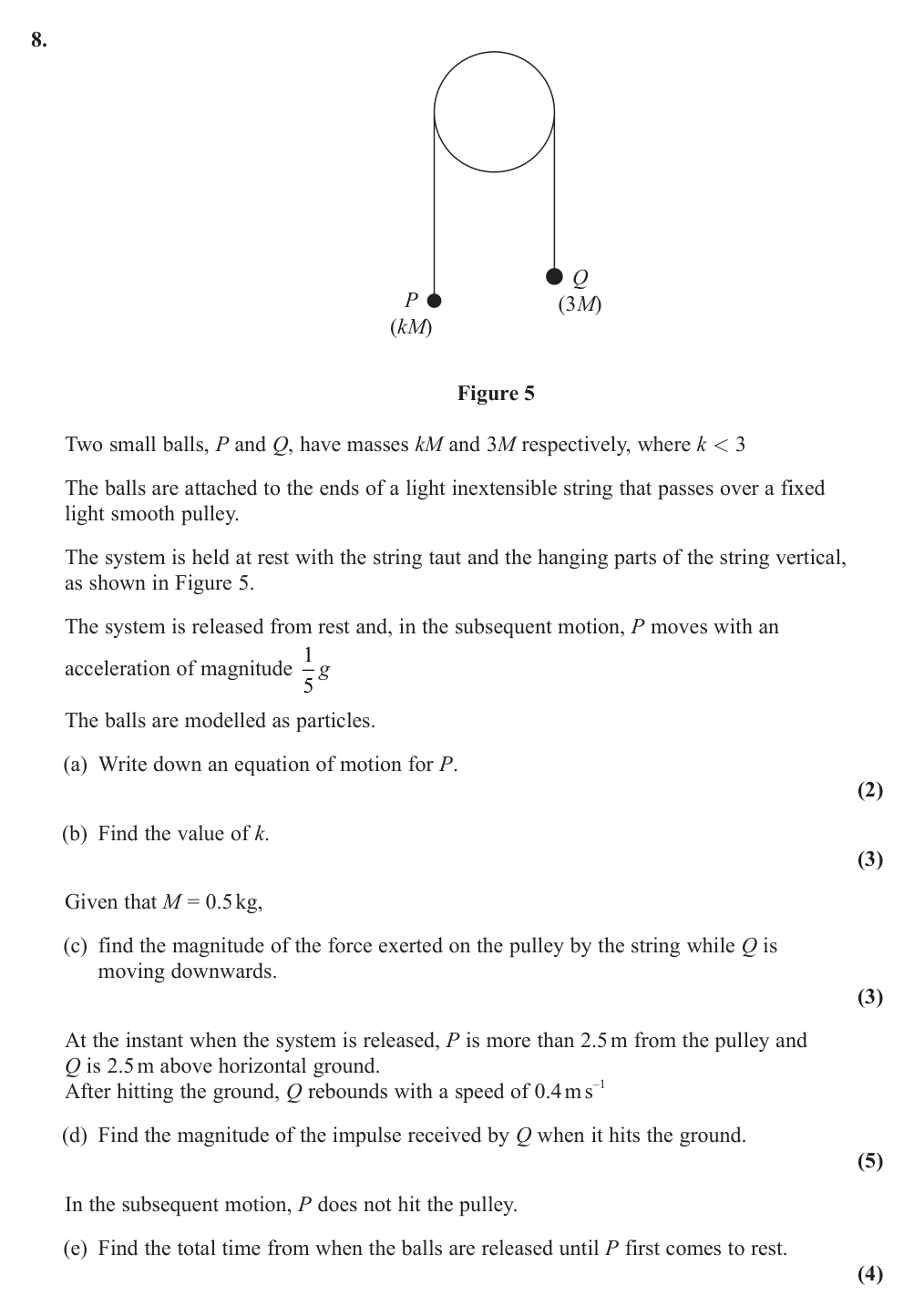
Particle P (mass $kM$) moves upward with acceleration $\frac{g}{5}$: ; Tension T (upward) ; Weight $kMg$ (downward)
Part (a): Write equation of motion for P - Apply Newton's Second Law
Taking upward as positive: $\sum F = ma$ $T - kMg = kM \times \frac{g}{5}$
Part (b): Find value of k - Write equation of motion for Q
Particle Q (mass $3M$) moves downward with acceleration $\frac{g}{5}$: Taking downward as positive for Q: $3Mg - T = 3M \times \frac{g}{5}$ $3Mg - T = \frac{3Mg}{5}$ $T = 3Mg - \frac{3Mg}{5}$ $T = \frac{12Mg}{5}$
Part (b): Find value of k - Substitute into equation for P
Hard17 marks · main topic: Resolving Forces, Inclined PlanesShow worked solution
Use the trig ratios
Since $\tan\alpha=\dfrac34$, $\sin\alpha=\dfrac35$ and $\cos\alpha=\dfrac45$.
Find friction on A
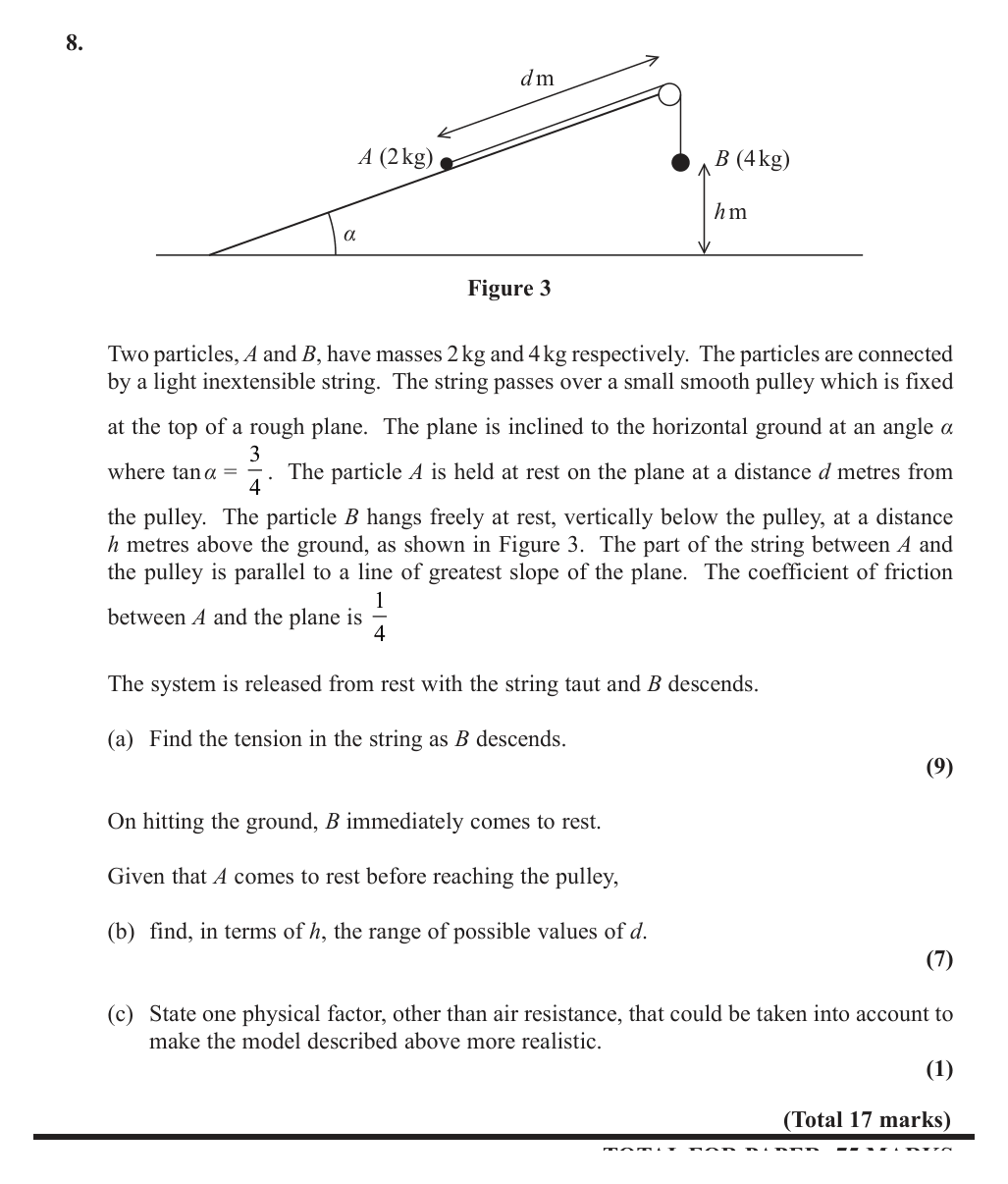
For A, $R=2g\cos\alpha=\dfrac{8g}{5}$. With coefficient $\dfrac14$, friction is $F=\dfrac14R=\dfrac{2g}{5}$.
Equation for A
A moves up the plane. Taking up the plane as positive: $T-2g\sin\alpha-F=2a$.
Simplify A's equation
$T-2g\cdot\dfrac35-\dfrac{2g}{5}=2a$, so $T-\dfrac{8g}{5}=2a$.
Equation for B
B descends. Taking downward as positive: $4g-T=4a$.
Solve for T
From A, $T=2a+\dfrac{8g}{5}$. From B, $T=4g-4a$. Equating gives $6a=\dfrac{12g}{5}$, so $a=\dfrac{2g}{5}$. Then $T=4g-4\left(\dfrac{2g}{5}\right)=\dfrac{12g}{5}$ N.
Find speed when B reaches the ground
Before B hits the ground, both particles move distance $h$ from rest with acceleration $\dfrac{2g}{5}$. Thus $v^2=2\left(\dfrac{2g}{5}\right)h=\dfrac{4gh}{5}$.
Find extra distance after B stops
After B hits the ground, A continues up the plane. The forces down the plane on A are $2g\sin\alpha+F=\dfrac{6g}{5}+\dfrac{2g}{5}=\dfrac{8g}{5}$, so its deceleration is $\dfrac{4g}{5}$.
Calculate extra distance
Let the extra distance be $s$. Then $0=\dfrac{4gh}{5}-2\left(\dfrac{4g}{5}\right)s$, so $s=\dfrac{h}{2}$.
Find the range for d
A travels total distance $h+\dfrac{h}{2}=\dfrac{3h}{2}$ before stopping. Since it comes to rest before reaching the pulley, $d>\dfrac{3h}{2}$.
Name a more realistic factor
A more realistic model could include friction at the pulley.
Final answer
$(a)\ T=\dfrac{12g}{5}\ \mathrm{N}=23.5\ \mathrm{N}.\quad (b)\ d>\dfrac{3h}{2}.\quad (c)$ A more realistic model could include friction at the pulley.
55. WME01/01 January 2020 · Q7
Hard18 marksShow worked solution
Use B's descent
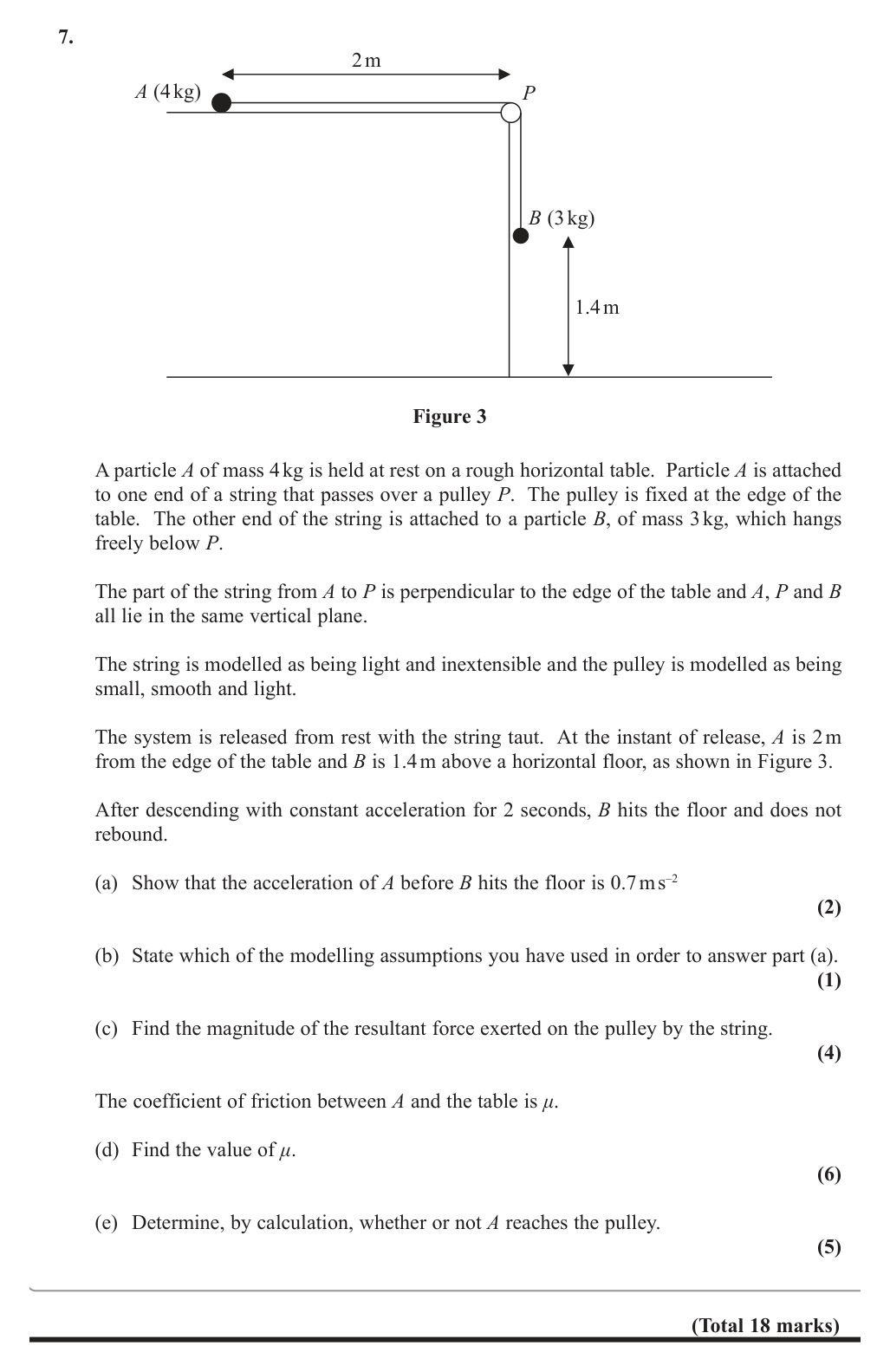
Before B hits the floor, it descends $1.4$ m from rest in $2$ s. Use $s=ut+\dfrac12at^2$: $1.4=\dfrac12a(2)^2$. Hence $a=0.7\ \mathrm{m\,s^{-2}}$.
Name the modelling assumption
The string is inextensible, so A and B have the same magnitude of acceleration while the string is taut.
Find the tension
For B, taking downward as positive: $3g-T=3(0.7)$. Thus $T=3g-2.1=27.3$ N.
Find the resultant force on the pulley
The pulley is pulled by two perpendicular tensions of magnitude $T$. Therefore the resultant is $\sqrt{T^2+T^2}=T\sqrt2=27.3\sqrt2=38.6$ N approximately.
Find the friction on A
For A before B hits the floor, $T-F=4(0.7)$. Hence $F=27.3-2.8=24.5$ N.
Find mu
On the horizontal table, $R=4g=39.2$ N and $F=\mu R$. So $\mu=\dfrac{24.5}{39.2}=0.625$.
Find A's speed when B hits the floor
At this instant, $v=at=0.7(2)=1.4\ \mathrm{m\,s^{-1}}$. A has also moved $1.4$ m towards the pulley.
Find the extra stopping distance
After B hits the floor, A is slowed only by friction. Its deceleration is $\mu g=0.625(9.8)=6.125\ \mathrm{m\,s^{-2}}$. Use $0=(1.4)^2-2(6.125)s$, giving $s=0.16$ m.
Compare with the distance to the pulley
A's total distance is $1.4+0.16=1.56$ m, which is less than $2$ m. Therefore A does not reach the pulley.
Final answer
$(a)\ a=0.7\ \mathrm{m\,s^{-2}}.\quad (b)$ Inextensibility of the string. $(c)\ 38.6\ \mathrm{N}.\quad (d)\ \mu=0.625.\quad (e)$ A does not reach the pulley.
 Elite Mathematics