Skip to content
Elite Mathematics
IAL · WME01 · Topic

Constant Acceleration in 2D: past paper questions & worked solutions

Every Constant Acceleration in 2D question from the WME01 papers in our bank, 2021–2026, sorted from easiest to hardest. Try each one first, then open the worked solution.

22questions
246marks in total
89%of papers (16 of 18) include it
1/3/18easy / medium / hard

Questions, easiest first

Level is estimated from marks: 1–6 easy, 7–8 medium, 9+ hard.

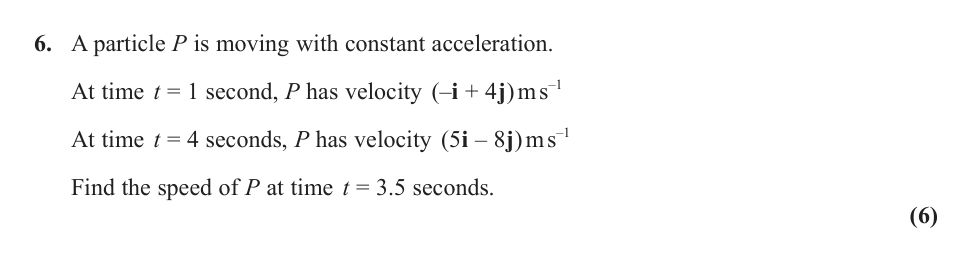
1. WME01/01 May/June 2022 · Q6

Easy6 marks · main topic: Working with Vectors
WME01/01 May/June 2022 Question 6 (6 marks): Constant Acceleration in 2D
Show worked solution
  1. Find the acceleration

    The velocity changes from $-\mathbf{i}+4\mathbf{j}$ at $t=1$ to $5\mathbf{i}-8\mathbf{j}$ at $t=4$. The time difference is $3$ s.

  2. Calculate acceleration

    $\mathbf{a}=\dfrac{(5\mathbf{i}-8\mathbf{j})-(-\mathbf{i}+4\mathbf{j})}{3}=\dfrac{6\mathbf{i}-12\mathbf{j}}{3}=2\mathbf{i}-4\mathbf{j}$.

  3. Find velocity at t = 3.5

    From $t=1$ to $t=3.5$ is $2.5$ s, so $\mathbf{v}=(-\mathbf{i}+4\mathbf{j})+2.5(2\mathbf{i}-4\mathbf{j})$.

  4. Simplify the velocity

    $\mathbf{v}=-\mathbf{i}+4\mathbf{j}+5\mathbf{i}-10\mathbf{j}=4\mathbf{i}-6\mathbf{j}$.

  5. Find the speed

    Speed $=\sqrt{4^2+(-6)^2}=\sqrt{52}=2\sqrt{13}\ \mathrm{m\,s^{-1}}$, about $7.2\ \mathrm{m\,s^{-1}}$.

Final answer

$\text{speed}=\sqrt{52}=2\sqrt{13}\ \mathrm{m\,s^{-1}}\approx7.2\ \mathrm{m\,s^{-1}}$.

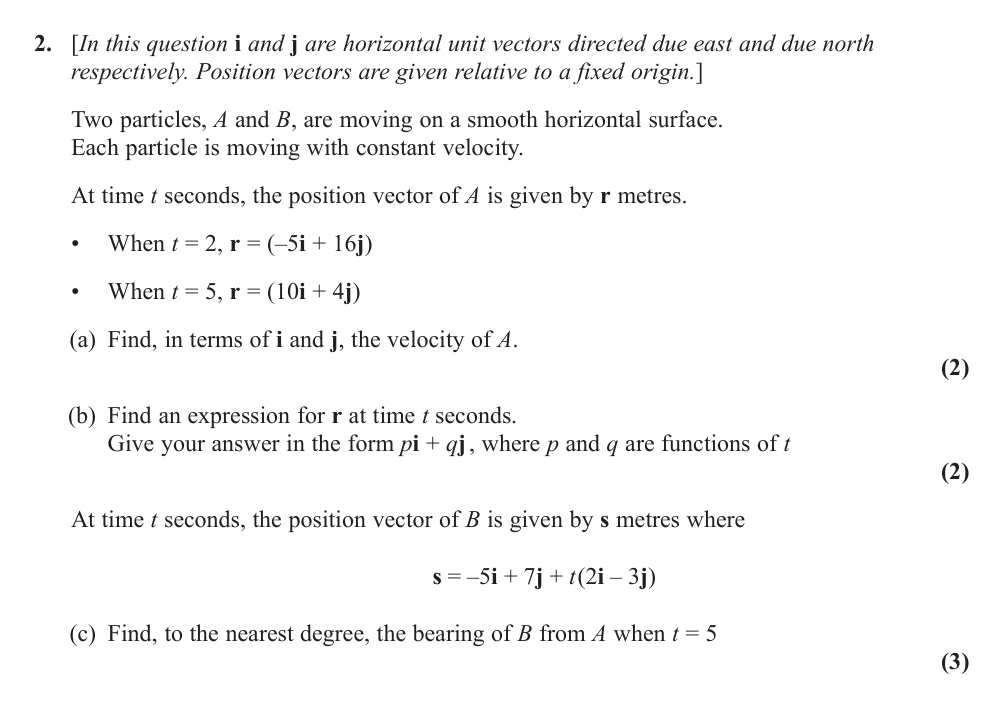
2. WME01/01 May/June 2025 · Q2

Medium7 marks · main topic: Working with Vectors
WME01/01 May/June 2025 Question 2 (7 marks): Constant Acceleration in 2D
Show worked solution
  1. Part (a): Find velocity of A - Find change in position

    Given positions for particle A: ; At $t = 2$: $\mathbf{r} = -5\mathbf{i} + 16\mathbf{j}$ ; At $t = 5$: $\mathbf{r} = 10\mathbf{i} + 4\mathbf{j}$ $\mathbf{v} = \frac{\Delta \mathbf{r}}{\Delta t}$ $\mathbf{v}_A = \frac{(10\mathbf{i} + 4\mathbf{j}) - (-5\mathbf{i} + 16\mathbf{j})}{5 - 2}$ $= \frac{(10 + 5)\mathbf{i} + (4 - 16)\mathbf{j}}{3}$ $= \frac{15\mathbf{i} - 12\mathbf{j}}{3}$ $= 5\mathbf{i} - 4\mathbf{j} \text{ m s}^{-1}$

  2. Part (b): Find expression for r at time t - Use position-velocity relationship

    $\mathbf{r}(t) = \mathbf{r}(t_0) + \mathbf{v}(t - t_0)$ Using $t_0 = 2$ with $\mathbf{r}(2) = -5\mathbf{i} + 16\mathbf{j}$: $\mathbf{r}(t) = (-5\mathbf{i} + 16\mathbf{j}) + (5\mathbf{i} - 4\mathbf{j})(t - 2)$ $= -5\mathbf{i} + 16\mathbf{j} + 5(t-2)\mathbf{i} - 4(t-2)\mathbf{j}$ $= -5\mathbf{i} + 16\mathbf{j} + (5t - 10)\mathbf{i} + (-4t + 8)\mathbf{j}$ $= (-5 + 5t - 10)\mathbf{i} + (16 - 4t + 8)\mathbf{j}$ $= (5t - 15)\mathbf{i} + (24 - 4t)\mathbf{j}$

  3. Part (c): Find bearing of B from A when t = 5 - Find positions at t = 5

    For A at $t = 5$: $\mathbf{r}_A = 10\mathbf{i} + 4\mathbf{j}$ (given) For B at $t = 5$: $\mathbf{s}_B = -5\mathbf{i} + 7\mathbf{j} + 5(2\mathbf{i} - 3\mathbf{j})$ $= -5\mathbf{i} + 7\mathbf{j} + 10\mathbf{i} - 15\mathbf{j}$ $= 5\mathbf{i} - 8\mathbf{j}$

  4. Part (c): Find bearing of B from A when t = 5 - Find vector from A to B

    $\overrightarrow{AB} = \mathbf{s}_B - \mathbf{r}_A$ $= (5\mathbf{i} - 8\mathbf{j}) - (10\mathbf{i} + 4\mathbf{j})$ $= -5\mathbf{i} - 12\mathbf{j}$

  5. Part (c): Find bearing of B from A when t = 5 - Find angle and bearing

    Angle from South (negative j direction): $\tan \alpha = \frac{5}{12}$ $\alpha = \tan^{-1}\left(\frac{5}{12}\right)$ $\alpha = 22.619...°$ Bearing = $180° + \alpha = 180° + 22.619...° = 202.619...°$

Final answer

$(a)\ \mathbf{v}_A=5\mathbf{i}-4\mathbf{j}\ \mathrm{m\,s^{-1}}.\quad (b)\ \mathbf{r}=(5t-15)\mathbf{i}+(24-4t)\mathbf{j}.\quad (c)\ \text{bearing}=203^\circ$.

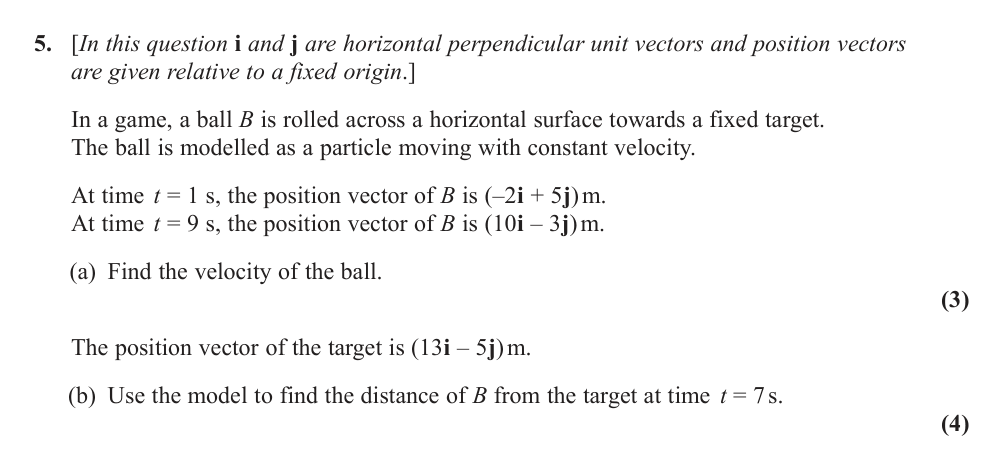
3. WME01/01 January 2025 · Q5

Medium7 marks · main topic: Working with Vectors
WME01/01 January 2025 Question 5 (7 marks): Constant Acceleration in 2D
Show worked solution
  1. Find the displacement over 8 seconds

    From $t=1$ to $t=9$, the displacement is $(10\mathbf{i}-3\mathbf{j})-(-2\mathbf{i}+5\mathbf{j})=12\mathbf{i}-8\mathbf{j}$.

  2. Find the velocity

    The time interval is $8$ seconds, so $\mathbf{v}=\dfrac{12\mathbf{i}-8\mathbf{j}}{8}=1.5\mathbf{i}-\mathbf{j}\ \mathrm{m\,s^{-1}}$.

  3. Find the position at t=7

    Time $t=7$ is 6 seconds after $t=1$. Therefore $\mathbf{r}_B(7)=(-2\mathbf{i}+5\mathbf{j})+6(1.5\mathbf{i}-\mathbf{j})=7\mathbf{i}-\mathbf{j}$.

  4. Find the vector from B to the target

    The target has position vector $13\mathbf{i}-5\mathbf{j}$. The vector from the ball to the target is $(13\mathbf{i}-5\mathbf{j})-(7\mathbf{i}-\mathbf{j})=6\mathbf{i}-4\mathbf{j}$.

  5. Find the distance

    The distance is $\sqrt{6^2+(-4)^2}=\sqrt{52}=2\sqrt{13}\ \mathrm{m}$, which is about $7.2\ \mathrm{m}$.

Final answer

$(a)\ \mathbf{v}=1.5\mathbf{i}-\mathbf{j}\ \mathrm{m\,s^{-1}}.\quad (b)\ \text{distance}=2\sqrt{13}\ \mathrm{m}\approx7.2\ \mathrm{m}$.

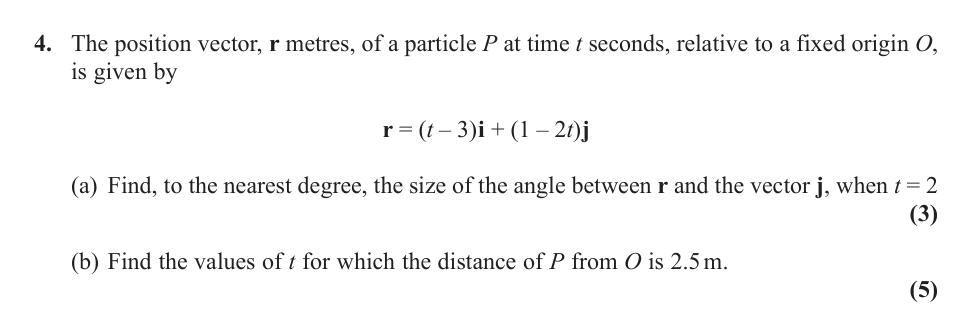
4. WME01/01 October 2021 · Q4

Medium8 marks · main topic: Working with Vectors
WME01/01 October 2021 Question 4 (8 marks): Constant Acceleration in 2D
Show worked solution
  1. Find r when t = 2

    $\mathbf{r}=(2-3)\mathbf{i}+(1-2(2))\mathbf{j}=-\mathbf{i}-3\mathbf{j}$.

  2. Find the angle with j

    The vector is in the third quadrant. The angle between $\mathbf{r}$ and the positive $\mathbf{j}$ direction satisfies $\tan\alpha=\dfrac{1}{3}$ from the vertical comparison.

  3. State the angle

    $\alpha=18.4^\circ$ from the negative $\mathbf{j}$ direction, so the size of the angle with positive $\mathbf{j}$ is $180^\circ-18.4^\circ=161.6^\circ$, which is $162^\circ$.

  4. Use the distance condition

    Distance from O is $2.5$, so $(t-3)^2+(1-2t)^2=2.5^2$.

  5. Form the quadratic

    $t^2-6t+9+1-4t+4t^2=6.25$, so $5t^2-10t+3.75=0$.

  6. Solve

    Multiply by $4$: $20t^2-40t+15=0$, or $4t^2-8t+3=0$. Hence $(2t-1)(2t-3)=0$, so $t=\dfrac12$ or $t=\dfrac32$.

Final answer

$(a)\ 162^\circ.\quad (b)\ t=\dfrac12\ \text{or}\ t=\dfrac32$.

5. WME01/01 October 2025 · Q4

Hard9 marks
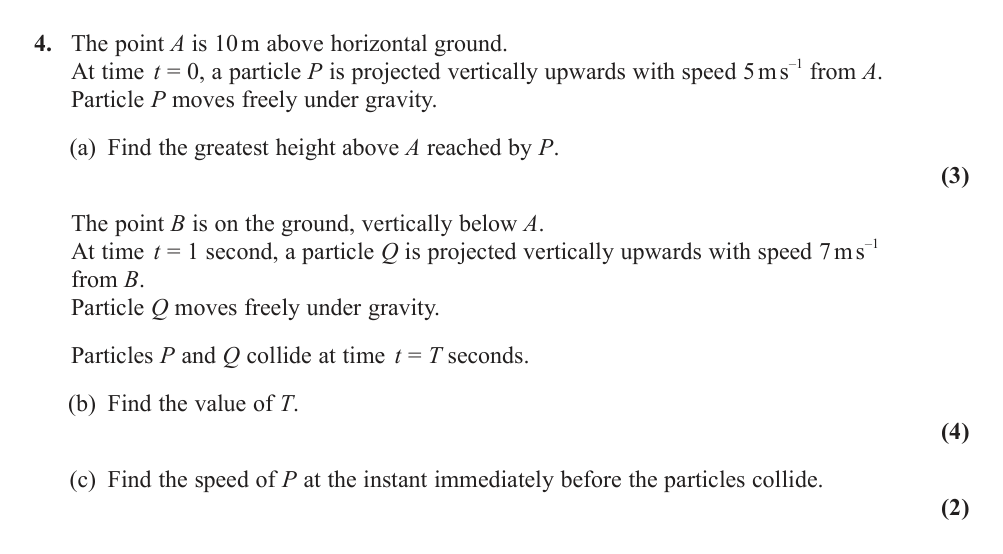
WME01/01 October 2025 Question 4 (9 marks): Constant Acceleration in 2D
Show worked solution
  1. Part (a): Find the greatest height above A reached by P - Identify the SUVAT variables

    At maximum height, velocity = 0 ; $u = 5$ m s$^{-1}$ (initial velocity) ; $v = 0$ m s$^{-1}$ (at maximum height) ; $a = -9.8$ m s$^{-2}$ (gravity, downward) ; $s = ?$ (displacement above A)

  2. Part (a): Find the greatest height above A reached by P - Apply $v^2 = u^2 + 2as$

    $v^2 = u^2 + 2as$ $0^2 = 5^2 + 2(-9.8)s$ $0 = 25 - 19.6s$ $19.6s = 25$ $s = \frac{25}{19.6}$ $s = 1.276...$ $s = 1.28 \text{ m (3 s.f.)}$

  3. Part (b): Find the value of T - Position of P at time $t$

    Taking upward as positive, with origin at ground level: $s = s_0 + ut + \frac{1}{2}at^2$ For P (starting at A, 10 m above ground): $s_P = 10 + 5t + \frac{1}{2}(-9.8)t^2$ $s_P = 10 + 5t - 4.9t^2$

  4. Part (b): Find the value of T - Position of Q at time $t$

    Q starts at $t = 1$, so Q has been moving for $(t-1)$ seconds: For Q (starting at B, ground level): $s_Q = 0 + 7(t-1) + \frac{1}{2}(-9.8)(t-1)^2$ $s_Q = 7(t-1) - 4.9(t-1)^2$ $s_Q = 7t - 7 - 4.9(t^2 - 2t + 1)$ $s_Q = 7t - 7 - 4.9t^2 + 9.8t - 4.9$ $s_Q = -4.9t^2 + 16.8t - 11.9$

  5. Part (b): Find the value of T - Set $s_P = s_Q$ at collision (when $t = T$)

    $10 + 5T - 4.9T^2 = -4.9T^2 + 16.8T - 11.9$ $10 + 5T = 16.8T - 11.9$ $10 + 11.9 = 16.8T - 5T$ $21.9 = 11.8T$ $T = \frac{21.9}{11.8}$ $T = 1.855...$ $T = 1.86 \text{ s (3 s.f.)}$

  6. Part (c): Find the speed of P immediately before collision - Find velocity of P at time $T = 1.86$ s

    $v = u + at$ For particle P: ; $u = 5$ m s$^{-1}$ ; $a = -9.8$ m s$^{-2}$ ; $t = 1.86$ s $v_P = 5 + (-9.8)(1.86)$ $= 5 - 18.228$ $= -13.228...$ $= -13.2 \text{ m s}^{-1}$ The negative sign indicates P is moving downward.

  7. Part (c): Find the speed of P immediately before collision - Find speed

    Speed = $|v|$ $\text{Speed} = |-13.2|$ $= 13.2 \text{ m s}^{-1}$

Final answer

$(a)\ \text{maximum height above A}=1.28\ \mathrm{m}.\quad (b)\ T=1.86\ \mathrm{s}.\quad (c)\ \text{speed of P}=13.2\ \mathrm{m\,s^{-1}}$.

6. WME01/01 May/June 2023 · Q8

Hard9 marks · main topic: Working with Vectors
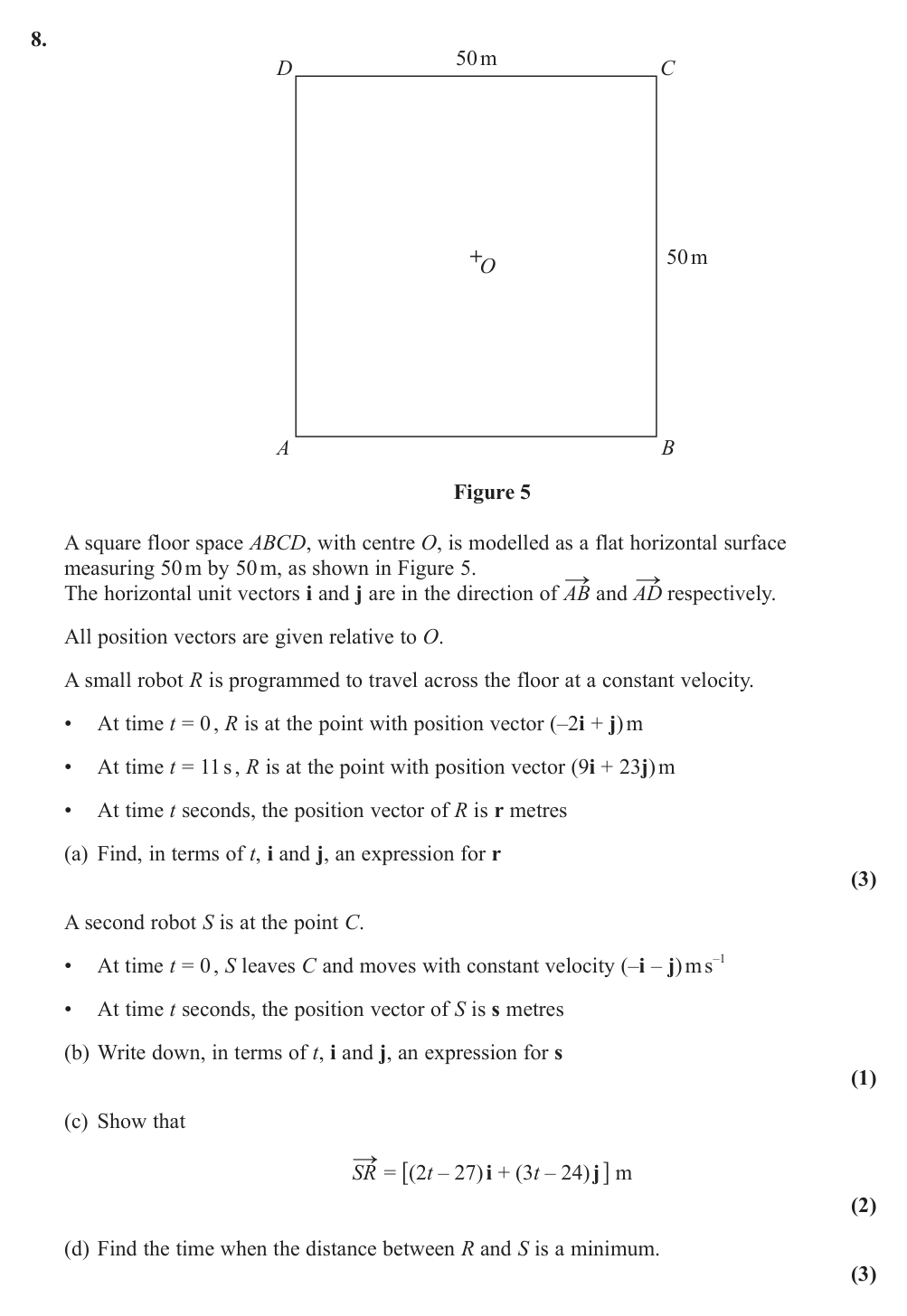
WME01/01 May/June 2023 Question 8 (9 marks): Constant Acceleration in 2D
Show worked solution
  1. Find the velocity of R

    R moves from $-2\mathbf{i}+\mathbf{j}$ to $9\mathbf{i}+23\mathbf{j}$ in $11$ s. Its displacement is $11\mathbf{i}+22\mathbf{j}$, so its velocity is $\mathbf{i}+2\mathbf{j}$.

  2. Write r

    $\mathbf{r}=(-2\mathbf{i}+\mathbf{j})+t(\mathbf{i}+2\mathbf{j})=(t-2)\mathbf{i}+(2t+1)\mathbf{j}$.

  3. Write s

    Point C has position vector $25\mathbf{i}+25\mathbf{j}$. Since S moves with velocity $-\mathbf{i}-\mathbf{j}$, $\mathbf{s}=(25-t)\mathbf{i}+(25-t)\mathbf{j}$.

  4. Find SR vector

    $\overrightarrow{SR}=\mathbf{r}-\mathbf{s}=[(t-2)-(25-t)]\mathbf{i}+[(2t+1)-(25-t)]\mathbf{j}$.

  5. Simplify SR

    Therefore $\overrightarrow{SR}=(2t-27)\mathbf{i}+(3t-24)\mathbf{j}$ m.

  6. Minimise the distance squared

    The distance squared is $d^2=(2t-27)^2+(3t-24)^2$.

  7. Expand the quadratic

    $d^2=4t^2-108t+729+9t^2-144t+576=13t^2-252t+1305$.

  8. Find the minimum time

    The quadratic is minimum at $t=\dfrac{252}{2\cdot13}=\dfrac{126}{13}=9.69\ldots$ s.

Final answer

$(a)\ \mathbf{r}=(t-2)\mathbf{i}+(2t+1)\mathbf{j}.\quad (b)\ \mathbf{s}=(25-t)\mathbf{i}+(25-t)\mathbf{j}.\quad (c)\ \overrightarrow{SR}=(2t-27)\mathbf{i}+(3t-24)\mathbf{j}.\quad (d)\ t=\dfrac{126}{13}\ \mathrm{s}\approx9.7\ \mathrm{s}$.

7. WME01/01 May/June 2022 · Q5

Hard9 marks · main topic: Moments
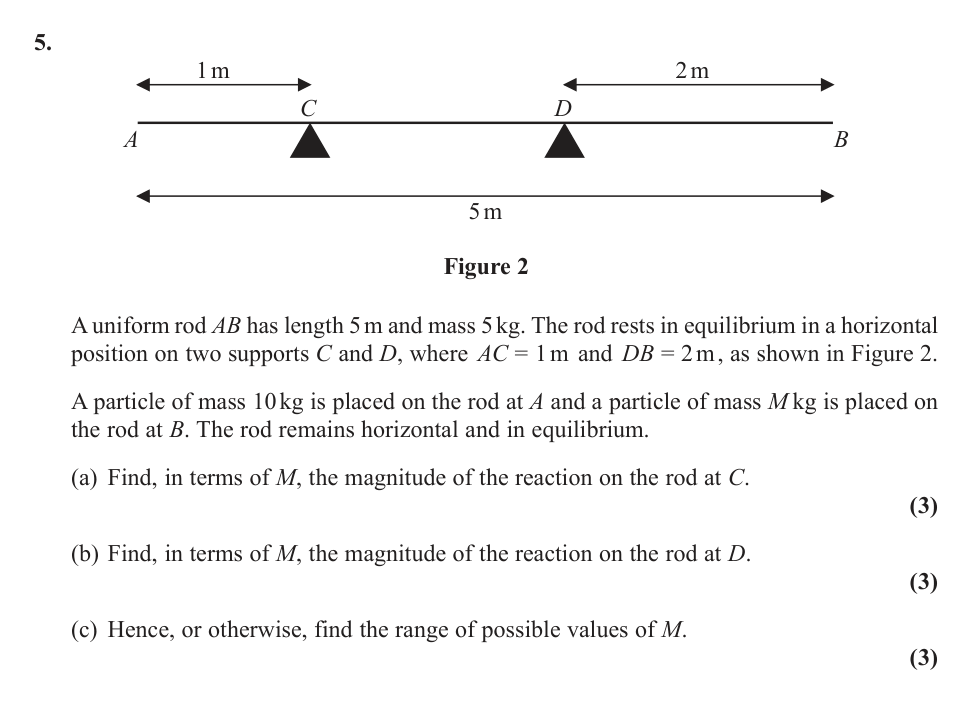
WME01/01 May/June 2022 Question 5 (9 marks): Constant Acceleration in 2D
Show worked solution
  1. Set the positions

    Take distances from A. Then C is at $1$ m, D is at $3$ m, the rod's centre of mass is at $2.5$ m, and B is at $5$ m.

  2. Find RC by moments about D

    Taking moments about D: $R_C(2)+Mg(2)=10g(3)+5g(0.5)$.

  3. Simplify RC

    $2R_C+2Mg=30g+2.5g=32.5g$, so $R_C=16.25g-Mg=(16.25-M)g$.

  4. Find RD by moments about C

    Taking moments about C: $10g(1)+R_D(2)=5g(1.5)+Mg(4)$.

  5. Simplify RD

    $10g+2R_D=7.5g+4Mg$, so $2R_D=(4M-2.5)g$ and $R_D=(2M-1.25)g$.

  6. Use non-negative reactions

    For the rod to rest on both supports, both reactions must be non-negative.

  7. Find the range

    $R_C\ge0$ gives $16.25-M\ge0$, so $M\le16.25$. Also $R_D\ge0$ gives $2M-1.25\ge0$, so $M\ge0.625$. Therefore $0.625\le M\le16.25$.

Final answer

$(a)\ R_C=(16.25-M)g.\quad (b)\ R_D=(2M-1.25)g.\quad (c)\ 0.625\le M\le16.25$.

8. WME01/01 May/June 2021 · Q5

Hard9 marks · main topic: Working with Vectors
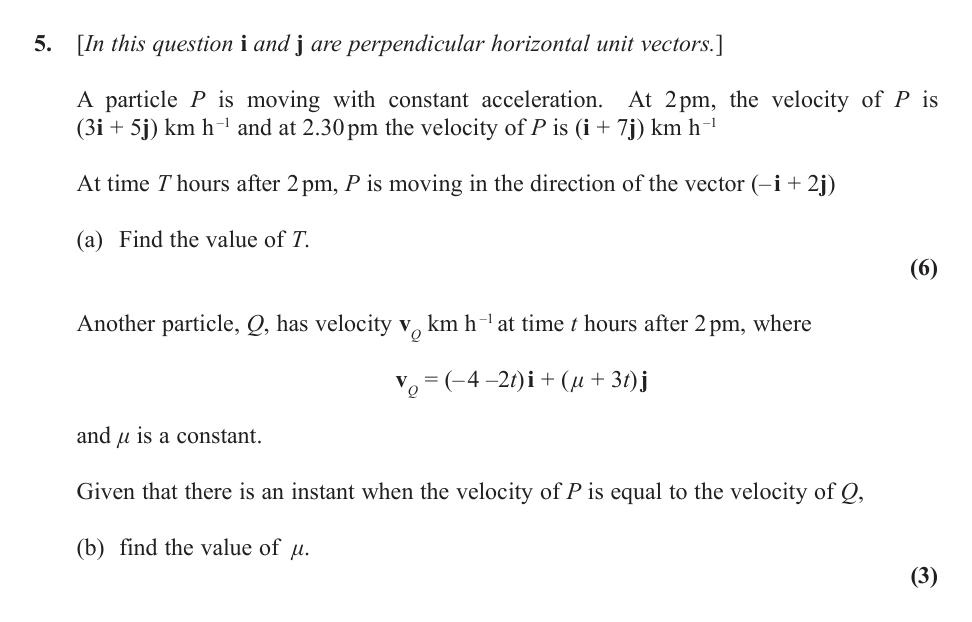
WME01/01 May/June 2021 Question 5 (9 marks): Constant Acceleration in 2D
Show worked solution
  1. Find P acceleration

    From 2:00 to 2:30 is $0.5$ hours. The velocity changes from $3\mathbf{i}+5\mathbf{j}$ to $\mathbf{i}+7\mathbf{j}$.

  2. Calculate acceleration

    $\mathbf{a}=\dfrac{(\mathbf{i}+7\mathbf{j})-(3\mathbf{i}+5\mathbf{j})}{0.5}=-4\mathbf{i}+4\mathbf{j}$.

  3. Write P velocity

    At time $t$ hours after 2:00, $\mathbf{v}_P=(3-4t)\mathbf{i}+(5+4t)\mathbf{j}$.

  4. Use the direction vector

    At time $T$, the velocity is parallel to $-\mathbf{i}+2\mathbf{j}$, so $\dfrac{5+4T}{3-4T}=\dfrac{2}{-1}=-2$.

  5. Find T

    $5+4T=-2(3-4T)=-6+8T$. Hence $11=4T$ and $T=\dfrac{11}{4}$ hours.

  6. Equate i-components for P and Q

    For equal velocities, $3-4t=-4-2t$. This gives $7=2t$, so $t=3.5$.

  7. Equate j-components

    At $t=3.5$, P's j-component is $5+4(3.5)=19$. Q's j-component is $\mu+3(3.5)=\mu+10.5$.

  8. Find mu

    $\mu+10.5=19$, so $\mu=8.5$.

Final answer

$(a)\ T=\dfrac{11}{4}\ \mathrm{h}.\quad (b)\ \mu=8.5$.

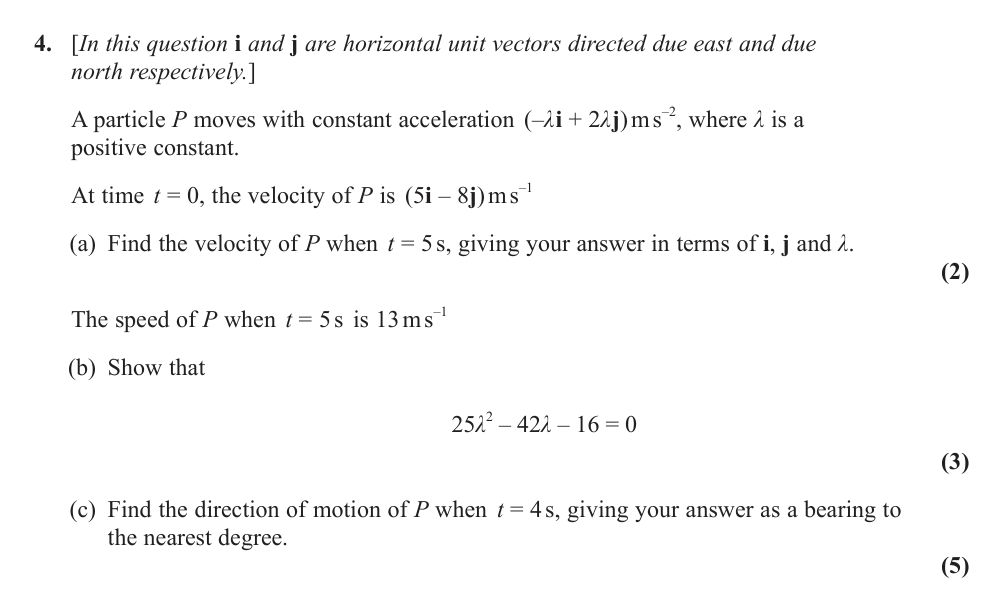
9. WME01/01 October 2023 · Q4

Hard10 marks · main topic: Working with Vectors
WME01/01 October 2023 Question 4 (10 marks): Constant Acceleration in 2D
Show worked solution
  1. Use v = u + at

    The initial velocity is $(5\mathbf{i}-8\mathbf{j})$ and the acceleration is $(-\lambda\mathbf{i}+2\lambda\mathbf{j})$. At $t=5$, $\mathbf{v}=(5\mathbf{i}-8\mathbf{j})+5(-\lambda\mathbf{i}+2\lambda\mathbf{j})$.

  2. Write the velocity at t = 5

    So $\mathbf{v}=(5-5\lambda)\mathbf{i}+(-8+10\lambda)\mathbf{j}$.

  3. Use the speed at t = 5

    The speed is $13$, so $(5-5\lambda)^2+(-8+10\lambda)^2=13^2$.

  4. Simplify to the printed equation

    Expanding gives $25-50\lambda+25\lambda^2+64-160\lambda+100\lambda^2=169$. Therefore $125\lambda^2-210\lambda-80=0$, and dividing by $5$ gives $25\lambda^2-42\lambda-16=0$.

  5. Find lambda

    Solving $25\lambda^2-42\lambda-16=0$ gives $\lambda=2$ or $\lambda=-\dfrac{8}{25}$. Since $\lambda$ is positive, $\lambda=2$.

  6. Find the velocity at t = 4

    $\mathbf{v}(4)=(5\mathbf{i}-8\mathbf{j})+4(-2\mathbf{i}+4\mathbf{j})=-3\mathbf{i}+8\mathbf{j}$.

  7. Convert to a bearing

    The motion is north-west. The angle west of north satisfies $\tan\alpha=\dfrac{3}{8}$, so $\alpha=20.6^\circ$. The bearing is $360^\circ-20.6^\circ=339.4^\circ$, so $339^\circ$ to the nearest degree.

Final answer

$(a)\ \mathbf{v}=(5-5\lambda)\mathbf{i}+(-8+10\lambda)\mathbf{j}$. $(b)\ 25\lambda^2-42\lambda-16=0$. $(c)\ \text{bearing}=339^\circ$.

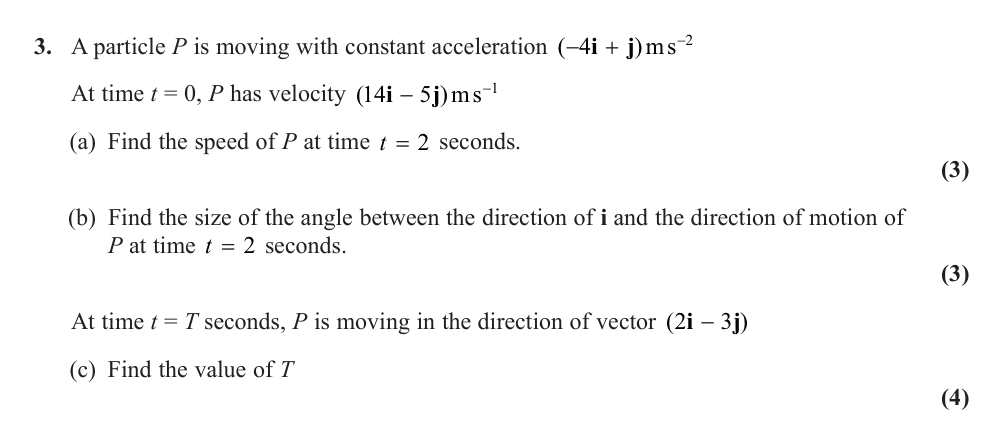
10. WME01/01 January 2023 · Q3

Hard10 marks · main topic: Working with Vectors
WME01/01 January 2023 Question 3 (10 marks): Constant Acceleration in 2D
Show worked solution
  1. Find the velocity at t = 2

    $\mathbf{v}=(14\mathbf{i}-5\mathbf{j})+2(-4\mathbf{i}+\mathbf{j})=6\mathbf{i}-3\mathbf{j}$.

  2. Find the speed

    The speed is $\sqrt{6^2+(-3)^2}=\sqrt{45}=3\sqrt5\ \mathrm{m\,s^{-1}}$.

  3. Find the angle with i

    The velocity $6\mathbf{i}-3\mathbf{j}$ is below the positive $\mathbf{i}$ direction. The acute angle satisfies $\tan\theta=\dfrac{3}{6}$.

  4. State the angle

    $\theta=26.6^\circ$, so the size of the angle is $27^\circ$ to the nearest degree.

  5. Write the velocity at time T

    $\mathbf{v}(T)=(14-4T)\mathbf{i}+(-5+T)\mathbf{j}$.

  6. Use the given direction

    The direction is parallel to $2\mathbf{i}-3\mathbf{j}$, so the component ratio must match: $\dfrac{14-4T}{2}=\dfrac{-5+T}{-3}$.

  7. Solve for T

    $-3(14-4T)=2(-5+T)$, so $-42+12T=-10+2T$. Hence $10T=32$ and $T=3.2$.

Final answer

$(a)\ 3\sqrt5\ \mathrm{m\,s^{-1}}\approx6.7\ \mathrm{m\,s^{-1}}.\quad (b)\ 27^\circ.\quad (c)\ T=3.2$.

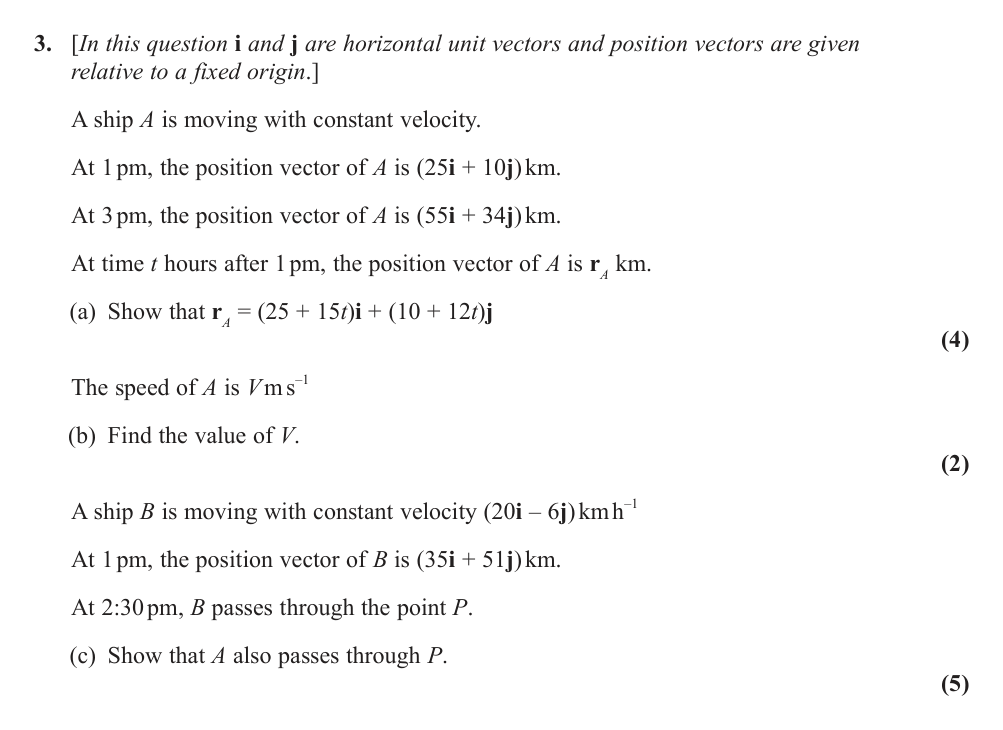
11. WME01/01 October 2024 · Q3

Hard11 marks · main topic: Working with Vectors
WME01/01 October 2024 Question 3 (11 marks): Constant Acceleration in 2D
Show worked solution
  1. Find the velocity of A

    From 1 pm to 3 pm is 2 hours. The displacement of A is $(55\mathbf{i}+34\mathbf{j})-(25\mathbf{i}+10\mathbf{j})=30\mathbf{i}+24\mathbf{j}$ km, so $\mathbf{v}_A=15\mathbf{i}+12\mathbf{j}\ \mathrm{km\,h^{-1}}$.

  2. Write the position vector of A

    At time $t$ hours after 1 pm, $\mathbf{r}_A=(25\mathbf{i}+10\mathbf{j})+t(15\mathbf{i}+12\mathbf{j})=(25+15t)\mathbf{i}+(10+12t)\mathbf{j}$.

  3. Convert the speed to metres per second

    The speed of A is $\sqrt{15^2+12^2}=\sqrt{369}\ \mathrm{km\,h^{-1}}$. Converting to $\mathrm{m\,s^{-1}}$, $V=\sqrt{369}\times\dfrac{1000}{3600}=\dfrac{5\sqrt{41}}{6}\ \mathrm{m\,s^{-1}}$.

  4. Find the point P reached by B

    At 2:30 pm, $t=1.5$ hours after 1 pm. For B, $\mathbf{r}_B=(35\mathbf{i}+51\mathbf{j})+1.5(20\mathbf{i}-6\mathbf{j})=65\mathbf{i}+42\mathbf{j}$.

  5. Check whether A reaches P

    Set $\mathbf{r}_A=65\mathbf{i}+42\mathbf{j}$. From the i-component, $25+15t=65$, so $t=\dfrac{8}{3}$.

  6. Confirm with the j-component

    When $t=\dfrac{8}{3}$, $10+12t=10+32=42$. Both components match, so A also passes through P.

Final answer

$(a)\ \mathbf{r}_A=(25+15t)\mathbf{i}+(10+12t)\mathbf{j}.\quad (b)\ V=\dfrac{5\sqrt{41}}{6}\ \mathrm{m\,s^{-1}}\approx5.3\ \mathrm{m\,s^{-1}}.\quad (c)\ A\ \text{also passes through }P$.

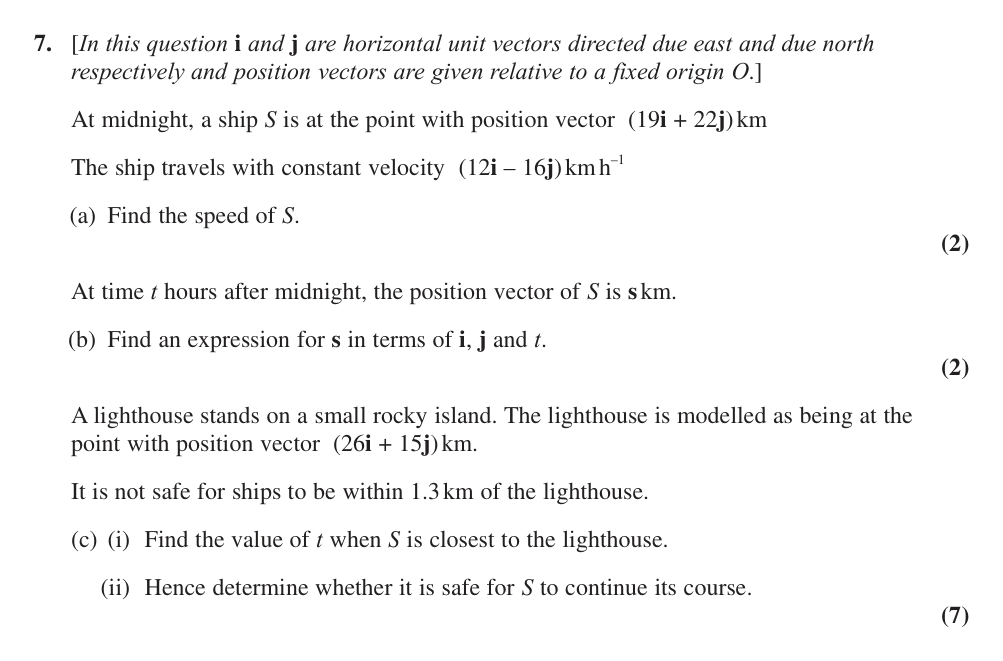
12. WME01/01 January 2024 · Q7

Hard11 marks · main topic: Working with Vectors
WME01/01 January 2024 Question 7 (11 marks): Constant Acceleration in 2D
Show worked solution
  1. Find the speed

    The velocity is $12\mathbf{i}-16\mathbf{j}$, so the speed is $\sqrt{12^2+(-16)^2}=20\ \mathrm{km\,h^{-1}}$.

  2. Write the ship position vector

    At time $t$ hours after midnight, $\mathbf{s}=(19\mathbf{i}+22\mathbf{j})+t(12\mathbf{i}-16\mathbf{j})=(19+12t)\mathbf{i}+(22-16t)\mathbf{j}$.

  3. Form the vector from lighthouse to ship

    The lighthouse is at $26\mathbf{i}+15\mathbf{j}$. Therefore $\overrightarrow{LS}=\mathbf{s}-\mathbf{l}=(12t-7)\mathbf{i}+(7-16t)\mathbf{j}$.

  4. Use distance squared

    The square of the distance is $d^2=(12t-7)^2+(7-16t)^2=400t^2-392t+98$.

  5. Find the time of closest approach

    This quadratic is minimum when $t=\dfrac{392}{2\cdot400}=0.49$.

  6. Find the minimum distance

    At $t=0.49$, $d^2=1.96$, so $d=1.4\ \mathrm{km}$.

  7. Decide if the course is safe

    The unsafe distance is $1.3$ km. Since $1.4>1.3$, it is safe for the ship to continue its course.

Final answer

$(a)\ 20\ \mathrm{km\,h^{-1}}.\quad (b)\ \mathbf{s}=(19+12t)\mathbf{i}+(22-16t)\mathbf{j}.\quad (c)(i)\ t=0.49.\quad (c)(ii)\ \text{minimum distance}=1.4\ \mathrm{km},\ \text{so it is safe}$.

13. WME01/01 January 2022 · Q6

Hard12 marks · main topic: Working with Vectors
WME01/01 January 2022 Question 6 (12 marks): Constant Acceleration in 2D
Show worked solution
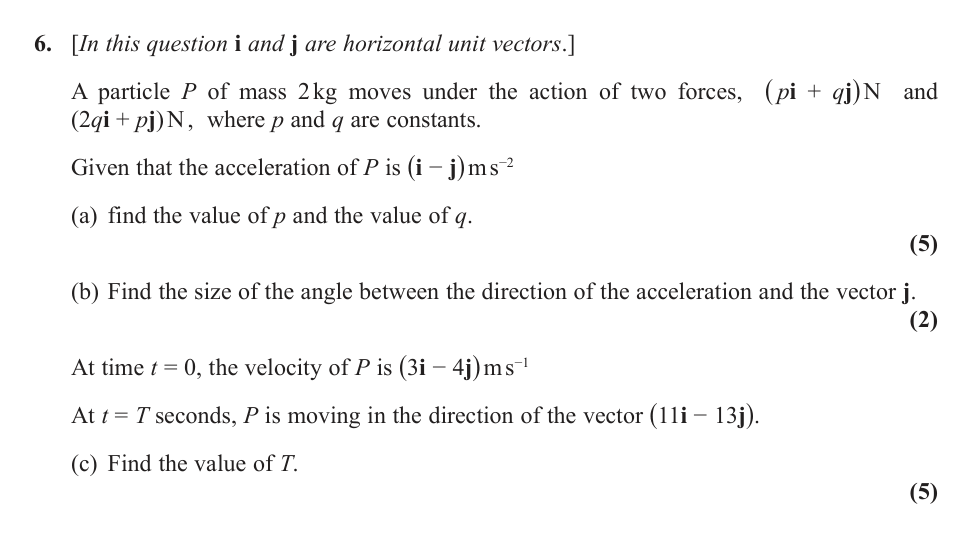
  1. Use F = ma

    The total force is $(p\mathbf{i}+q\mathbf{j})+(2q\mathbf{i}+p\mathbf{j})=(p+2q)\mathbf{i}+(p+q)\mathbf{j}$. Since the mass is $2$ kg and acceleration is $\mathbf{i}-\mathbf{j}$, the total force is $2\mathbf{i}-2\mathbf{j}$.

  2. Equate components

    $p+2q=2$ and $p+q=-2$.

  3. Find p and q

    Subtract the equations to get $q=4$. Then $p+4=-2$, so $p=-6$.

  4. Find the angle with j

    The acceleration is $\mathbf{i}-\mathbf{j}$. Its dot product with $\mathbf{j}$ is $-1$, so the angle with the positive $\mathbf{j}$ direction is obtuse. Since the components are equal in magnitude, the angle is $135^\circ$.

  5. Write the velocity at time T

    $\mathbf{v}=(3\mathbf{i}-4\mathbf{j})+T(\mathbf{i}-\mathbf{j})=(3+T)\mathbf{i}+(-4-T)\mathbf{j}$.

  6. Use the direction vector

    The velocity is parallel to $11\mathbf{i}-13\mathbf{j}$, so $\dfrac{3+T}{11}=\dfrac{-4-T}{-13}$.

  7. Solve for T

    $13(3+T)=11(4+T)$, so $39+13T=44+11T$. Hence $2T=5$ and $T=2.5$.

Final answer

$(a)\ p=-6,\ q=4.\quad (b)\ 135^\circ.\quad (c)\ T=2.5$.

14. WME01/01 October 2021 · Q8

Hard12 marks · main topic: Working with Vectors
WME01/01 October 2021 Question 8 (12 marks): Constant Acceleration in 2D
Show worked solution
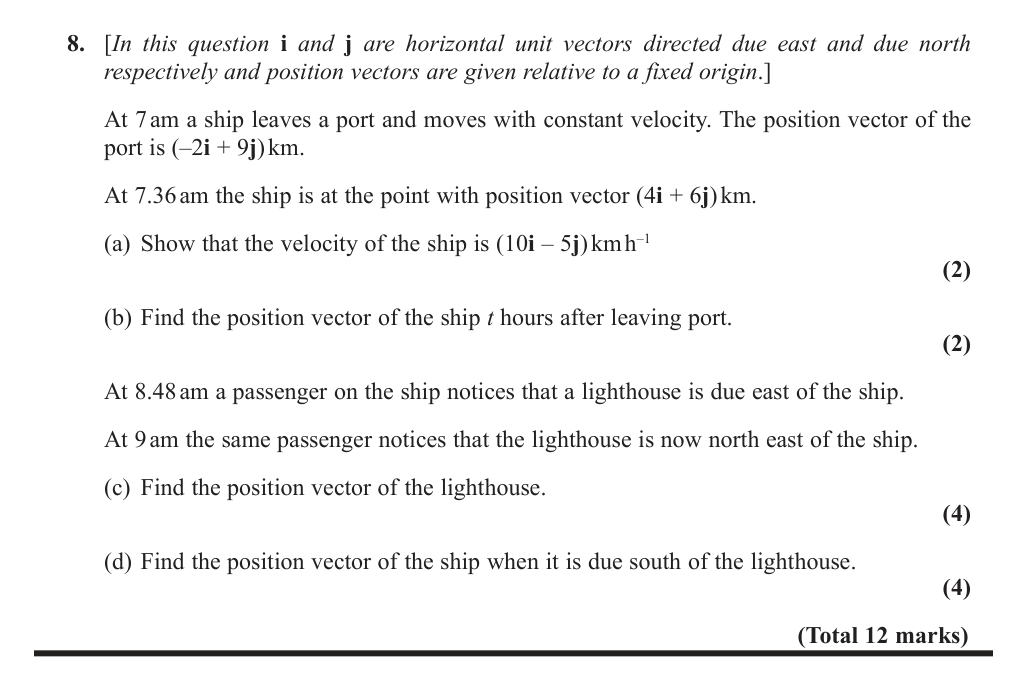
  1. Convert the time

    From 7:00 to 7:36 is $36$ minutes, which is $0.6$ hours.

  2. Find velocity

    Displacement $=(4\mathbf{i}+6\mathbf{j})-(-2\mathbf{i}+9\mathbf{j})=6\mathbf{i}-3\mathbf{j}$. Divide by $0.6$: $\mathbf{v}=10\mathbf{i}-5\mathbf{j}$.

  3. Write the ship position

    $\mathbf{r}=(-2\mathbf{i}+9\mathbf{j})+t(10\mathbf{i}-5\mathbf{j})=(-2+10t)\mathbf{i}+(9-5t)\mathbf{j}$.

  4. Use 8:48

    At 8:48, $t=1.8$. The ship position is $(-2+18)\mathbf{i}+(9-9)\mathbf{j}=16\mathbf{i}$. The lighthouse is due east, so it has the same j-component, $0$.

  5. Use 9:00

    At 9:00, $t=2$. The ship position is $18\mathbf{i}-\mathbf{j}$. The lighthouse is north-east of the ship, so its east and north displacements from the ship are equal.

  6. Find the lighthouse position

    Since the lighthouse has j-component $0$, from $18\mathbf{i}-\mathbf{j}$ it is $1$ km north, so it is also $1$ km east. Hence its position is $19\mathbf{i}$.

  7. Find when the ship is due south

    Due south of the lighthouse means the ship has i-component $19$. Set $-2+10t=19$, so $t=2.1$.

  8. Find the ship position

    At $t=2.1$, $\mathbf{r}=(-2+21)\mathbf{i}+(9-10.5)\mathbf{j}=19\mathbf{i}-1.5\mathbf{j}$.

Final answer

$(a)\ \mathbf{v}=10\mathbf{i}-5\mathbf{j}\ \mathrm{km\,h^{-1}}.\quad (b)\ \mathbf{r}=(-2+10t)\mathbf{i}+(9-5t)\mathbf{j}.\quad (c)\ \text{lighthouse}=19\mathbf{i}.\quad (d)\ \text{ship position}=19\mathbf{i}-1.5\mathbf{j}$.

15. WME01/01 January 2021 · Q6

Hard12 marks · main topic: Working with Vectors
WME01/01 January 2021 Question 6 (12 marks): Constant Acceleration in 2D
Show worked solution
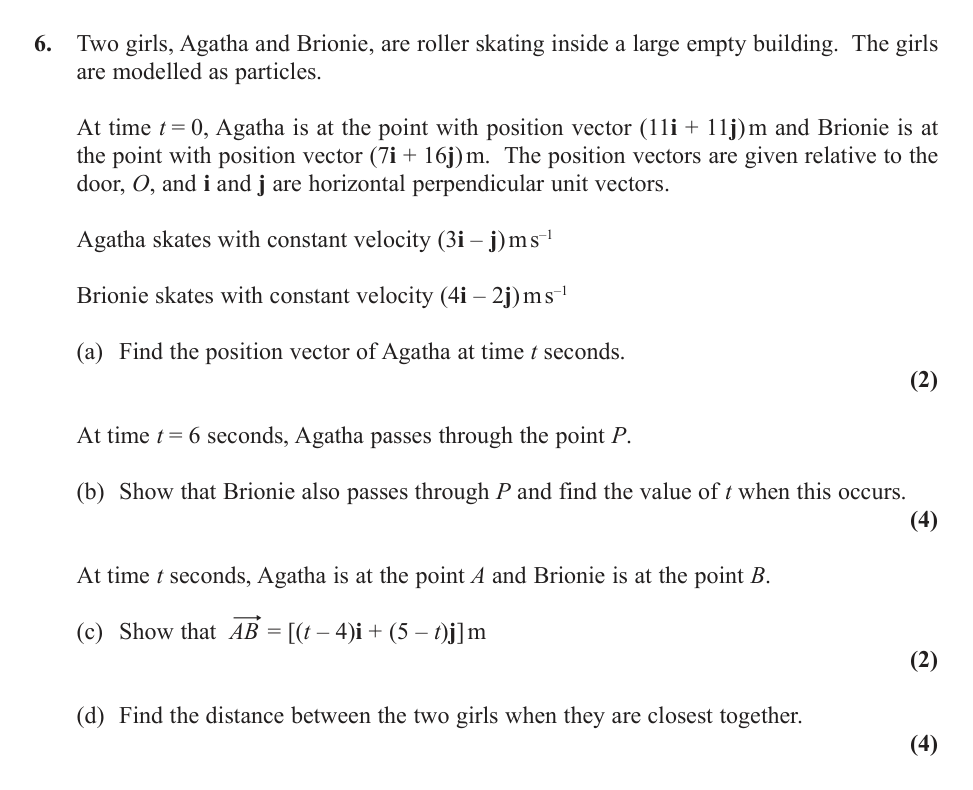
  1. Write Agatha position

    $\mathbf{r}_A=(11\mathbf{i}+11\mathbf{j})+t(3\mathbf{i}-\mathbf{j})=(11+3t)\mathbf{i}+(11-t)\mathbf{j}$.

  2. Find point P

    At $t=6$, Agatha is at $(11+18)\mathbf{i}+(11-6)\mathbf{j}=29\mathbf{i}+5\mathbf{j}$.

  3. Write Brionie position

    $\mathbf{r}_B=(7\mathbf{i}+16\mathbf{j})+t(4\mathbf{i}-2\mathbf{j})=(7+4t)\mathbf{i}+(16-2t)\mathbf{j}$.

  4. Show Brionie passes P

    Set $7+4t=29$ to get $t=5.5$. Also $16-2t=5$ gives $t=5.5$. So Brionie also passes through P at $t=5.5$ s.

  5. Find AB vector

    $\overrightarrow{AB}=\mathbf{r}_B-\mathbf{r}_A=[7+4t-(11+3t)]\mathbf{i}+[16-2t-(11-t)]\mathbf{j}$.

  6. Simplify AB

    So $\overrightarrow{AB}=(t-4)\mathbf{i}+(5-t)\mathbf{j}$ m.

  7. Minimise distance squared

    $AB^2=(t-4)^2+(5-t)^2=2(t-4.5)^2+0.5$.

  8. State the minimum distance

    The minimum occurs when $t=4.5$, giving $AB^2=0.5$. Hence the minimum distance is $\sqrt{0.5}=0.707\ldots\ \mathrm{m}$.

Final answer

$(a)\ \mathbf{r}_A=(11+3t)\mathbf{i}+(11-t)\mathbf{j}.\quad (b)\ t=5.5\ \mathrm{s}.\quad (c)\ \overrightarrow{AB}=(t-4)\mathbf{i}+(5-t)\mathbf{j}.\quad (d)\ \text{minimum distance}=\sqrt{0.5}\ \mathrm{m}\approx0.71\ \mathrm{m}$.

16. WME01/01 May/June 2025 · Q7

Hard13 marks · main topic: Working with Vectors
WME01/01 May/June 2025 Question 7 (13 marks): Constant Acceleration in 2D
Show worked solution
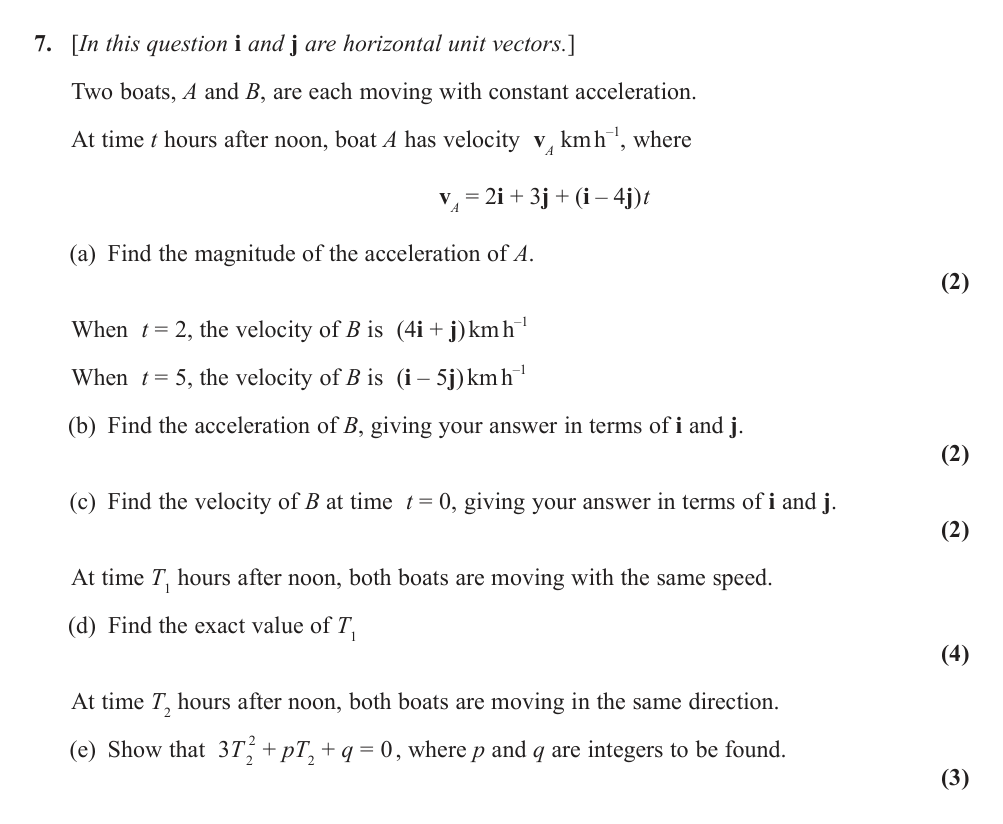
  1. Part (a): Find magnitude of acceleration of A - Identify acceleration from velocity function

    Given: $\mathbf{v}_A = 2\mathbf{i} + 3\mathbf{j} + (\mathbf{i} - 4\mathbf{j})t$ This is in form: $\mathbf{v} = \mathbf{u} + \mathbf{a}t$ Therefore: ; Initial velocity: $\mathbf{u}_A = 2\mathbf{i} + 3\mathbf{j}$ ; Acceleration: $\mathbf{a}_A = \mathbf{i} - 4\mathbf{j}$ km h$^{-2}$

  2. Part (a): Find magnitude of acceleration of A - Find magnitude

    $|\mathbf{a}| = \sqrt{a_x^2 + a_y^2}$ $|\mathbf{a}_A| = \sqrt{1^2 + (-4)^2}$ $= \sqrt{1 + 16}$ $= \sqrt{17}$ $= 4.123...$ $= 4.1 \text{ km h}^{-2} \text{ (2 sf)}$

  3. Part (b): Find acceleration of B - Use two velocity points to find acceleration

    Given: ; At $t = 2$: $\mathbf{v}_B = 4\mathbf{i} + \mathbf{j}$ ; At $t = 5$: $\mathbf{v}_B = \mathbf{i} - 5\mathbf{j}$ $\mathbf{a} = \frac{\Delta \mathbf{v}}{\Delta t}$ $\mathbf{a}_B = \frac{(\mathbf{i} - 5\mathbf{j}) - (4\mathbf{i} + \mathbf{j})}{5 - 2}$ $= \frac{(1-4)\mathbf{i} + (-5-1)\mathbf{j}}{3}$ $= \frac{-3\mathbf{i} - 6\mathbf{j}}{3}$ $= -\mathbf{i} - 2\mathbf{j} \text{ km h}^{-2}$

  4. Part (c): Find velocity of B at t = 0 - Use velocity equation backward

    $\mathbf{v}(t) = \mathbf{v}(t_0) + \mathbf{a}(t - t_0)$ From $t = 2$ back to $t = 0$: $\mathbf{v}_B(0) = \mathbf{v}_B(2) + \mathbf{a}_B(0 - 2)$ $= (4\mathbf{i} + \mathbf{j}) + (-\mathbf{i} - 2\mathbf{j})(-2)$ $= 4\mathbf{i} + \mathbf{j} + 2\mathbf{i} + 4\mathbf{j}$ $= 6\mathbf{i} + 5\mathbf{j} \text{ km h}^{-1}$

  5. Part (d): Find exact value of $T_1$ when both have same speed - Express velocities at time t

    For boat A: $\mathbf{v}_A(t) = 2\mathbf{i} + 3\mathbf{j} + (\mathbf{i} - 4\mathbf{j})t = (2+t)\mathbf{i} + (3-4t)\mathbf{j}$ For boat B: $\mathbf{v}_B(t) = (6\mathbf{i} + 5\mathbf{j}) + (-\mathbf{i} - 2\mathbf{j})t$ $= (6-t)\mathbf{i} + (5-2t)\mathbf{j}$

  6. Part (d): Find exact value of $T_1$ when both have same speed - Find magnitudes

    $|\mathbf{v}_A|^2 = (2+t)^2 + (3-4t)^2$ $= 4 + 4t + t^2 + 9 - 24t + 16t^2$ $= 17t^2 - 20t + 13$ $|\mathbf{v}_B|^2 = (6-t)^2 + (5-2t)^2$ $= 36 - 12t + t^2 + 25 - 20t + 4t^2$ $= 5t^2 - 32t + 61$

  7. Part (d): Find exact value of $T_1$ when both have same speed - Set magnitudes equal

    $17t^2 - 20t + 13 = 5t^2 - 32t + 61$ $12t^2 + 12t - 48 = 0$ $t^2 + t - 4 = 0$

  8. Part (d): Find exact value of $T_1$ when both have same speed - Solve using quadratic formula

    $t = \frac{-1 \pm \sqrt{1 + 16}}{2}$ $= \frac{-1 \pm \sqrt{17}}{2}$ Taking positive value: $T_1 = \frac{-1 + \sqrt{17}}{2}$

  9. Part (e): Show $3T_2^2 + pT_2 + q = 0$ - Condition for same direction

    Velocities parallel when: $\frac{2 + T_2}{6 - T_2} = \frac{3 - 4T_2}{5 - 2T_2}$

  10. Part (e): Show $3T_2^2 + pT_2 + q = 0$ - Cross-multiply

    $(2 + T_2)(5 - 2T_2) = (3 - 4T_2)(6 - T_2)$ $10 - 4T_2 + 5T_2 - 2T_2^2 = 18 - 3T_2 - 24T_2 + 4T_2^2$ $10 + T_2 - 2T_2^2 = 18 - 27T_2 + 4T_2^2$ $0 = 4T_2^2 + 2T_2^2 - 27T_2 - T_2 + 18 - 10$ $0 = 6T_2^2 - 28T_2 + 8$

  11. Part (e): Show $3T_2^2 + pT_2 + q = 0$ - Divide by 2 to get required form

    $0 = 3T_2^2 - 14T_2 + 4$ Therefore: $p = -14$ and $q = 4$

Final answer

$(a)\ |\mathbf{a}_A|=\sqrt{17}\ \mathrm{km\,h^{-2}}\approx4.1\ \mathrm{km\,h^{-2}}.\quad (b)\ \mathbf{a}_B=-\mathbf{i}-2\mathbf{j}\ \mathrm{km\,h^{-2}}.\quad (c)\ \mathbf{v}_B(0)=6\mathbf{i}+5\mathbf{j}\ \mathrm{km\,h^{-1}}.\quad (d)\ T_1=\dfrac{-1+\sqrt{17}}{2}\ \text{hours}.\quad (e)\ 3T_2^2-14T_2+4=0,\ p=-14,\ q=4$.

17. WME01/01 May/June 2024 · Q7

Hard13 marks · main topic: Working with Vectors
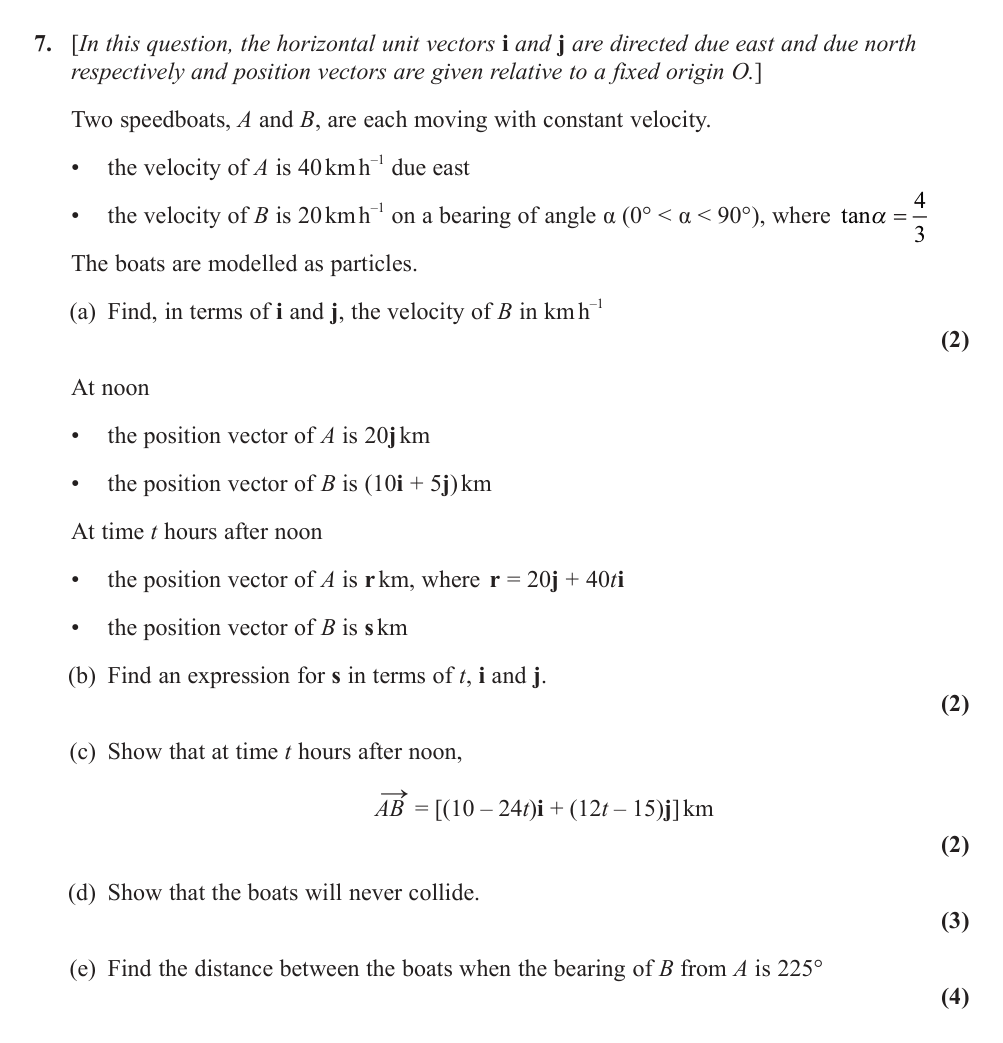
WME01/01 May/June 2024 Question 7 (13 marks): Constant Acceleration in 2D
Show worked solution
  1. Resolve the velocity of B

    For a bearing angle $\alpha$ with $\tan\alpha=\dfrac43$, use $\sin\alpha=\dfrac45$ and $\cos\alpha=\dfrac35$. Therefore $\mathbf{v}_B=20\sin\alpha\mathbf{i}+20\cos\alpha\mathbf{j}=16\mathbf{i}+12\mathbf{j}$.

  2. Write the position of B

    At noon, B is at $10\mathbf{i}+5\mathbf{j}$. With constant velocity $16\mathbf{i}+12\mathbf{j}$, $\mathbf{s}=(10+16t)\mathbf{i}+(5+12t)\mathbf{j}$.

  3. Find AB vector

    A has position vector $\mathbf{r}=40t\mathbf{i}+20\mathbf{j}$. Hence $\overrightarrow{AB}=\mathbf{s}-\mathbf{r}=(10+16t-40t)\mathbf{i}+(5+12t-20)\mathbf{j}$.

  4. Show the printed expression

    This simplifies to $\overrightarrow{AB}=(10-24t)\mathbf{i}+(12t-15)\mathbf{j}$ km.

  5. Show the boats do not collide

    For collision, both components must be zero. From $10-24t=0$, $t=\dfrac{5}{12}$. From $12t-15=0$, $t=\dfrac54$. These times are different, so the boats never collide.

  6. Use the bearing 225 degrees condition

    A bearing of $225^\circ$ means B is south-west of A, so the i and j components of $\overrightarrow{AB}$ are equal and negative. Set $10-24t=12t-15$.

  7. Find the distance

    The equation gives $t=\dfrac{25}{36}$. Then each component is $-\dfrac{20}{3}$, so the distance is $\sqrt{\left(\dfrac{20}{3}\right)^2+\left(\dfrac{20}{3}\right)^2}=\dfrac{20\sqrt2}{3}\ \mathrm{km}$.

Final answer

$(a)\ \mathbf{v}_B=16\mathbf{i}+12\mathbf{j}\ \mathrm{km\,h^{-1}}.\quad (b)\ \mathbf{s}=(10+16t)\mathbf{i}+(5+12t)\mathbf{j}.\quad (c)\ \overrightarrow{AB}=(10-24t)\mathbf{i}+(12t-15)\mathbf{j}.\quad (d)\ \text{no collision}.\quad (e)\ \dfrac{20\sqrt2}{3}\ \mathrm{km}\approx9.4\ \mathrm{km}$.

18. WME01/01 January 2022 · Q8

Hard14 marks · main topic: Working with Vectors
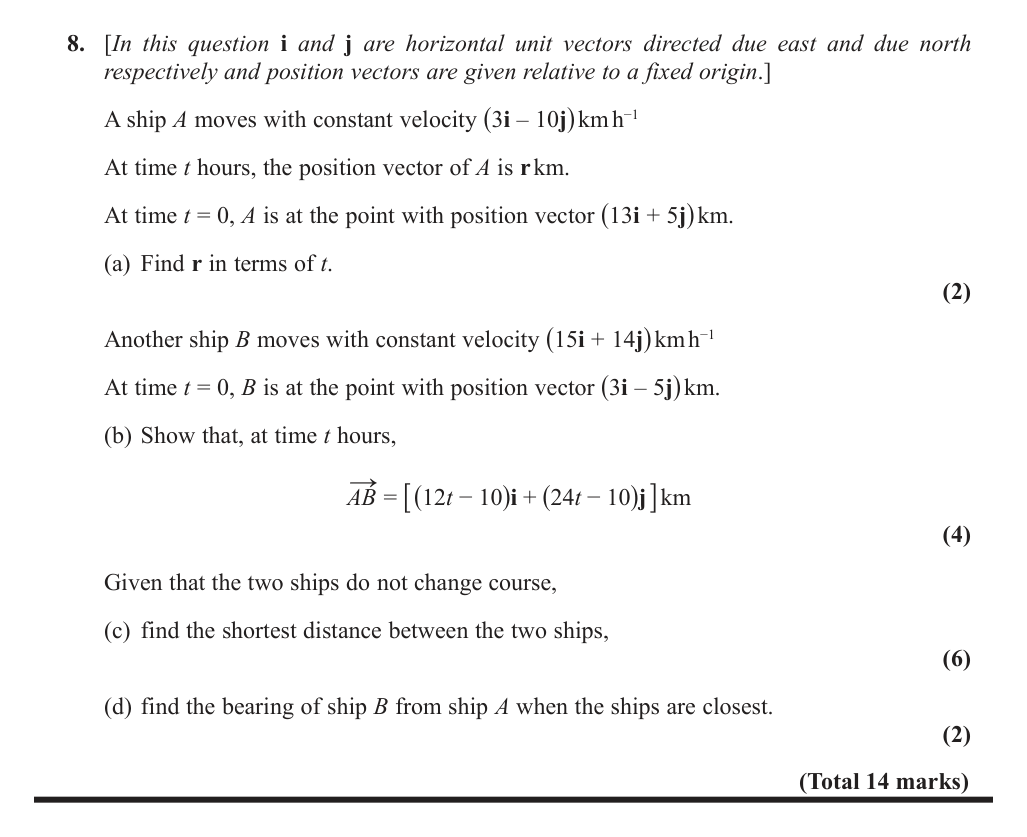
WME01/01 January 2022 Question 8 (14 marks): Constant Acceleration in 2D
Show worked solution
  1. Write the position of A

    $\mathbf{r}=(13\mathbf{i}+5\mathbf{j})+t(3\mathbf{i}-10\mathbf{j})=(13+3t)\mathbf{i}+(5-10t)\mathbf{j}$.

  2. Write the position of B

    $\mathbf{s}=(3\mathbf{i}-5\mathbf{j})+t(15\mathbf{i}+14\mathbf{j})=(3+15t)\mathbf{i}+(-5+14t)\mathbf{j}$.

  3. Find AB

    $\overrightarrow{AB}=\mathbf{s}-\mathbf{r}=[3+15t-(13+3t)]\mathbf{i}+[-5+14t-(5-10t)]\mathbf{j}$.

  4. Show the expression

    This simplifies to $\overrightarrow{AB}=(12t-10)\mathbf{i}+(24t-10)\mathbf{j}$ km.

  5. Use distance squared

    The square of the distance is $d^2=(12t-10)^2+(24t-10)^2$.

  6. Expand and minimise

    $d^2=720t^2-720t+200$. This quadratic is minimum at $t=\dfrac{720}{2\cdot720}=\dfrac12$.

  7. Find the shortest distance

    At $t=\dfrac12$, $\overrightarrow{AB}=(-4)\mathbf{i}+2\mathbf{j}$, so the shortest distance is $\sqrt{(-4)^2+2^2}=\sqrt{20}=2\sqrt5\ \mathrm{km}$.

  8. Find the bearing

    At closest approach, B is west and north of A. The angle west of north satisfies $\tan\theta=\dfrac{4}{2}=2$, so $\theta=63.4^\circ$. Bearing $=360^\circ-63.4^\circ=296.6^\circ$, which is $297^\circ$.

Final answer

$(a)\ \mathbf{r}=(13+3t)\mathbf{i}+(5-10t)\mathbf{j}.\quad (b)\ \overrightarrow{AB}=(12t-10)\mathbf{i}+(24t-10)\mathbf{j}.\quad (c)\ 2\sqrt5\ \mathrm{km}\approx4.5\ \mathrm{km}.\quad (d)\ 297^\circ$.

19. WME01/01 October 2023 · Q6

Hard15 marks · main topic: Working with Vectors
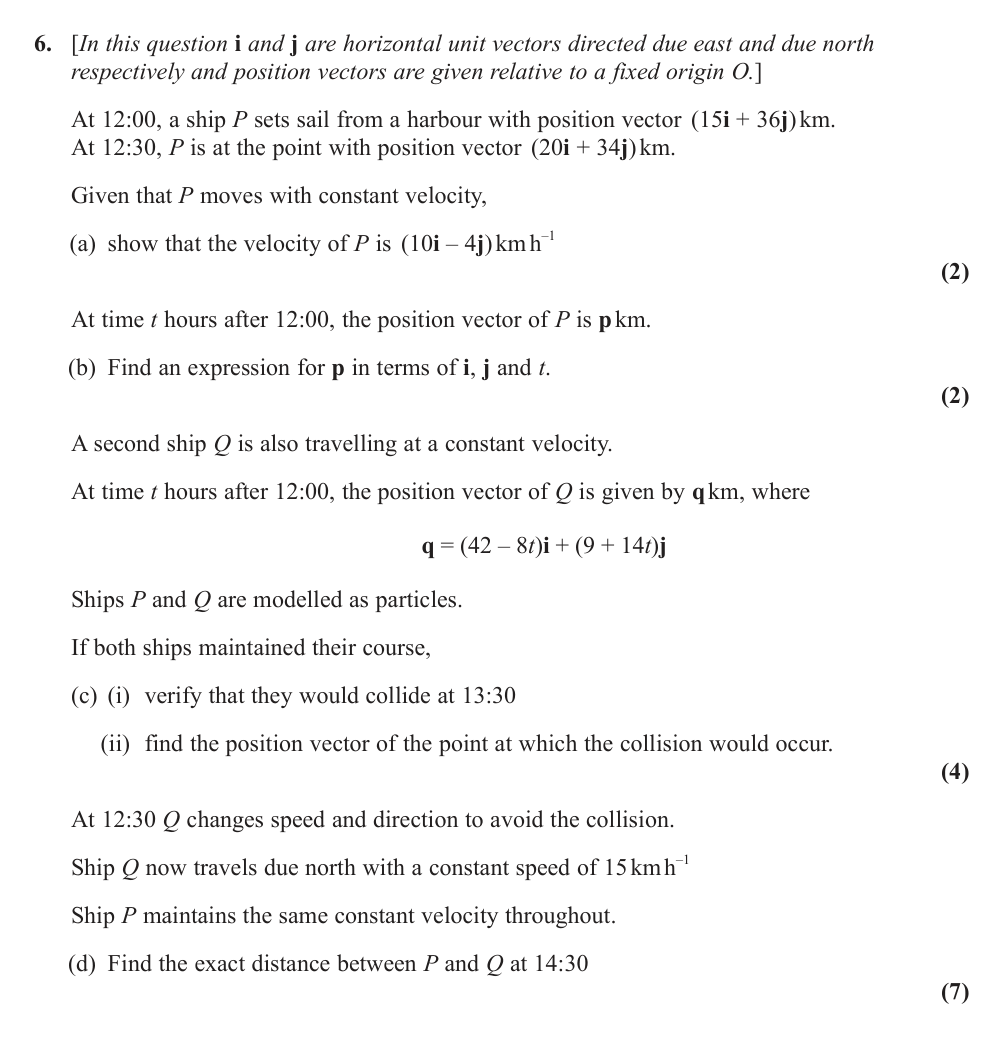
WME01/01 October 2023 Question 6 (15 marks): Constant Acceleration in 2D
Show worked solution
  1. Find the velocity of P

    From 12:00 to 12:30, the displacement of P is $(20\mathbf{i}+34\mathbf{j})-(15\mathbf{i}+36\mathbf{j})=5\mathbf{i}-2\mathbf{j}$ km. The time is $0.5$ hours, so $\mathbf{v}_P=\dfrac{5\mathbf{i}-2\mathbf{j}}{0.5}=10\mathbf{i}-4\mathbf{j}$.

  2. Write the position of P

    At $t$ hours after 12:00, $\mathbf{p}=(15\mathbf{i}+36\mathbf{j})+t(10\mathbf{i}-4\mathbf{j})=(15+10t)\mathbf{i}+(36-4t)\mathbf{j}$.

  3. Verify the collision time

    At 13:30, $t=1.5$. Then $\mathbf{p}=(15+15)\mathbf{i}+(36-6)\mathbf{j}=30\mathbf{i}+30\mathbf{j}$. Also $\mathbf{q}=(42-8(1.5))\mathbf{i}+(9+14(1.5))\mathbf{j}=30\mathbf{i}+30\mathbf{j}$.

  4. State the collision position

    Since both position vectors are the same, the collision point has position vector $30\mathbf{i}+30\mathbf{j}$ km.

  5. Find P at 14:30

    At 14:30, $t=2.5$, so $\mathbf{p}=(15+25)\mathbf{i}+(36-10)\mathbf{j}=40\mathbf{i}+26\mathbf{j}$.

  6. Find Q after changing course

    At 12:30, $t=0.5$, so $\mathbf{q}=38\mathbf{i}+16\mathbf{j}$. From 12:30 to 14:30 is $2$ hours due north at $15\ \mathrm{km\,h^{-1}}$, so the extra displacement is $30\mathbf{j}$. Thus Q is at $38\mathbf{i}+46\mathbf{j}$.

  7. Find the distance

    The separation vector is $(40-38)\mathbf{i}+(26-46)\mathbf{j}=2\mathbf{i}-20\mathbf{j}$. The distance is $\sqrt{2^2+20^2}=\sqrt{404}=2\sqrt{101}\ \mathrm{km}$.

Final answer

$(a)\ \mathbf{v}_P=10\mathbf{i}-4\mathbf{j}\ \mathrm{km\,h^{-1}}.\quad (b)\ \mathbf{p}=(15+10t)\mathbf{i}+(36-4t)\mathbf{j}.\quad (c)(ii)\ 30\mathbf{i}+30\mathbf{j}.\quad (d)\ 2\sqrt{101}\ \mathrm{km}$.

20. WME01/01 January 2026 · Q6

Hard16 marks · main topic: Working with Vectors
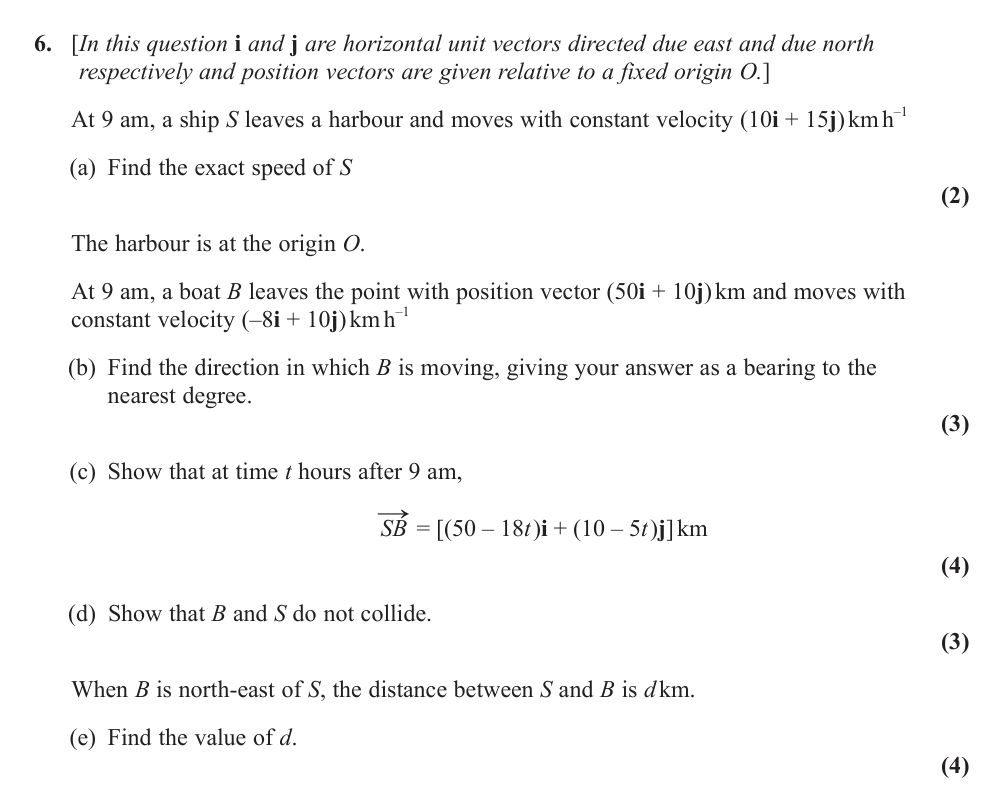
WME01/01 January 2026 Question 6 (16 marks): Constant Acceleration in 2D
Show worked solution
  1. Find the speed of S

    The velocity of S is $10\mathbf{i}+15\mathbf{j}$. Its speed is the magnitude: $\sqrt{10^2+15^2}=\sqrt{325}=5\sqrt{13}\ \mathrm{km\,h^{-1}}$.

  2. Find the bearing of B

    B has velocity $-8\mathbf{i}+10\mathbf{j}$, so it moves west and north. The angle west of north satisfies $\tan\theta=\dfrac{8}{10}$, giving $\theta=38.66^\circ$. The bearing is $360^\circ-38.66^\circ=321^\circ$ to the nearest degree.

  3. Write both position vectors

    At time $t$ hours after 9 am, $\mathbf{r}_S=(10t)\mathbf{i}+(15t)\mathbf{j}$. Also $\mathbf{r}_B=(50\mathbf{i}+10\mathbf{j})+t(-8\mathbf{i}+10\mathbf{j})=(50-8t)\mathbf{i}+(10+10t)\mathbf{j}$.

  4. Find the relative position vector

    $\overrightarrow{SB}=\mathbf{r}_B-\mathbf{r}_S=[(50-8t)-10t]\mathbf{i}+[(10+10t)-15t]\mathbf{j}=(50-18t)\mathbf{i}+(10-5t)\mathbf{j}$.

  5. Show they do not collide

    For a collision, both components of $\overrightarrow{SB}$ must be zero at the same time. From $50-18t=0$, $t=\dfrac{25}{9}$. From $10-5t=0$, $t=2$. These are different, so B and S do not collide.

  6. Find the north-east or south-west instant

    When the separation is along a $45^\circ$ diagonal, the two components have equal magnitude. Using the given condition, set $50-18t=10-5t$, so $40=13t$ and $t=\dfrac{40}{13}$.

  7. Find the distance d

    At $t=\dfrac{40}{13}$, both components are $-\dfrac{70}{13}$. Therefore $d=\sqrt{\left(\dfrac{70}{13}\right)^2+\left(\dfrac{70}{13}\right)^2}=\dfrac{70\sqrt2}{13}=7.6\ \mathrm{km}$ to 2 significant figures.

Final answer

$(a)\ 5\sqrt{13}\ \mathrm{km\,h^{-1}}.\quad (b)\ 321^\circ.\quad (c)\ \overrightarrow{SB}=(50-18t)\mathbf{i}+(10-5t)\mathbf{j}.\quad (d)\ \text{no collision}.\quad (e)\ d=\dfrac{70\sqrt2}{13}\ \mathrm{km}\approx7.6\ \mathrm{km}$.

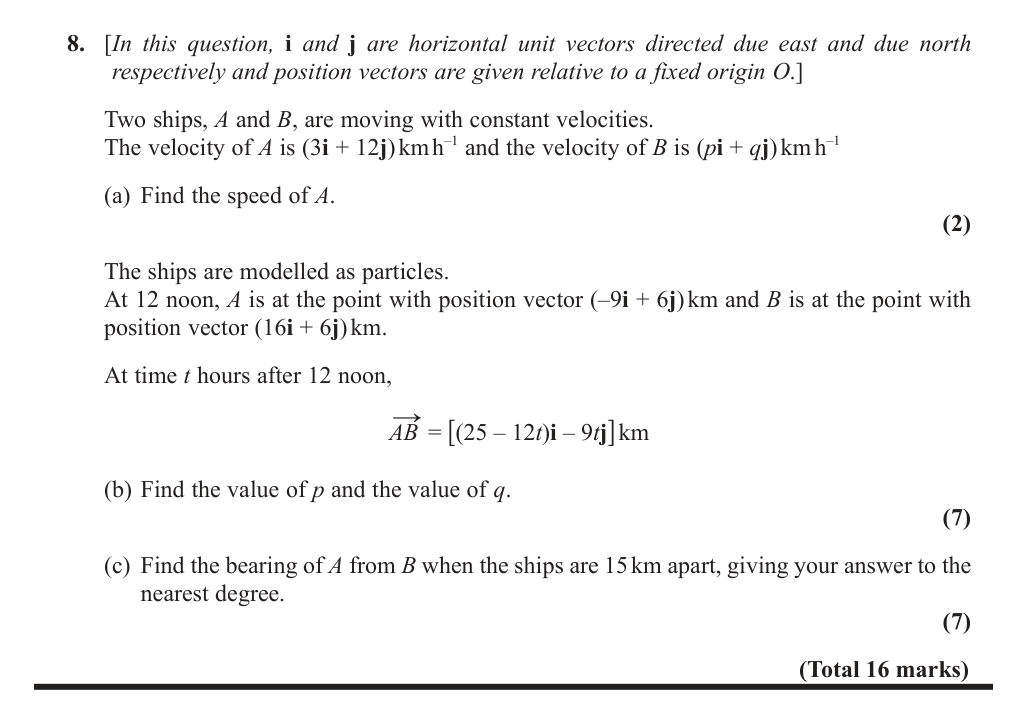
21. WME01/01 October 2022 · Q8

Hard16 marks · main topic: Working with Vectors
WME01/01 October 2022 Question 8 (16 marks): Constant Acceleration in 2D
Show worked solution
  1. Find the speed of A

    $|\mathbf{v}_A|=\sqrt{3^2+12^2}=\sqrt{153}=3\sqrt{17}\ \mathrm{km\,h^{-1}}$.

  2. Write A position

    At time $t$, $\mathbf{a}=(-9\mathbf{i}+6\mathbf{j})+t(3\mathbf{i}+12\mathbf{j})=(-9+3t)\mathbf{i}+(6+12t)\mathbf{j}$.

  3. Write B position

    $\mathbf{b}=(16\mathbf{i}+6\mathbf{j})+t(p\mathbf{i}+q\mathbf{j})=(16+pt)\mathbf{i}+(6+qt)\mathbf{j}$.

  4. Use AB vector

    $\overrightarrow{AB}=\mathbf{b}-\mathbf{a}=[25+(p-3)t]\mathbf{i}+[(q-12)t]\mathbf{j}$.

  5. Compare components

    Given $\overrightarrow{AB}=(25-12t)\mathbf{i}-9t\mathbf{j}$, compare coefficients: $p-3=-12$ and $q-12=-9$.

  6. Find p and q

    Therefore $p=-9$ and $q=3$.

  7. Find the time when the distance is 15

    Use $|\overrightarrow{AB}|=15$: $(25-12t)^2+(-9t)^2=15^2$.

  8. Solve the distance equation

    This gives $225t^2-600t+400=0$, so $(3t-4)^2=0$ and $t=\dfrac43$.

  9. Find BA at this time

    At $t=\dfrac43$, $\overrightarrow{AB}=9\mathbf{i}-12\mathbf{j}$. Therefore $\overrightarrow{BA}=-9\mathbf{i}+12\mathbf{j}$.

  10. Convert to a bearing

    A is north-west of B. The angle west of north satisfies $\tan\theta=\dfrac{9}{12}$, so $\theta=36.9^\circ$. Bearing $=360^\circ-36.9^\circ=323^\circ$ to the nearest degree.

Final answer

$(a)\ 3\sqrt{17}\ \mathrm{km\,h^{-1}}.\quad (b)\ p=-9,\ q=3.\quad (c)\ \text{bearing}=323^\circ$.

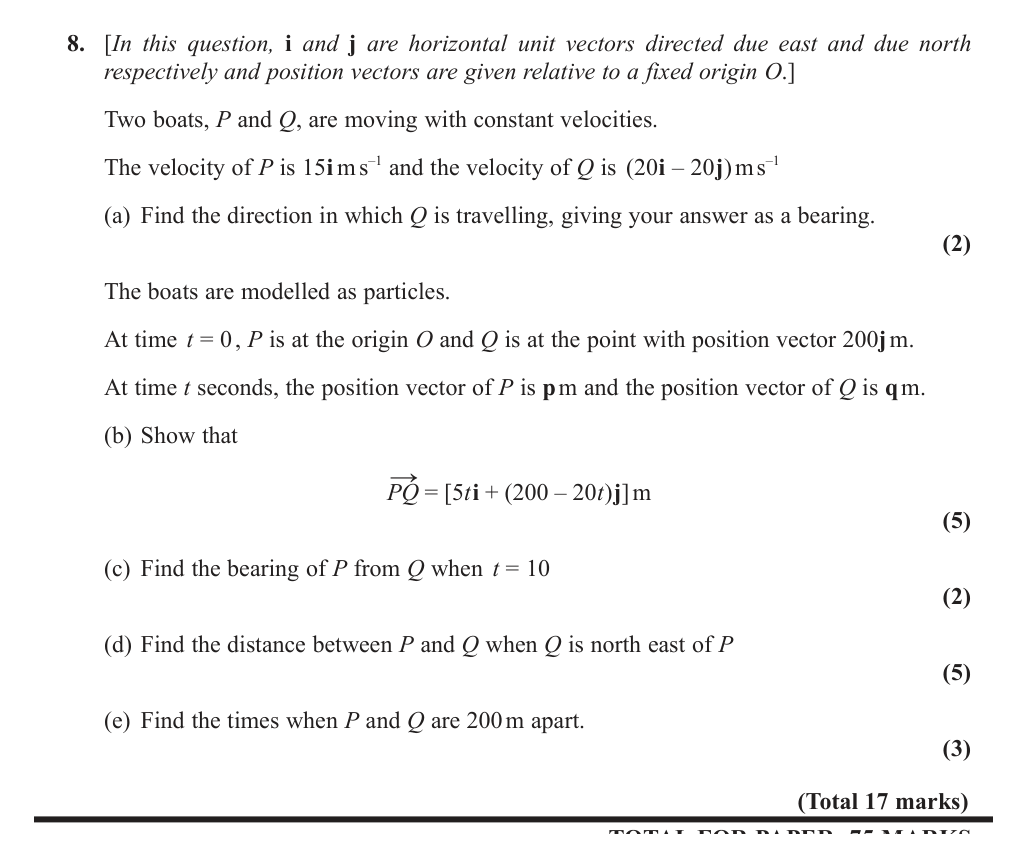
22. WME01/01 May/June 2022 · Q8

Hard17 marks · main topic: Working with Vectors
WME01/01 May/June 2022 Question 8 (17 marks): Constant Acceleration in 2D
Show worked solution
  1. Find the bearing of Q

    Q has velocity $20\mathbf{i}-20\mathbf{j}$, so it travels south-east with equal east and south components. Its bearing is $135^\circ$.

  2. Write P position

    P starts at the origin and has velocity $15\mathbf{i}$, so $\mathbf{p}=15t\mathbf{i}$.

  3. Write Q position

    Q starts at $200\mathbf{j}$ and has velocity $20\mathbf{i}-20\mathbf{j}$, so $\mathbf{q}=20t\mathbf{i}+(200-20t)\mathbf{j}$.

  4. Show PQ

    $\overrightarrow{PQ}=\mathbf{q}-\mathbf{p}=(20t-15t)\mathbf{i}+(200-20t)\mathbf{j}=5t\mathbf{i}+(200-20t)\mathbf{j}$.

  5. Find the bearing at t = 10

    At $t=10$, $\overrightarrow{PQ}=50\mathbf{i}$. This means Q is east of P, so P is west of Q. The bearing of P from Q is $270^\circ$.

  6. Use the north-east condition

    Q is north-east of P when the i and j components of $\overrightarrow{PQ}$ are equal and positive. So $5t=200-20t$.

  7. Find the distance then

    The equation gives $t=8$. Then $\overrightarrow{PQ}=40\mathbf{i}+40\mathbf{j}$, so the distance is $\sqrt{40^2+40^2}=40\sqrt2\ \mathrm{m}$.

  8. Set the 200 m distance equation

    For distance $200$ m, $(5t)^2+(200-20t)^2=200^2$.

  9. Solve for t

    This simplifies to $425t^2-8000t=0$, so $t(425t-8000)=0$. Hence $t=0$ or $t=\dfrac{8000}{425}=\dfrac{320}{17}$ s.

Final answer

$(a)\ 135^\circ.\quad (b)\ \overrightarrow{PQ}=5t\mathbf{i}+(200-20t)\mathbf{j}.\quad (c)\ 270^\circ.\quad (d)\ 40\sqrt2\ \mathrm{m}.\quad (e)\ t=0\ \mathrm{s}\ \text{or}\ \dfrac{320}{17}\ \mathrm{s}$.

More IAL Mechanics 1 topics

Dr Eslam Ahmed
Dr Eslam Ahmed

Elite Mathematics · Questions classified by topic, solutions checked by Dr Eslam